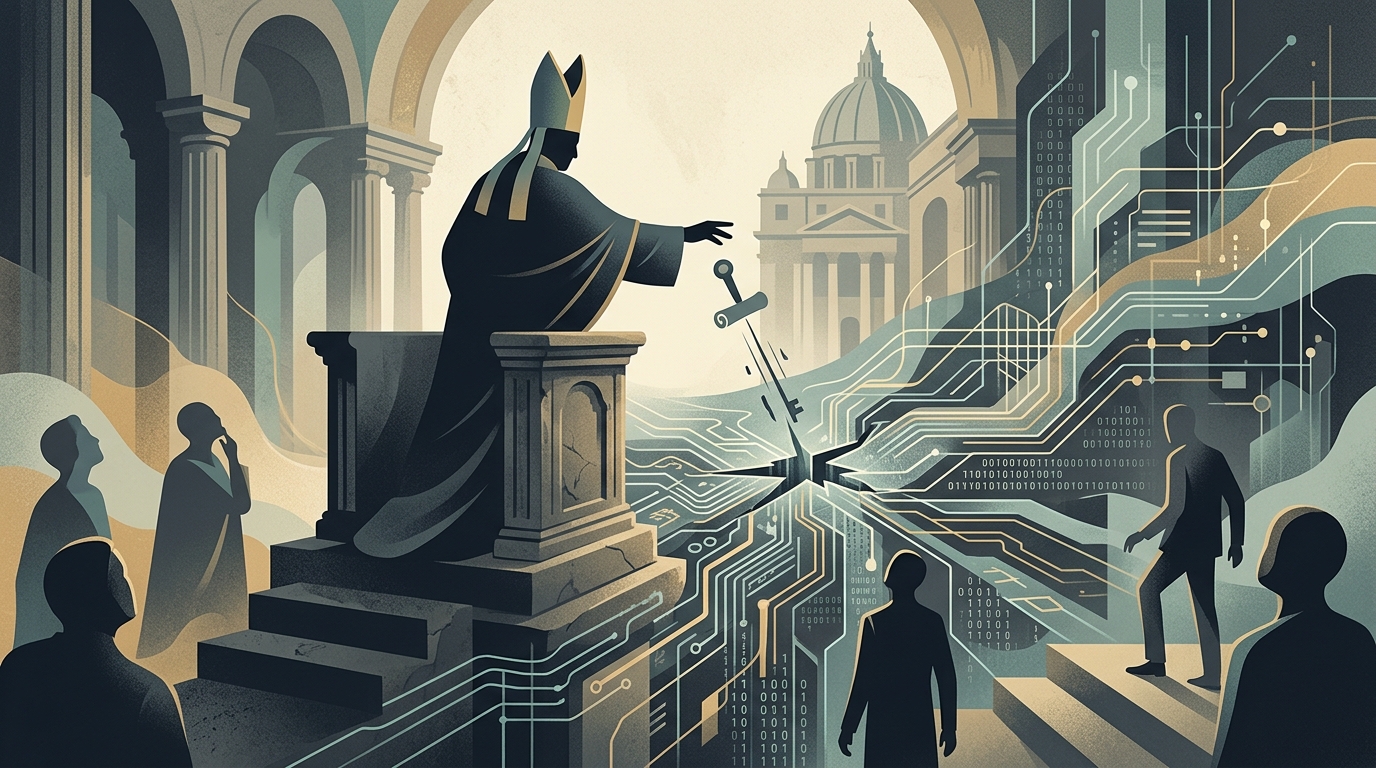
In the hallowed halls of the Vatican, where the weight of centuries-old tradition meets the precipice of a digital future, Pope Leo is preparing to deliver what analysts are calling an “AI mic drop.” This is not merely another theological discourse; it is a calculated, strategic intervention into the very heart of technological evolution. The upcoming Papal Encyclical, dedicated entirely to Artificial Intelligence, seeks to position the Holy See as the ultimate moral arbiter in an age governed by silicon and software. As Silicon Valley moves at breakneck speed, the Vatican is stepping in to provide the ethical brakes.
The Doctrine of 'Algor-ethics'
The concept of “Algor-ethics” has been circulating within the Roman Curia for some time, but under Pope Leo, it has matured into a comprehensive philosophical and political manifesto. The central premise is both simple and profound: technology is never neutral. Every algorithm reflects the values, biases, and socio-economic priorities of its creators. The Pope argues that if AI development is driven solely by market forces and profit maximization, it risks becoming a tool of mass exclusion and dehumanization.
Reliable sources within the Holy See suggest that the encyclical will focus on six core pillars: transparency, inclusion, accountability, impartiality, reliability, and security. However, the true “mic drop” lies in the Pope’s call for a globally binding treaty that enshrines “human primacy” over machines. Pope Leo is not merely asking for corporate social responsibility; he is demanding a radical restructuring of how sovereign states and international bodies govern digital intelligence.
Faith Diplomacy in the Silicon Age
One might wonder why a 2,000-year-old institution’s opinion matters to the engineers at Google, Meta, or OpenAI. The answer lies in the Vatican’s unparalleled soft power. With over 1.3 billion followers, the Catholic Church possesses a unique ability to mobilize public opinion and influence policy in regions where Western regulators have little reach. Furthermore, the Vatican has successfully brokered an interfaith alliance—including prominent Muslim, Jewish, and Buddhist leaders—to present a united front against “algorithmic tyranny.”
“Artificial intelligence must serve the common good, not replace it. A machine can calculate, but only a human being can judge with mercy and justice,” reads a leaked excerpt from the Pope’s forthcoming address.
This intervention comes at a critical juncture. With deepfakes threatening democratic integrity and AI-driven automation disrupting global labor markets, the world is desperate for an anchor. Pope Leo provides a narrative that transcends technical jargon and quarterly earnings. He speaks of the human soul in the machine age, a dimension often ignored by the technocratic elite who view humanity as a set of data points to be optimized.
Beyond Regulation: The Existential Stand
The most contentious aspect of the Pope’s stance concerns the burgeoning legal debate over “electronic personhood.” While some legal scholars and tech visionaries advocate for granting rights to advanced AI systems, Pope Leo is expected to draw a hard line in the sand. For the Church, consciousness and the soul are uniquely human attributes. Equating a machine—no matter how sophisticated—with a human being is viewed not as progress, but as a dangerous fallacy that erodes the intrinsic dignity of life.
Predictably, this stance will meet resistance. The “accelerationist” movement argues that such ethical constraints will only slow down breakthroughs in medicine, climate science, and energy. Yet, the Holy See’s counter-argument is that speed without a moral compass leads to catastrophe. Pope Leo is not an anti-technology Luddite; rather, he is a realist who insists that humanity must remain the driver, not merely a passenger, on the road to AGI (Artificial General Intelligence).
- The encyclical will call for an absolute ban on lethal autonomous weapons systems (LAWS).
- It will propose the creation of a UN-backed international agency for AI ethics.
- It will emphasize “digital solidarity” to prevent a new form of technological colonialism against the Global South.
Ultimately, Pope Leo’s AI intervention is a reminder that technology is too important to be left to technologists alone. As the lines between the physical and digital worlds continue to blur, the need for a moral North Star becomes existential. The Vatican, drawing on two millennia of navigating human nature, is betting that in a world of infinite data, humanity will eventually crave finite, lived truth. This is more than a religious statement; it is a call to reclaim our future from the black box of the algorithm.