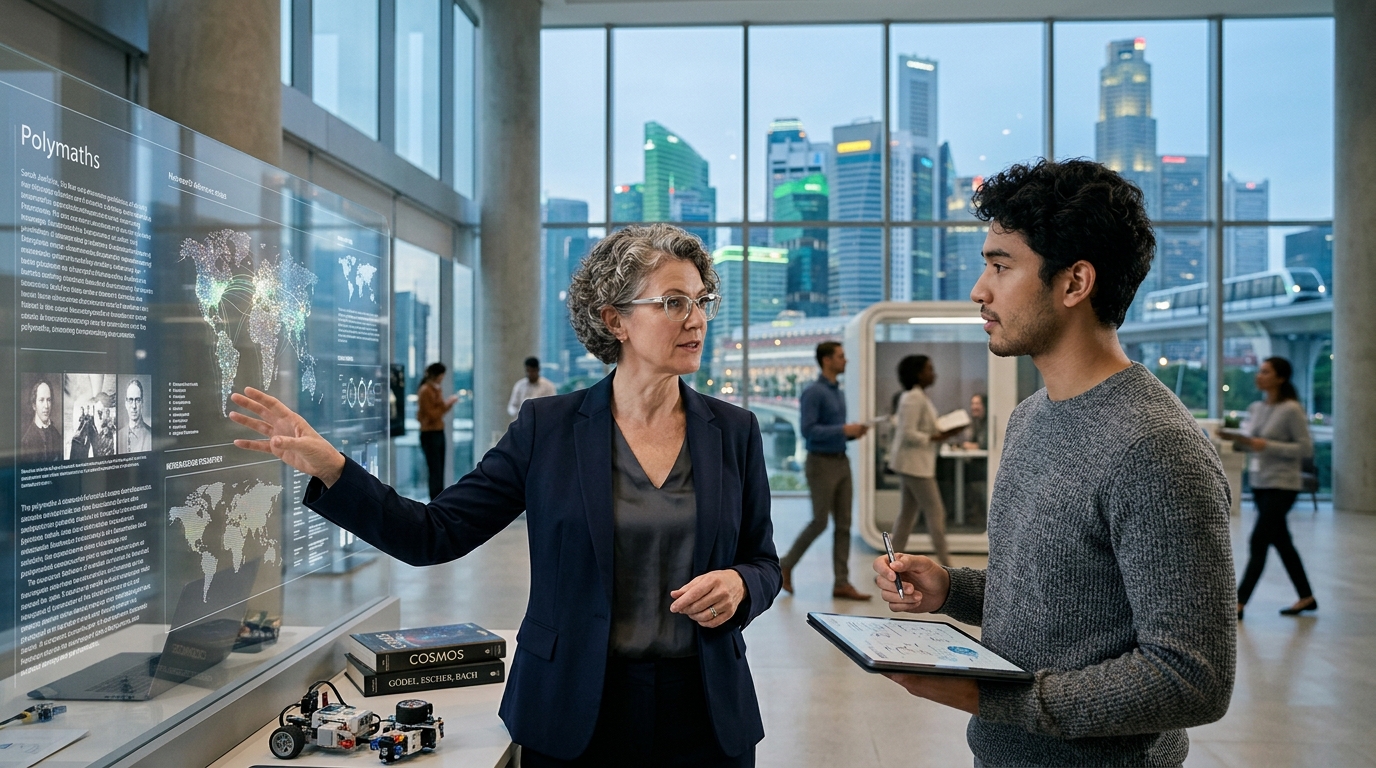
In the long history of human knowledge, specialization has been both a blessing and a curse. Since the Renaissance, where the 'Homo Universalis' could arguably master the entirety of human science, we moved into a 20th century of silos—a world where a leading biologist might not understand the code required to analyze their own data. Today, in 2026, Artificial Intelligence (AI) is emerging as the great 'bridge' promising to dismantle these walls. As a recent analysis from The Scientist highlights, AI is not replacing the expert; it is providing them with the keys to enter rooms of knowledge that were previously locked.
The Democratization of Technical Skills
The greatest barrier to scientific progress has traditionally been the steep learning curve of complex tools. An oncologist with a brilliant hypothesis about genomics often needed months to learn Python or R, or had to rely on a programmer who might not grasp the biological essence of the problem. With the advent of Large Language Models (LLMs) and specialized AI agents, this friction is evaporating. AI acts as a 'competency interpreter,' translating natural language into executable code, statistical analysis, or even laboratory automation protocols.
This evolution is giving rise to a new type of scientist: the 'synthetic researcher.' These professionals use AI to bridge the gap between their theoretical training and technical implementation. For instance, in ecology, field researchers are now using computer vision models to identify species across thousands of hours of video footage—a task that previously required an army of graduate students and years of manual classification. AI doesn't make the work 'easy'; it makes it accessible, allowing the scientist to focus on the 'why' rather than the 'how.'
The Risk of Shallow Expertise and the Ethics of Mastery
However, every bridge carries risks. The ease with which AI generates results in fields outside a user's direct expertise can lead to the 'illusion of knowledge.' If a chemist uses AI to design a neural network architecture without understanding the fundamental linear algebra principles behind it, how will they recognize a flawed result or data bias? The scientific community warns that AI could become a 'black box' producing impressive but inaccurate conclusions.
- The need for critical thinking remains more urgent than ever.
- Education must shift from tool-memorization to understanding AI principles.
- Interdisciplinary collaboration is not being abolished; it is changing form, with AI specialists becoming architects of methodological integrity.
Furthermore, there is the issue of ethical responsibility. When AI allows non-experts to experiment with dangerous pathogens or sensitive social data through automated tools, safety guardrails must be more robust. The AI 'bridge' must not become a Trojan horse for the erosion of scientific rigor.
Toward a New Era of Renaissance Thinking
Despite the challenges, the outlook is exhilarating. AI enables the synthesis of knowledge from seemingly disconnected fields. Imagine an archaeologist using AI-guided spectroscopy to analyze ancient pigments, blending art history with materials chemistry in real-time. This fluidity of boundaries promises to solve some of humanity's most pressing problems, from climate change to rare diseases, which by definition require multi-dimensional approaches.
In conclusion, Artificial Intelligence is not the death of the expert, but their liberation. It frees them from the drudgery of technical minutiae and allows them to return to the essence of science: the pursuit of truth through synthesis and creativity. The bridge is there; the question is whether we have the wisdom to cross it responsibly.