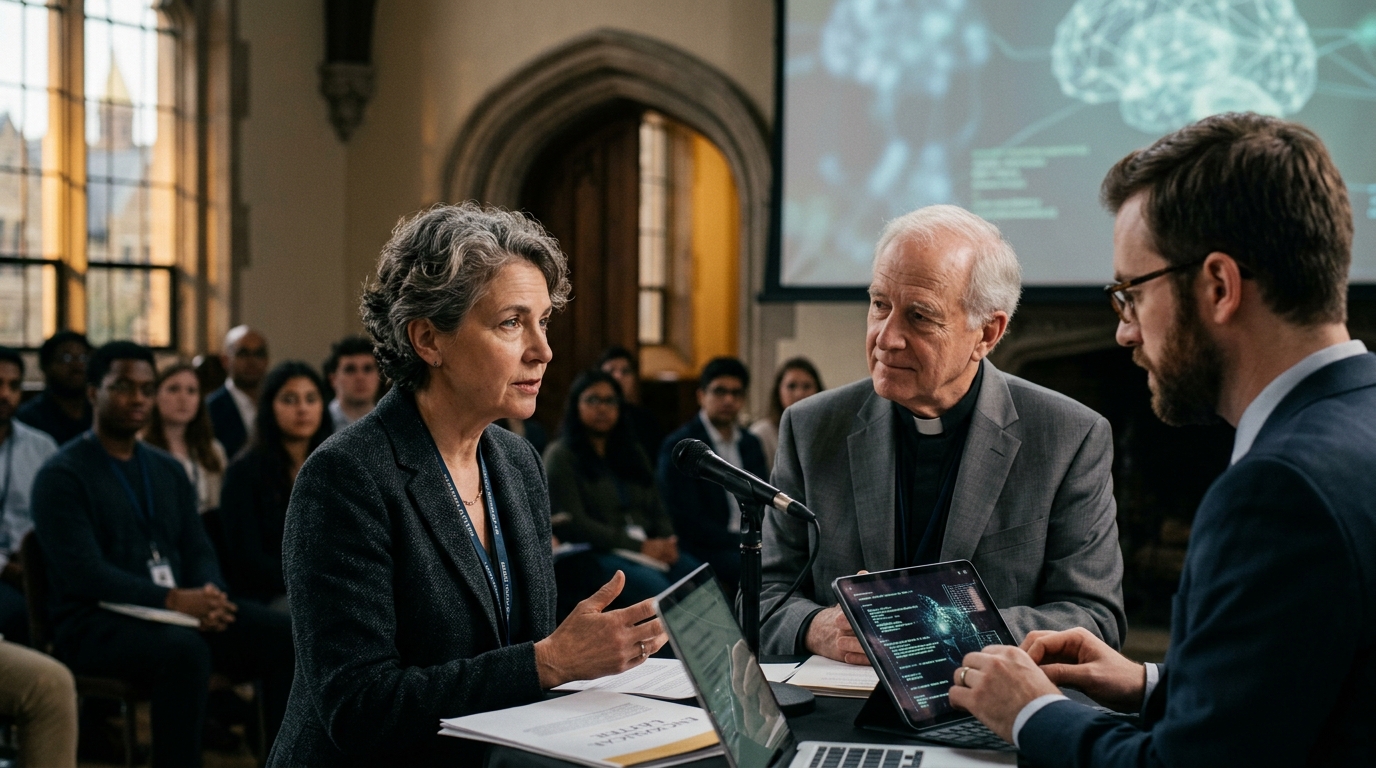
In an era where Artificial Intelligence (AI) is fundamentally reshaping the fabric of society, the intersection of faith and technology has taken on a new, urgent dimension. The President of the University of Notre Dame, responding to Pope Leo XIV’s recent letter on AI, issued a comprehensive statement emphasizing the role of religious and educational institutions in harnessing algorithms. This move is not merely a formal exchange of letters but a strategic alignment of one of the world’s leading research universities with the Vatican’s moral compass.
The Anthropocentric Approach and 'Algor-ethics'
Pope Leo XIV’s letter, released in early 2026, introduced the term 'algor-ethics' into the global discourse. The Pontiff warned that the unchecked use of AI could lead to a 'dictatorship of data,' where human judgment is supplanted by cold calculations. In his response, Notre Dame’s President emphasized that the university is committed to being the laboratory where technology is examined through the lens of Catholic social teaching.
According to the statement, AI should not be viewed as a neutral force. On the contrary, it carries the biases of its creators and the inequalities of the data on which it is trained. Notre Dame, through its Institute for Ethics in Technology, intends to develop new curricula that combine computer science with moral philosophy, ensuring that future engineers understand the social consequences of the code they write.
The Challenge of Automation and Social Justice
A central point of the papal letter was the impact of AI on labor. Pope Leo XIV expressed concern over the displacement of millions of workers, not only in manual but also in cognitive roles. The President of Notre Dame concurred, noting that economic efficiency cannot be the sole criterion for AI adoption. "Technology must serve the person, not the person technology," he stated pointedly.
The university announced the creation of an interdisciplinary committee to study how AI can be used to augment human labor rather than replace it. Research will focus on sectors such as healthcare and education, where AI can function as an assistant, allowing professionals to focus on the more human aspects of their vocation, such as empathy and ethical judgment.
International Cooperation and Regulatory Frameworks
Notre Dame’s intervention comes at a critical moment for international legislation. With the European Union and the United States attempting to define rules for generative AI, the voice of a religious institution with a global reach adds a moral weight often missing from technocratic discussions. The university president called for a 'global consensus,' similar to that for climate change, which would set red lines for the use of AI in weapon systems and citizen surveillance.
"We cannot allow algorithms to decide on life and death, nor to determine the value of a human being based on their productivity," the President declared.
In conclusion, Notre Dame’s response to Pope Leo XIV’s letter serves as a reminder that technological progress without moral direction is blind. In a world moving at the speed of silicon, returning to the fundamental values of humanity seems to be the only safe path toward the future.