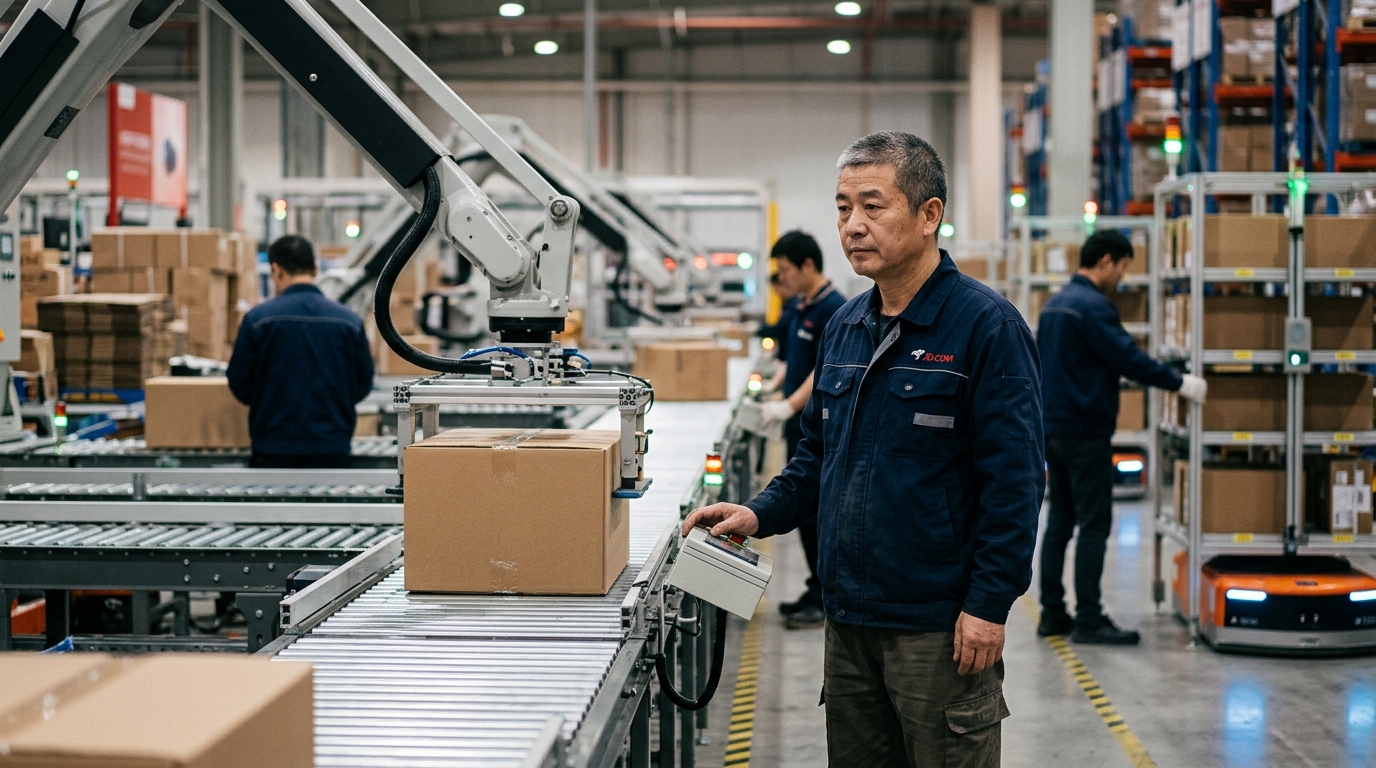
In an era where artificial intelligence and robotics threaten to upend the foundations of the global labor market, Liu Qiangdong, the billionaire founder of Chinese e-commerce giant JD.com, has made an announcement that sent ripples through the industry. In a rare public intervention, Liu pledged that none of his company's 900,000 employees would lose their jobs due to automation. This statement is more than just a corporate promise; it is a profound political and social positioning in an environment where China is striving to balance technological supremacy with social stability.
The Challenge of 900,000 Workers
JD.com is no ordinary tech firm. Unlike its chief rival, Alibaba, which relies heavily on third-party logistics providers, JD.com operates its own vast warehouse and distribution network. This means it employs a massive army of couriers, drivers, and warehouse workers—people on the front lines of potential replacement by robots. Liu's commitment comes at a time when fears of "technological unemployment" have reached a fever pitch, not just in China but globally.
Liu emphasized that AI should be used to improve workers' quality of life rather than eliminate them. According to his vision, automation will take over the most dangerous, tedious, and repetitive tasks, allowing humans to transition into roles that require greater empathy, critical thinking, and specialized skills. However, analysts point out that fulfilling this promise will require a Herculean reskilling program, the cost of which could significantly weigh on the company's financial performance.
The Political Dimension of "Common Prosperity"
To understand the significance of Liu's move, one must place it within the broader political context of China under Xi Jinping's leadership. The central policy of "Common Prosperity" mandates that tech giants actively contribute to reducing social inequality. Following the harsh regulatory crackdowns of recent years, Chinese entrepreneurs are well aware that maintaining social peace is a prerequisite for their business survival.
JD.com has traditionally branded itself as a company that respects workers' rights, offering full insurance coverage and benefits—a rarity in China's often precarious delivery sector. The new AI pledge reinforces this narrative, positioning the company as a "responsible national champion" aligned with the Communist Party's goals of full employment and social cohesion.
Technological Progress vs. Human Capital
Despite the promises, JD.com remains a global leader in logistics robotics. The company already operates fully automated "dark warehouses" where robots work in the absence of light and human intervention. It is also aggressively experimenting with drones and autonomous delivery vehicles. The contradiction is stark: how can a company invest billions in technologies that render human labor redundant while simultaneously promising to keep all its workers?
The answer, according to JD executives, lies in expansion. The company hopes that the increased efficiency provided by AI will allow it to grow rapidly enough to create new needs in other sectors, absorbing the surplus staff. For instance, delivery drivers could be retrained as fleet managers for autonomous vehicles or high-level customer service consultants. It is a high-stakes gamble, as China's economic slowdown makes explosive growth less certain than in the past.
The Future of Work in the AI Era
Liu Qiangdong's stance is an experiment being closely watched worldwide. If JD.com manages to integrate AI without mass layoffs, it will provide a model for how tech capitalism can coexist with social protection. If it fails, it will reinforce the view that AI is inevitably a "job destroyer."
In any case, this statement marks the end of an era where technological progress was seen as an end in itself. From now on, the legitimacy of big tech companies will be judged not just by their profitability or innovation, but by their ability to protect the most vulnerable link in the chain: the human worker. In the China of 2026, artificial intelligence is no longer just a matter of code; it is a matter of survival and social ethics.