In the modern digital landscape, education is no longer just a sanctum of knowledge; it has become a high-stakes cybersecurity battlefield. Community colleges across the United States, traditionally the bastions of accessible higher education, are facing an unprecedented threat: "ghost students." These are sophisticated bots and scammers leveraging Artificial Intelligence to enroll en masse in courses, with the sole objective of embezzling federal and state financial aid. As this phenomenon reaches epidemic proportions, educational institutions are deploying their own AI countermeasures, creating an algorithmic arms race where code clashes with code.
The Anatomy of a Digital Heist
The fraud typically begins with identity theft or the creation of "synthetic" identities. Using generative AI tools, scammers can churn out thousands of convincing enrollment applications in minutes. These applications feature realistic personal statements, academic histories, and all the necessary documentation required for admission. Because community colleges maintain "open-door" policies to encourage enrollment, they often lack the stringent, multi-layered vetting processes seen at elite private universities, making them a prime target for exploitation.
Once a "ghost student" is admitted, the next step is applying for financial aid, such as the Pell Grant. Scammers enroll in the minimum number of credits required, wait for the first disbursement of funds to hit their accounts, and then vanish into the digital ether. This leaves behind empty virtual seats and massive deficits in institutional budgets. The damage is not merely financial; the presence of bots skews enrollment data, deprives real students of limited class spots, and creates administrative nightmares for registrars and financial aid officers.
AI as a Shield: Predictive Defense
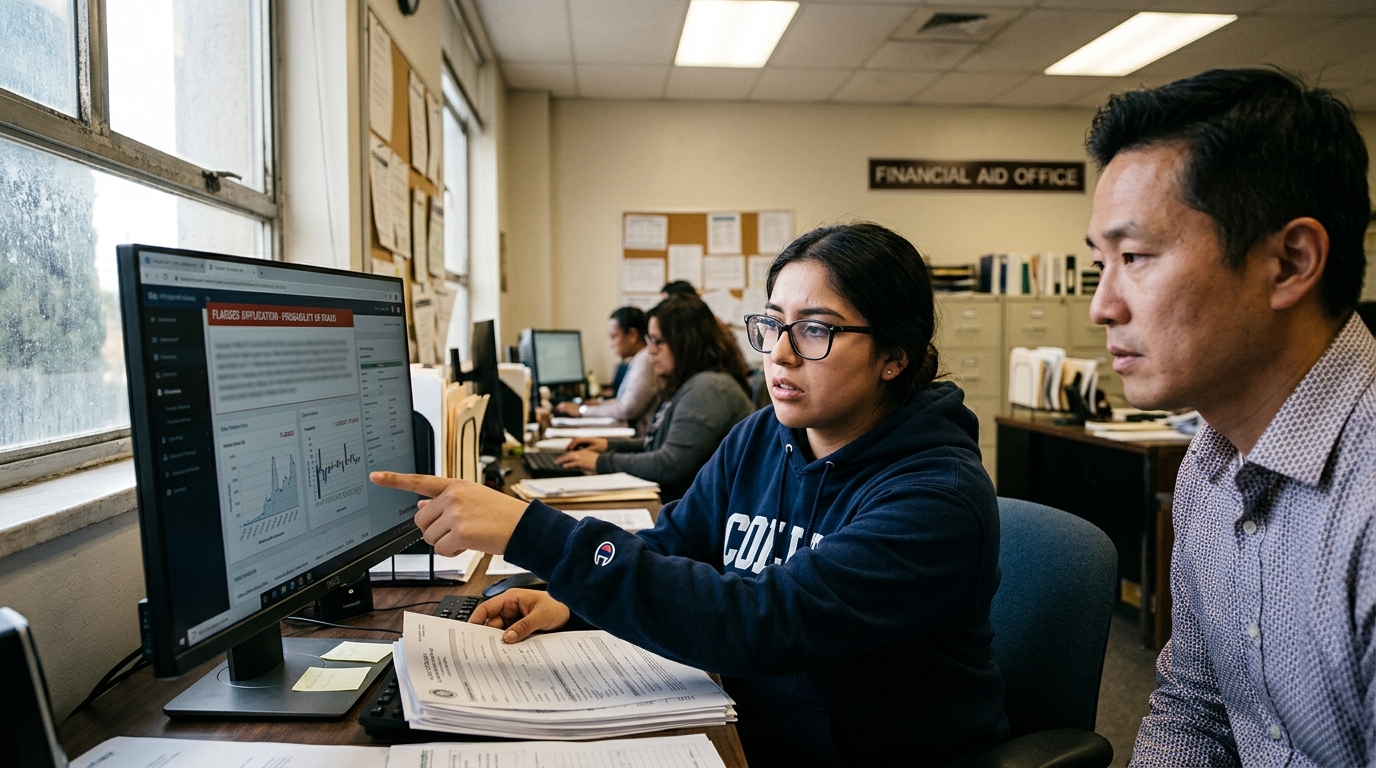
To counter this onslaught, colleges are turning to advanced fraud detection systems powered by Machine Learning. These systems analyze thousands of data points in real-time to flag suspicious patterns. For instance, if hundreds of applications originate from the same IP address or if applicants utilize nearly identical linguistic structures in their essays, the system triggers a high-priority alert.
Furthermore, institutions are using AI to monitor student engagement within Learning Management Systems (LMS). "Ghost students" typically exhibit non-human behavior; they may never log in, or they may log in only to perform scripted, repetitive actions. AI can distinguish between the organic, messy behavior of a human student and the automated efficiency of a bot. However, this level of surveillance raises significant ethical concerns regarding student privacy and the risk of "false positives," where legitimate students from marginalized backgrounds—who may have irregular internet access or non-traditional study habits—might be unfairly flagged and de-enrolled.
The Evolving Arms Race
The most concerning aspect of this conflict is the speed of adaptation. As colleges refine their detection algorithms, scammers are utilizing even more sophisticated AI to bypass these filters. They use residential proxies to mask their locations, tools that mimic human keystroke rhythms, and Large Language Models (LLMs) to generate entirely unique, high-quality essays for every single application. This makes the distinction between a bot and a real applicant increasingly blurred.
The solution cannot be purely technological. It requires a holistic strategy that blends AI-driven insights with human intuition. Many colleges are now investing in specialized verification teams that manually review cases flagged by the system. There is also a growing call for tighter integration between educational institutions, state agencies, and financial institutions to verify identities before any funds are released. The fight against educational fraud is a marathon, not a sprint, where technology serves as both the weapon and the shield.
Conclusion: Protecting the Open Door
The rise of "ghost student" fraud highlights a dark side of the digital transformation in education. While AI offers transformative potential for personalized learning, it also provides bad actors with the tools to exploit the system's vulnerabilities. For community colleges, which often operate on razor-thin margins, the cost of this battle—both in lost funds and in the price of security software—is immense. The challenge for the coming years will be to protect the "open-door" mission of these institutions without allowing them to be looted by automated syndicates. Maintaining this balance is essential for the continued credibility and viability of public higher education in the AI era.