History is not merely written on paper. It lies hidden in thousands of hours of magnetic tapes, films, and digital files that have captured the pulse of society for nearly a century. The U.S. Library of Congress, in collaboration with WGBH and the American Archive of Public Broadcasting (AAPB), has embarked on an ambitious venture: to make this vast volume of information searchable and accessible to all. The key to this "unlocking" is not just Artificial Intelligence, but a hybrid combination of algorithmic power and human curation.
The Challenge of "Silent" Archives
For decades, the problem with audiovisual archives has been their "opacity." While a digitized book can be searched via keywords in seconds, a 1950s radio broadcast or a 1970s television news bulletin remained "black boxes." Without accurate transcripts, researchers had to listen to hours of material to find a specific reference. The scale of the AAPB is daunting: over 150,000 items covering seven decades of public broadcasting.
Traditional manual transcription methods would have required hundreds of years and budgets that no public agency possesses. This is where Artificial Intelligence enters the fray. Using advanced Speech-to-Text (STT) models, such as OpenAI’s Whisper and Kaldi, the Library has managed to generate automated text drafts for thousands of hours of programming. However, AI is not infallible. Old recordings with background noise, regional accents, and technical jargon often lead to comical or misleading errors.
Project "Fix It+": Collective Intelligence in Action
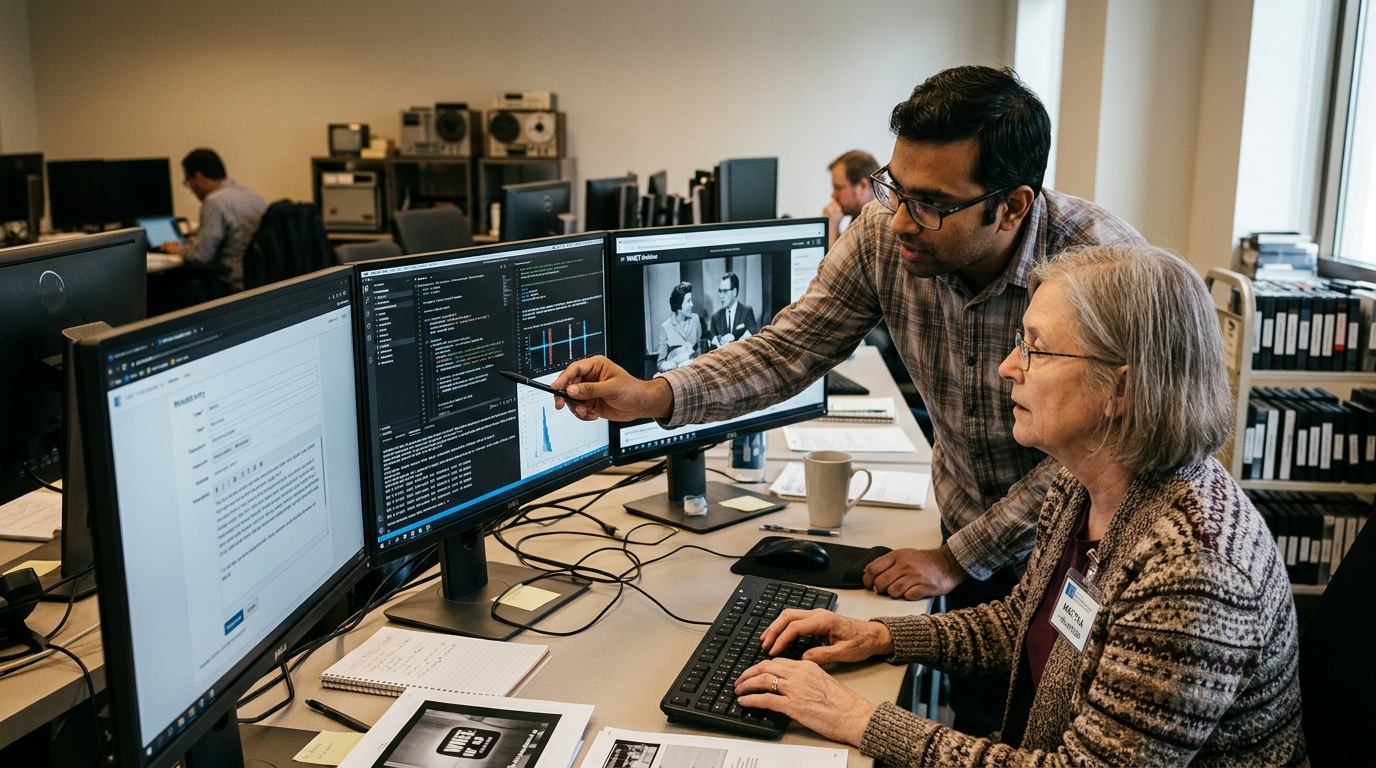
The solution to the accuracy problem was found through crowdsourcing. The "Fix It+" platform allows volunteers from around the world to listen to snippets and correct AI errors in real-time. This "Human-in-the-Loop" model ensures that the machine's speed is combined with human critical thinking and auditory acuity.
Volunteers are not just text editors; they act as digital archivists. By correcting names of politicians, place names, or historical terms that AI fails to recognize, they create a high-fidelity dataset. This material is then fed back into the system, improving the searchability of the entire archive. It is a democratic process where the preservation of memory becomes a collective task.
"Technology gives us the skeleton, but volunteers provide the soul and the precision that historical research demands," a Library official noted.
Ethical and Technical Hurdles
Using AI in historical archives is not without its challenges. There is always the risk of algorithms introducing biases or "hallucinating," replacing words they don't understand with others that sound similar but change the meaning. Furthermore, managing thousands of volunteers requires strict quality control protocols. The Library of Congress uses a multi-layered verification system where one volunteer's corrections are often cross-checked by a second person or permanent staff.
Moreover, issues of intellectual property and privacy arise. Many of these archives contain voices of individuals who might never have imagined their words would become globally searchable via an algorithm. The Library moves cautiously, balancing the right to information with respect for the material's provenance.
The Future of Digital Memory
This model of AI-human collaboration serves as a beacon for other institutions worldwide. From the National Library of Greece to the BBC archives, the need for mass data processing is urgent. The success of the Library of Congress demonstrates that AI is not going to replace archivists, but rather give them the tools to perform their work at a scale previously unthinkable.
In the future, we expect the integration of even more sophisticated models that can recognize not just words, but also emotions, musical themes, or even identify faces in old videos with high precision. Our history is finally becoming "live" and searchable, allowing future generations to hear the voices of the past with crystal clarity.