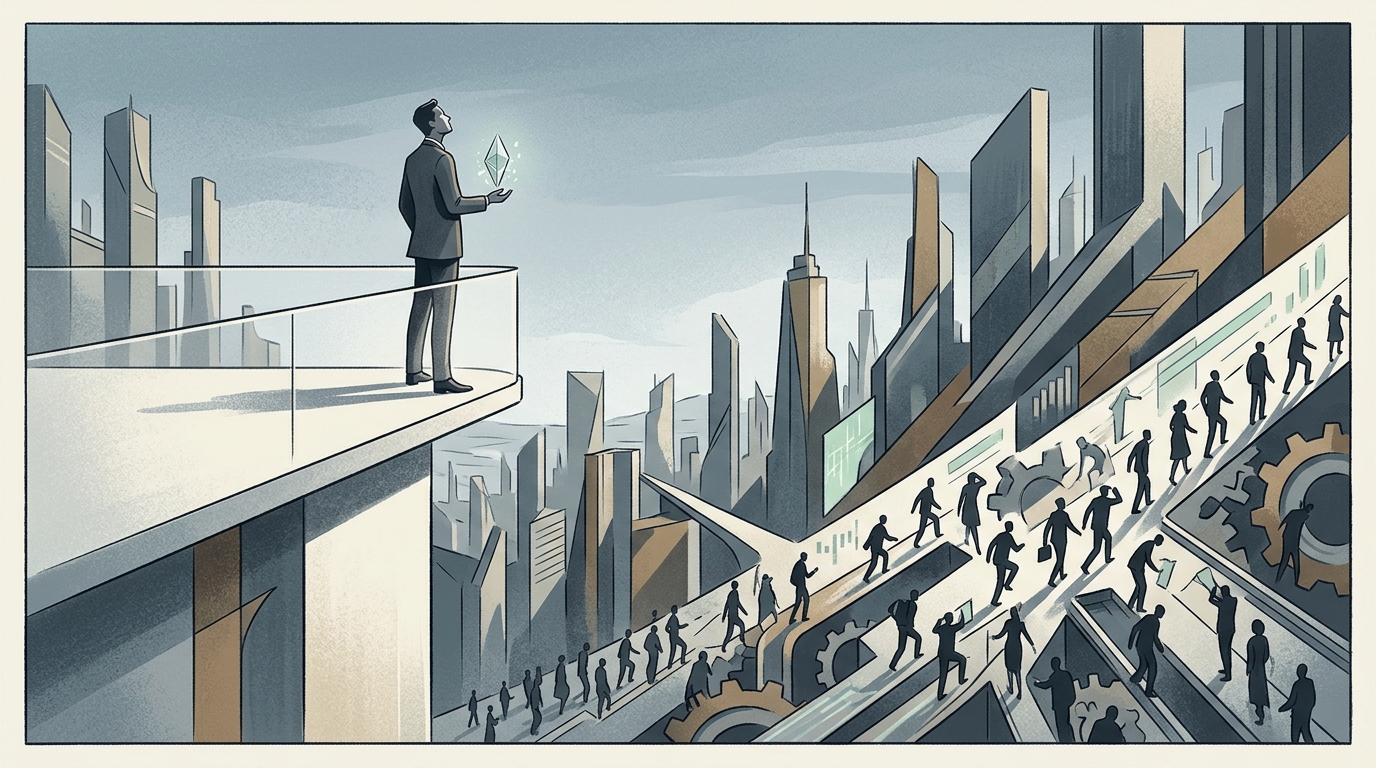
In an era where uncertainty about the future of work dominates global discourse, Jeff Bezos, the man who transformed global commerce through Amazon, has made a statement that caused a significant stir. According to the billionaire, the advent of Artificial Intelligence (AI) is not a threat to be feared, but a development for which we "should be happy." This stance, while aligned with the traditionally optimistic narrative of Silicon Valley, comes at a time when the contradiction between promises of labor "enhancement" and the reality of mass layoffs in Big Tech is sharper than ever.
Productivity as the Holy Grail of Prosperity
Bezos bases his argument on a classic economic theory: increased productivity inevitably leads to an improved standard of living. For him, AI will act as a "co-pilot" that will liberate humans from repetitive, tedious, and dangerous tasks, allowing them to focus on creativity and high-level decision-making. "Every time we invent a way to do things more efficiently, society as a whole wins," he argued, referencing the historical transition from an agrarian to an industrial economy.
However, Bezos's analysis often overlooks the cost of transition. While it is true that technology creates new categories of jobs, the pace at which AI is penetrating sectors such as programming, copywriting, and legal support is unprecedented. The concern lies not in the final disappearance of work, but in the speed of obsolescence of existing skills, which leaves millions of workers in a state of "technological vulnerability."
The Layoff Paradox and the Shift of Capital
The statement "you should be happy" rings ironically in the ears of the thousands of employees who were shown the door by Amazon, Google, and Microsoft over the past year. Critics point out that the same companies touting AI as an empowerment tool are using the profits from automation to reduce their labor costs and satisfy shareholders. At Amazon, the use of robotics and algorithms in warehouses has skyrocketed efficiency, but it has also led to complaints about dehumanizing work paces and strict AI-driven surveillance.
- AI reduces the marginal cost of production, increasing the profit margins of tech giants.
- Tech sector layoffs in 2025-2026 are directly linked to the reallocation of resources toward AI infrastructure.
- The "happiness" Bezos refers to primarily concerns the consumer experience (cheaper products, faster services) and less so job security.
From Warehouses to Offices: The New Era of Automation
The difference between this technological revolution and previous ones is that it hits white-collar workers. Bezos argues that this will free the human mind, but the labor market is showing signs of saturation in roles that were previously considered "safe." The ability of generative AI to synthesize code or analyze data in seconds means that a junior analyst today competes with an algorithm that costs pennies and never tires.
"Artificial Intelligence is the most transformative technology of our time, and its ability to augment human capability is its greatest gift." — Jeff Bezos
According to Bezos, the solution lies in education and adaptability. However, the social challenge remains: How will it be ensured that the benefits of this productivity explosion do not accumulate only at the top of the pyramid? If AI is indeed a "gift" to humanity, then the distribution of this gift requires new policies, such as robot taxation or strengthening the social safety net—topics on which tech titans rarely comment with the same enthusiasm.
Conclusion: Optimism with Asterisks
Jeff Bezos's position is a reminder of the Silicon Valley worldview: technology is the answer to every problem. While AI indeed promises to solve complex issues, from medical diagnosis to climate change, the "happiness" of workers depends on whether they remain participants in wealth production or whether they will be turned into mere spectators of an automated economy. The challenge for 2026 and beyond is not the technology itself, but the management of the human transition to a world where intelligence is no longer the exclusive privilege of humans.