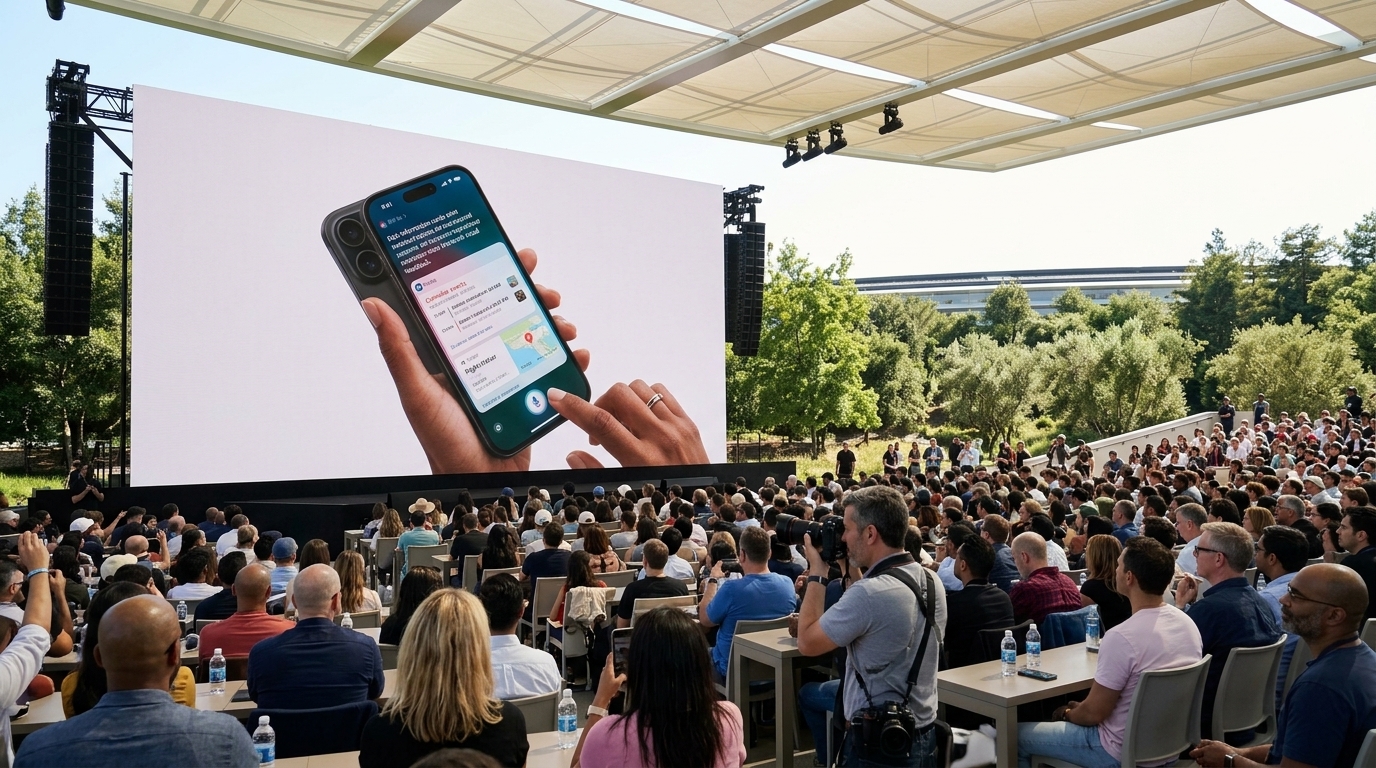
The history of Siri is a chronicle of unfulfilled promises. Since its debut in 2011, Apple’s digital assistant has remained trapped within a limited functional scope, while competition from OpenAI and Google has surged ahead. At this year's WWDC 2026, Apple appears to be playing its final card: a complete overhaul of Siri via Apple Intelligence and a strategic partnership with Google’s Gemini, promising to transform the iPhone from an app-centric device into an autonomous personal agent.
From Commands to Actions: The Rise of the Agent
The core difference in the "new" Siri being showcased this year lies not just in better natural language processing, but in its capacity for "agency." Until recently, Siri could set an alarm or send a text. The 2026 version, however, is designed to navigate within the user's apps. Utilizing advanced Large Action Models (LAMs), Siri can now perform complex workflows, such as finding a specific photo from your vacation, editing it to remove bystanders, and then emailing it to a contact—all through a single voice command.
This evolution fundamentally shifts the user interface (UI) paradigm. If Siri can perform tasks on our behalf, the need to manually open individual apps diminishes significantly. Apple is doubling down on its App Intents framework, forcing developers to make their applications "AI-readable," creating an ecosystem where Siri acts as the central orchestrator of the user experience.
The Gemini Alliance and the Privacy Paradox
Perhaps the most controversial aspect of this year’s keynote is the integration of Google’s Gemini model for complex queries that exceed Apple’s on-device processing capabilities. Despite its historical rivalry with Google, Apple acknowledges that it cannot achieve the level of global knowledge possessed by its competitors on its own. However, Apple’s approach remains strictly "Privacy First."
"Privacy is not a feature we bolt on at the end. It is the foundation upon which every AI interaction is built," an Apple executive noted during the keynote.
Through Private Cloud Compute (PCC), Apple promises that data sent to the cloud for processing by Gemini or its own server-side models is never stored and remains inaccessible even to Apple or its partners. It is a delicate balancing act: Apple is borrowing Google’s "intelligence" while imposing its own ethical and security standards.
The iPhone as a Personal Secretary
The new Siri is no longer restricted to answering trivia. With "Personal Context Awareness," it has access to your emails, calendars, and notes, allowing it to understand the context of your life without compromising privacy. If you ask, "When does my mother's flight land?", Siri will scan your emails, find the flight number, and check the real-time flight status automatically.
- Autonomous Notification Management: Siri prioritizes alerts based on your current activity and urgency.
- Multimodal Communication: Seamless switching between voice and typing within the same interaction.
- System-wide Writing Tools: AI-driven editing and rewriting capabilities integrated across all native and third-party apps.
In conclusion, WWDC 2026 marks Apple’s coming of age in the era of generative AI. Siri is no longer a gimmick for checking the weather; it is the central nervous system of the Apple experience. The success of this pivot will determine whether the iPhone remains the dominant device of the next decade or if it will falter under the pressure of new, AI-first hardware competitors.