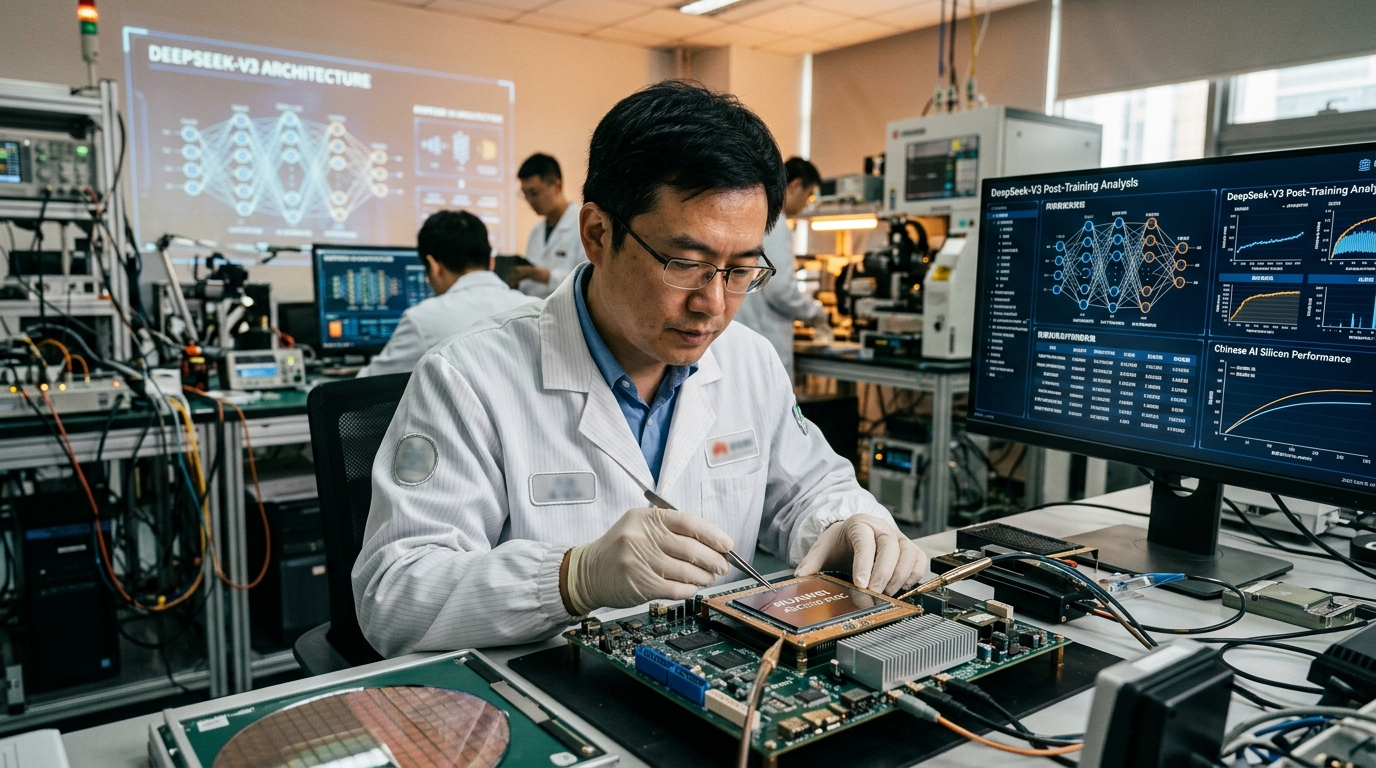
In a move that significantly reshapes the geopolitical AI landscape, a research team led by Huawei has announced the successful post-training of DeepSeek-V3, one of the world's most powerful open-source models. This achievement is far more than a technical milestone; it is a declaration of strategic independence. By utilizing 1,000 domestic Ascend 910C processors to handle a model with 1.6 trillion parameters, the consortium has demonstrated that U.S. export restrictions on high-end silicon, such as Nvidia’s H100s, have failed to halt Chinese progress.
The Architecture of Efficiency: DeepSeek-V3 and MoE
DeepSeek-V3 represents the pinnacle of Mixture-of-Experts (MoE) architecture. While it boasts a staggering 1.6 trillion total parameters, only 671 billion are active during any given computation cycle. This sparse activation allows the model to maintain a vast knowledge base without requiring the exorbitant computational power that a traditional, dense model of the same scale would demand.
Post-training is the critical stage where a model acquires its final capabilities through Supervised Fine-Tuning (SFT) and Reinforcement Learning from Human Feedback (RLHF). The fact that Huawei managed to synchronize 1,000 Ascend 910C chips to execute this process suggests a high level of maturity in interconnect software and memory management—areas where many Western analysts believed China would struggle for years. Huawei’s MindSpore platform now appears to be a formidable competitor to PyTorch and TensorFlow, offering highly optimized performance for domestic hardware.
Ascend 910C: Breaking the Silicon Curtain
The Ascend 910C processor is Huawei’s direct answer to Nvidia’s dominance. Following the ban on H100 and H200 exports to the Chinese market, Huawei accelerated the development of its Ascend series. Reports indicate that the 910C approaches the performance of the Nvidia A100 and, in specific workloads, rivals the H100, particularly when integrated within the OpenMind software ecosystem.
- Scalability: Coordinating 1,000 chips in a single cluster requires sophisticated low-latency interconnects, a hurdle Huawei seems to have cleared.
- Energy Efficiency: Huawei claims its architecture offers a superior performance-per-watt ratio compared to previous generations.
- Sovereignty: Production relies on Chinese foundries (like SMIC), bypassing the U.S.-controlled global supply chain.
"This success is not just about hardware. It is about creating an entire ecosystem capable of thriving under conditions of technological blockade," the research team’s report emphasizes.
Geopolitical and Economic Implications
This development sends a clear message to Washington: the strategy of restricting access to semiconductors may be producing the opposite of its intended effect, forcing China to rapidly innovate its own solutions. DeepSeek, a company that has startled the world by training top-tier models at a fraction of the cost incurred by American giants, has become the spearhead of Chinese AI diplomacy.
If Huawei can manufacture and deploy the Ascend 910C at scale, the reliance of Chinese tech firms on the black market for Nvidia chips will plummet. Furthermore, the success of DeepSeek-V3 on domestic hardware encourages other regional players to look toward alternative stacks, potentially eroding Silicon Valley's monopoly on AI infrastructure.
The Future of Model Training in China
The next logical step for Huawei and DeepSeek is the full pre-training of next-generation models entirely on domestic silicon. While post-training on 1,000 chips is a landmark, full pre-training for models of this scale typically requires clusters of tens of thousands of GPUs. The challenge is now shifting from chip architecture to mass manufacturing capabilities and the stability of massive-scale data centers. However, with DeepSeek-V3 proving its worth, China appears to have found the formula to remain a frontrunner in the global race toward Artificial General Intelligence (AGI).