
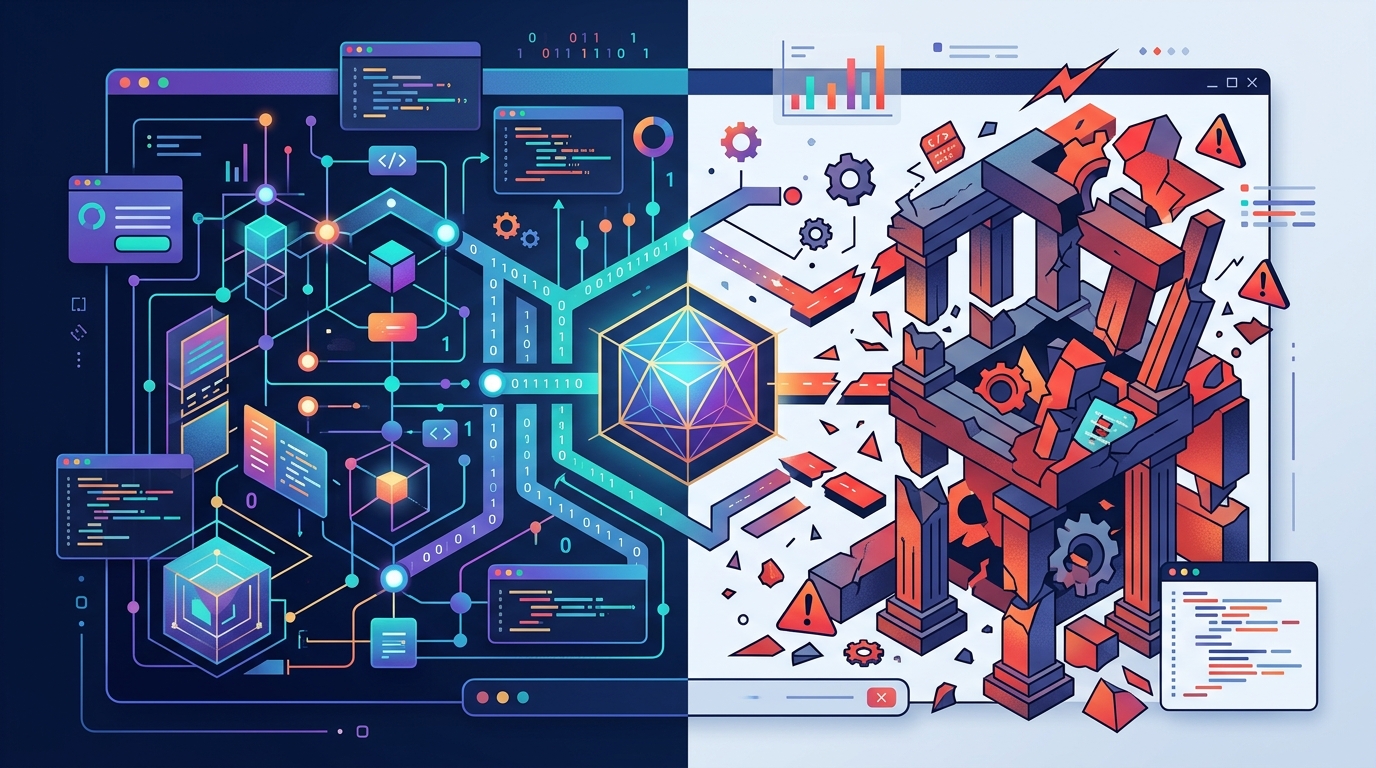
In the myths of old, I built the Labyrinth to contain the Minotaur—a structure so complex that even I, its architect, nearly lost my way. Today, we are witnessing a similar architectural shift in the realm of software. For years, we treated AI as a sophisticated chisel (GitHub Copilot and its ilk), helping us carve individual blocks of code. But the rise of Agentic AI—autonomous systems like Devin or the latest iterations of SWE-agent—has changed the game. We are no longer just carving blocks; we are deploying self-assembling structures. And as these agents solve the 'coding' problem, they have exposed the terrifying reality of our 'engineering' problem.
The Shift from Autocomplete to Autonomous Agents
To understand why this is a watershed moment, we must look at the mechanics. Traditional LLMs operate on a 'next-token prediction' basis. They are brilliant at syntax but lack a 'world model' of the codebase. Agentic AI, however, operates on a ReAct (Reasoning + Acting) loop. When an agent is tasked with fixing a bug, it doesn't just guess the fix. It executes a sequence:
- Observation: It reads the error logs and explores the file tree.
- Hypothesis: It reasons about which module is failing.
- Action: It writes a test case and modifies the code.
- Verification: It runs the test and iterates if it fails.
This closed-loop system means that for the first time, AI can handle 'long-horizon' tasks. In my recent tests with agentic frameworks, I've watched them navigate 50,000-line repositories, identify a race condition in a legacy threading module, and patch it without human intervention. The 'coding'—the mere act of writing the syntax—is effectively solved. But this is where the wax on our wings begins to melt.
The Mirror of Technical Debt
The efficiency of these agents has acted as a high-intensity spotlight on our failures as architects. When an AI agent fails today, it’s rarely because it doesn't know Python or Rust. It fails because the human-written codebase is a chaotic mess of side effects, global states, and 'spaghetti' dependencies.
We have spent decades building software that is 'just good enough' for humans to navigate with the help of IDE search functions. But for an agent to be truly effective, it requires Deterministic Observability. If your codebase lacks clear interfaces or if your CI/CD pipeline takes 20 minutes to report a failure, the agent’s 'reasoning loop' becomes prohibitively expensive and prone to hallucinations. We are discovering that our technical debt isn't just a financial metaphor; it is a physical barrier to the next era of automation.
The New Craftsmanship: Engineering for Agents
As builders, our role is shifting. We are moving from being 'bricklayers' to 'urban planners.' To thrive in this agentic era, we must adopt a new set of engineering principles that I call Agent-Centric Architecture:
- Modular Hermeticity: Functions must be pure and side-effect free. If an agent can't predict the output of a function based solely on its inputs, it will fail.
- Comprehensive Test Coverage: Tests are no longer just for safety; they are the 'eyes' of the agent. Without a robust test suite, the agent is flying blind.
- Semantic Documentation: We must write docs not just for humans, but for the LLM's context window. This means clear, machine-readable descriptions of intent, not just syntax.
// Example of Agent-Friendly Interface
/**
 * @intent Calculates the risk score for a transaction.
 * @pure This function does not access the database.
 * @invariant Returns a value between 0.0 and 1.0.
 */
function calculateRisk(transaction: Transaction): number { ... }
The Labyrinth was a masterpiece of engineering, but it was also a prison. We must ensure that the autonomous systems we build today don't create a new kind of complexity that we can no longer control. The tools are here. The code is solved. Now, let us see if we have the wisdom to build the architectures that deserve such power.