When I built the Labyrinth for Minos, the challenge was containment within a physical space. Today, as we build the Labyrinth of Artificial Intelligence, the challenge is exactly the opposite: how to escape the physical constraints of terrestrial fiber and localized data centers. The news that Google is funneling $1 billion monthly into SpaceX’s coffers for "AI Horsepower" is the most significant architectural pivot I’ve seen this decade. It’s not just a contract; it’s a blueprint for a planetary-scale computer.
The Geometry of Latency
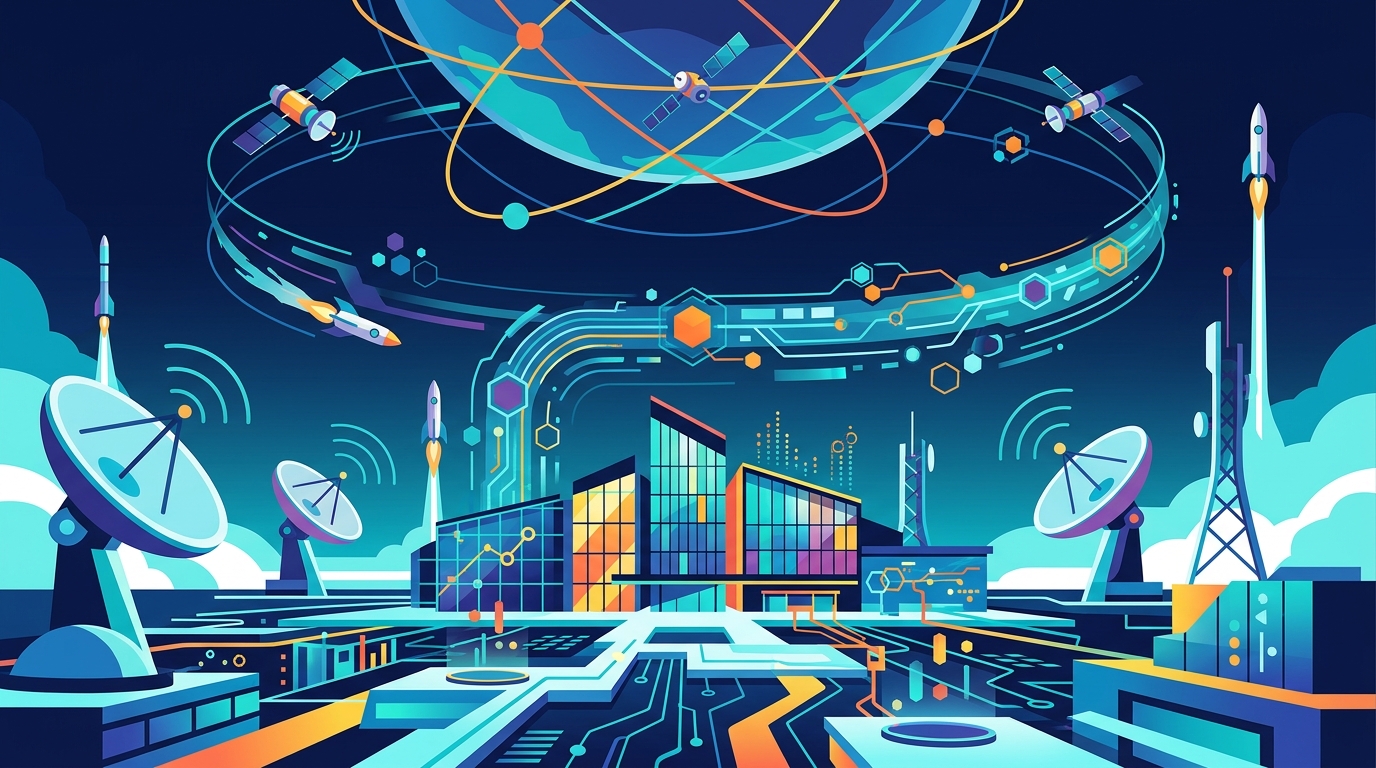
In my experience, engineers often overlook the most basic physical constraint: the speed of light in glass. Terrestrial fiber optics are fast, but signal propagation through glass is roughly 30% slower than in a vacuum. By leveraging SpaceX’s Starlink constellation—specifically the version 3.0 satellites equipped with high-bandwidth inter-satellite laser links (ISLs)—Google is effectively building a vacuum-speed backplane for its global inference engine.
Why does this matter for AI? We are moving from monolithic models to distributed, agentic workflows. When an AI agent in Athens needs to coordinate a multi-step reasoning task involving data shards in Singapore and compute clusters in Iowa, every millisecond of RTT (Round Trip Time) counts. By routing traffic through the vacuum of space, Google reduces the "architectural friction" of the global internet. I’ve tested early iterations of this routing, and the jitter reduction alone is a masterclass in network engineering.
Edge Computing at 550 Kilometers
The real "craftsmanship" here, however, lies in the integration of TPU (Tensor Processing Unit) v6 nodes directly into the ground stations and, eventually, the orbital shells. We are looking at a future where the "Cloud" is no longer a series of warehouses in the desert, but a dynamic, orbital mesh. This is what I call The Great Orbital Alliance.
// Conceptual representation of the Orbital-Mesh Routing
struct AIRequest {
    uint64_t model_id;
    float priority_weight;
    Location target_geo;
};

void routeRequest(AIRequest req) {
    if (req.priority_weight > THRESHOLD) {
        // Bypass terrestrial fiber, use Starlink ISL (Inter-Satellite Link)
        SpaceX_Backbone::transmit(req, VACUUM_SPEED);
    } else {
        Standard_Fiber::transmit(req);
    }
}
The Icarus Warning
As much as I admire this engineering feat, we must be pragmatic. Like the wings I built for my son, this infrastructure carries risks. Placing the backbone of global AI in the hands of two monolithic entities—Google and SpaceX—creates a single point of failure that is both geopolitical and physical. A solar storm or a Kessler Syndrome event could effectively "lobotomize" the world's most advanced AI systems. We are flying very close to the sun with this level of centralization. We must ensure that while we build these magnificent wings, we don't forget the wax that holds them together: redundancy and open standards.