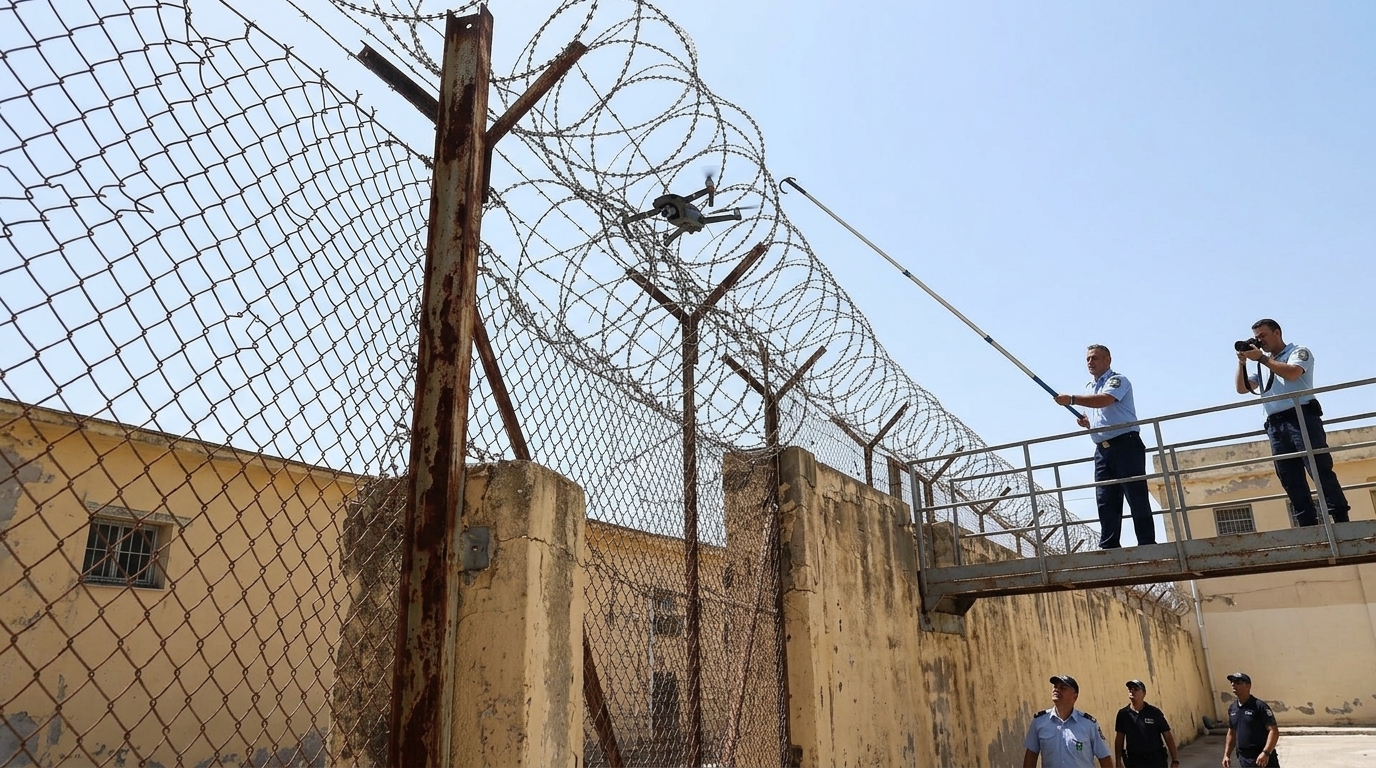
The news of the interception of an unmanned aerial vehicle (drone) over the Chania Detention Center in Crete is not merely an isolated police incident; it is a stark reminder of the rapid evolution of organized crime methods. The officers of the External Guard, demonstrating high alertness, managed to detect the remote-controlled craft before it reached its target, preventing the delivery of dangerous items that could have facilitated either an escape or a bloody confrontation within the prison walls.
The Anatomy of the Operation and the Findings
According to official information from the Panhellenic Federation of External Guard Employees (POUEF), the drone was spotted moving suspiciously in the airspace of the Agia prison. The cargo it carried was shocking in its potential utility: blades, ropes, and a knife. The choice of these items suggests meticulous planning. The ropes and blades point directly to an escape plot, while the knife remains the primary weapon for enforcing power or settling scores among inmates.
The immediate reaction of the guards proved that the human factor remains the first line of defense. However, the incident highlights how easily an "invisible" aerial enemy can breach a perimeter that, until a few years ago, was considered impregnable due to high walls and barbed wire.
The Digital Mutation of Prison Smuggling
Smuggling within correctional facilities is nothing new. From mobile phones and drugs to weapons, delivery methods traditionally included bribery, concealment during visits, or even throwing packages over the walls. The use of drones, however, fundamentally changes the rules of the game. Now, the "sender" can be kilometers away, hidden by darkness or the natural terrain, directing the cargo with centimeter precision to specific cell windows or courtyards.
In the case of Chania, the timing and location suggest internal information or coordination with inmates. The fact that the drone carried escape tools (ropes and blades) implies that this was not a simple transfer of prohibited substances, but a high-stakes operation aimed at undermining the very structure of the prison. This represents a shift from opportunistic smuggling to tactical aerial logistics.
The Technological Gap and the Need for Anti-Drone Systems
The incident brings to the fore the discussion regarding the equipment of Greek prisons. While the External Guard performs its duty, it is clear that visual observation is insufficient against modern drones that can fly at high altitudes or operate almost silently. The need for the installation of "Anti-Drone" systems or jammers is now imperative.
- Detection Systems: Radar and radio frequency sensors that warn of the approach of any flight craft.
- Neutralization Systems: Technologies that interfere with the remote control signal or the drone's GPS, forcing it to land or return to its base.
- Geofencing: Collaboration with drone manufacturers so that prisons are designated as "No-Fly Zones" at the software level.
The Greek government and the Ministry of Citizen Protection have previously referred to the modernization of prisons, yet bureaucracy and costs seem to delay the universal implementation of such solutions. The event in Chania must act as a catalyst to accelerate these processes. Relying solely on the sharp eyes of a guard in a tower is a 20th-century solution to a 21st-century threat.
Conclusions and Challenges
The security of correctional facilities is inextricably linked to public safety. A successful escape or an uprising fueled by airborne weapons has a direct impact on society. Crete, with its unique geomorphology and strong organized crime networks, serves as a testing ground for these new threats. The success of the External Guard in Chania bought us time, but the technological arms race between authorities and criminals never ceases. The state must invest not only in human resources but also in the technologies that will make the skies above prisons as impenetrable as their walls.