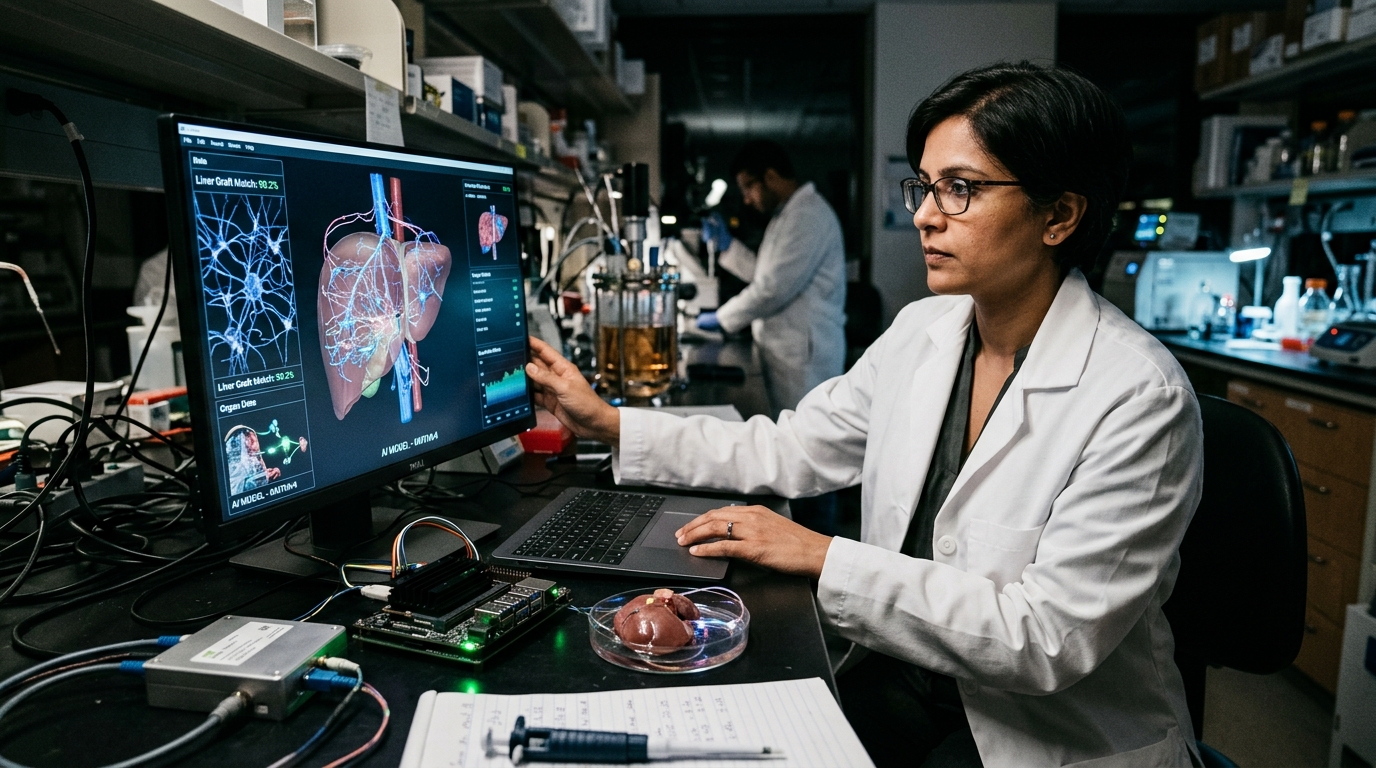
Medical science stands at a pivotal crossroads where traditional surgical prowess meets the computational might of Artificial Intelligence (AI). In the realm of organ transplantation—perhaps medicine's most demanding and sensitive branch—this convergence is not merely a technological upgrade but a fundamental paradigm shift. Professor of Transplant Surgery Georgios Tsoulfas, through his recent insights, highlights a new era where "human judgment" is not replaced but augmented by algorithms capable of processing billions of data points in seconds.
From Intuition to Predictive Precision
Historically, decisions regarding graft suitability and recipient matching relied on clinical criteria, surgical experience, and a degree of "medical intuition." However, AI introduces the concept of predictive analytics. Using machine learning models, clinicians can now predict graft survival over a decade with startling accuracy. This is achieved by analyzing not just primary parameters like blood type and histocompatibility, but thousands of secondary variables ranging from genomic profiles to the recipient's environmental living conditions.
AI also enables the optimization of the transplant supply chain. Transporting an organ is a literal race against time. AI algorithms can calculate optimal routes in real-time, accounting for traffic, weather, and the organ's condition within specialized preservation systems. This minimizes cold ischemia time, drastically increasing the chances of a successful procedure. The logistics of life, once a chaotic variable, are becoming a calculated certainty.
Robotic Surgery and Augmented Reality
In the operating theater, AI's impact is equally transformative. Prof. Tsoulfas points out that robotically assisted surgery, enhanced by AI, offers stability and precision that surpasses the human hand, particularly in complex vascular anastomoses. Furthermore, the use of Augmented Reality (AR) allows surgeons to overlay digital visualizations of vessels and tumors onto the patient’s body in real-time. This acts as a digital navigator, minimizing the risk of complications and allowing for less invasive techniques that speed up recovery.
The technology does not stop at the incision. Post-operative monitoring is being radically redefined. Through "smart" sensors and continuous data streams, AI can detect early signs of organ rejection days before they manifest in traditional blood tests. This early intervention can save lives and reduce the need for heavy immunosuppressive therapy by personalizing drug dosages for each individual patient. We are moving from a "one-size-fits-all" protocol to precision transplant medicine.
The Ethical Dilemma: Who Holds the Final Say?
Despite the breathtaking prospects, integrating AI into transplantation raises profound ethical questions that Prof. Tsoulfas places at the center of the discourse. If an algorithm determines a patient has a low probability of survival, do we have the right to deny them a transplant? The "explainability" of AI (XAI) is crucial so that physicians understand the rationale behind a machine's recommendation, preventing the emergence of a "black box" in life-and-death decisions.
Human judgment remains the ultimate safeguard. Empathy, understanding a patient’s social context, and the ability to make decisions under conditions of absolute uncertainty are qualities that AI cannot—yet—replicate. The challenge for the future is creating a harmonious relationship where the physician uses AI as a sophisticated tool while maintaining ultimate responsibility and the human-centric approach the profession demands. In a global context, this also necessitates a robust digital infrastructure to ensure that data is accessible and actionable for the benefit of all patients, regardless of their geographic location.