For years, Toyota stood as the bastion of conservative incrementalism. While Tesla and Chinese titans like BYD and Huawei promised a future defined by software and artificial intelligence, the Japanese giant remained focused on perfecting hybrid powertrains and mechanical reliability. That era has officially come to an end. At its dedicated test bed in Japan, Toyota has unveiled one of the world’s most sophisticated AI vision engines, a move that is as much about technological prowess as it is about Japan’s geopolitical standing in the 21st century.
The Architecture of the New Vision
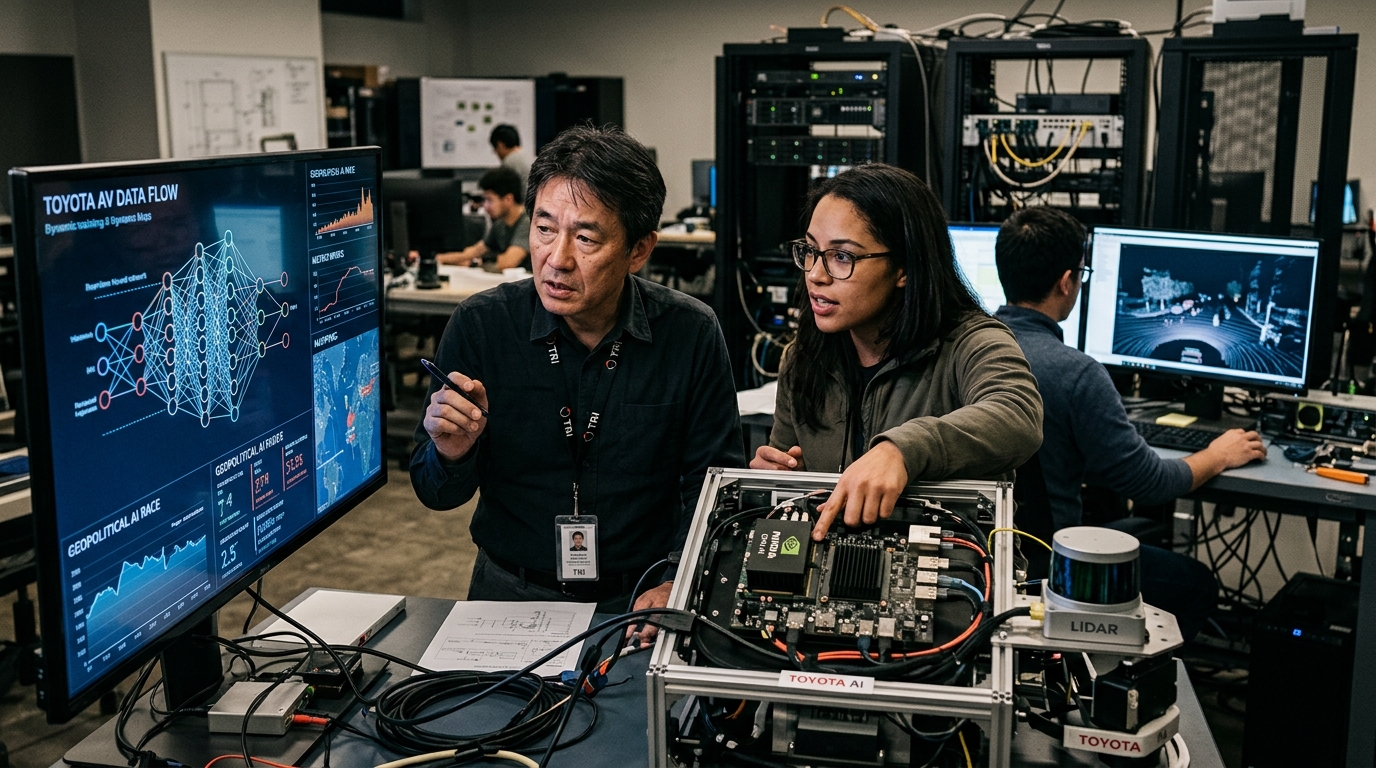
Toyota’s new AI vision engine is not merely an iterative update to existing Advanced Driver Assistance Systems (ADAS). It represents a fundamental paradigm shift in how a vehicle perceives and interacts with its environment. Utilizing advanced end-to-end neural networks, the system processes visual data in real-time with a latency and precision that aims to eclipse human reflexes. Unlike traditional rule-based systems that rely on hard-coded instructions, Toyota’s AI “learns” from vast datasets, allowing it to navigate complex urban scenarios and predict the erratic behavior of pedestrians and cyclists.
The system is currently undergoing rigorous testing at a specialized facility in Japan, designed to mimic the world's most challenging driving environments. From the hyper-dense alleys of Tokyo to high-speed expressway interchanges, Toyota is attempting to prove that its AI is more robust, adaptable, and—crucially—safer than the offerings from its Silicon Valley and Shenzhen rivals.
The Geopolitical Race with China
The timing of this unveiling is no coincidence. China has rapidly transformed the automobile into a “smartphone on wheels,” with companies like Xiaomi and Huawei leading the software-centric revolution. For Japan, the automotive sector is the backbone of the national economy. Losing the AI race would relegate the country to being a mere hardware supplier for foreign software platforms—a strategic nightmare for Japanese policymakers.
Under the leadership of CEO Koji Sato, Toyota has dramatically accelerated its investments in Woven by Toyota, the company’s dedicated software arm. The new vision engine is the centerpiece of this transformation. The goal is to establish a dominant position in the Software-Defined Vehicle (SDV) market, where vehicles can receive over-the-air updates that improve their intelligence and capabilities over time, mirroring the lifecycle of consumer electronics.
Challenges and the Road Ahead
Despite the technical breakthrough, significant hurdles remain. The sheer scale of data required to train these models is staggering. China holds a natural advantage due to its massive population and more flexible data privacy regulations, which allow Chinese firms to aggregate driving data at an unprecedented scale. Toyota, however, is betting on the quality of its data and the legendary Japanese philosophy of "Kaizen"—continuous, meticulous improvement.
This AI engine is expected to be a cornerstone of Toyota’s next-generation electric vehicle lineup and its Lexus luxury brand. If Toyota can successfully marry its reputation for bulletproof reliability with world-class artificial intelligence, it may well reclaim its title as the undisputed leader of the global automotive industry. The battle for the future of mobility is no longer fought under the hood, but within the silicon and code of the vehicle’s brain.
- Shift to AI vision reduces reliance on expensive Lidar sensors, potentially lowering costs.
- Strategic alignment with the Japanese government bolsters national AI capabilities.
- Safety remains the primary differentiator in Toyota's marketing against aggressive Chinese rivals.