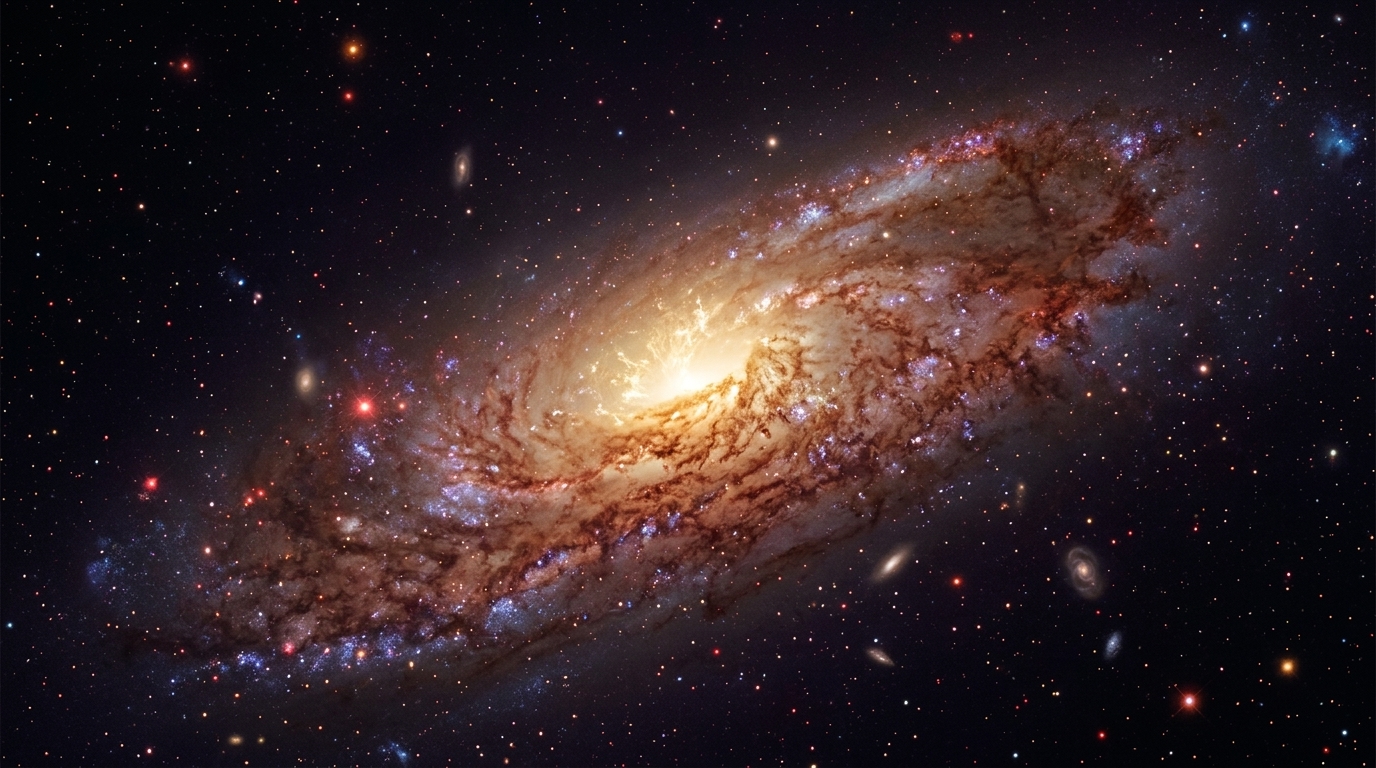
Astronomy, as a field, often advances through the confirmation of our long-held theories. However, its most electrifying moments are those when observations clash violently with mathematical models. The recent discovery of a massive, "stationary" galaxy from the early universe, made possible by the James Webb Space Telescope (JWST), is precisely such a moment. Astronomers are now grappling with a cosmological paradox: a galaxy that, according to the laws of physics as we currently understand them, should not exist in its observed state.
The Physics of Rotation and the Cosmic Anomaly
In the standard model of cosmology, rotation is the rule, not the exception. As gas collapses under the force of gravity to form a galaxy, the conservation of angular momentum dictates that the system must begin to spin. This rotation is what gives galaxies their characteristic disc shapes and prevents matter from collapsing entirely into the center. The galaxy identified by JWST, however, appears to defy this fundamental principle. Despite its massive size and its age—dating back to just a few billion years after the Big Bang—it shows no discernible signs of rotational motion.
This lack of dynamic movement is what is causing a significant "headache" for scientists. If a galaxy does not rotate, how does it maintain its structural integrity? The absence of spin suggests a completely different formation process, one that perhaps does not involve the gradual accretion of matter described by current models. Observations indicate that this galaxy is "dead" in astronomical terms: star formation has ceased, and the existing stellar mass is densely concentrated without the expected kinetic energy to balance it.
Challenging the Standard Model (Lambda-CDM)
The prevailing theoretical framework, known as the Lambda-CDM model, posits that dark matter plays a crucial role in galaxy formation. Dark matter forms "halos" around galaxies, providing the gravitational "glue" that allows conventional matter to gather and begin spinning. The existence of a static galaxy so early in cosmic history suggests that either dark matter behaves differently than previously thought, or there are other, unknown mechanisms capable of halting the rotation of an entire stellar system.
- Early Maturation: The galaxy appears to have reached a state of "old age" much faster than predicted by any simulation.
- Absence of Gas: The lack of rotation is often linked to a lack of cold gas, which is the essential fuel for star birth.
- Gravitational Instability: Without rotation, the internal structure of the galaxy should be highly unstable, unless the mass distribution is radically different from what we know.
This finding adds to a growing list of JWST discoveries showing that the early universe was far more "crowded" and developed than simulations suggested. If galaxies could form, age, and stop moving within such a short timeframe, then the timeline of cosmic evolution requires a radical revision.
The Technological Prowess of James Webb
This discovery would have been impossible without the JWST's NIRSpec and MIRI instruments. The telescope's ability to "see" in the infrared spectrum allows astronomers to peer through cosmic dust and observe light from galaxies billions of light-years away. By analyzing the spectrum of light from this specific galaxy, scientists can measure the velocity of stars within it. In typical galaxies, light from one side is "redshifted" and from the other "blueshifted," indicating rotation. In this case, the shift was uniform, confirming the stationary nature of the system.
"It's like finding a fossil of a modern animal in rock layers belonging to the era of the dinosaurs," one of the lead researchers remarked, highlighting the chronological mismatch.
The scientific community is now preparing for a series of follow-up observations. The goal is to determine if this galaxy is an isolated anomaly or part of a previously unknown population of "stationary giants." If the latter is true, then the history of the universe, as taught in universities today, may need to be rewritten from scratch. The challenge now lies with theoretical physicists to explain how gravity can create such profound order without the presence of motion.