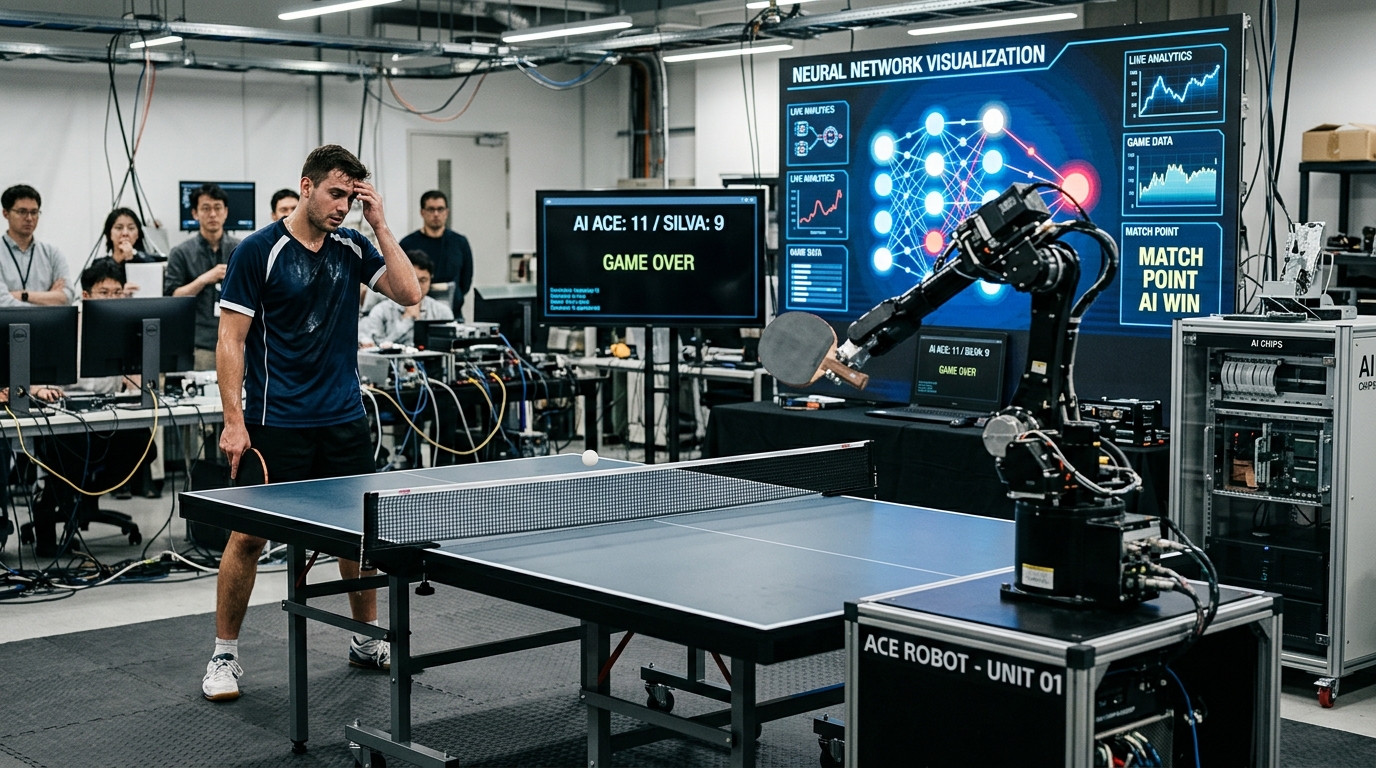
In the history of artificial intelligence, certain milestones have remained indelible: Deep Blue's victory in chess in 1997 and AlphaGo's dominance in 2016. Today, April 23, 2026, we stand at a new turning point, this time in the realm of physical interaction. Sony’s "Ace" robot didn't just win a match; it proved that AI can now transcend the boundaries of the digital world and dominate an environment that demands lightning-fast reflexes, fine motor skills, and real-time strategic foresight.
Table tennis has been considered the "Holy Grail" of robotics for decades. Unlike chess, where there is ample time for computation, table tennis requires responses in milliseconds. The ball can travel at speeds exceeding 100 kilometers per hour, carrying complex spins that change its trajectory the moment it touches the table. For a human, this is a matter of instinct and years of training. For a machine, it is a nightmare of computational power and mechanical precision.
The Technological Prowess Behind Ace
Ace's success is built on three pillars that Sony has been systematically developing over the past five years. The first is High-Speed Vision. The robot is equipped with image sensors that capture 1,000 frames per second (fps), allowing it to "see" the ball's spin and the slightest movement of the opponent's racket before the strike is even completed. Combined with low-latency processors, Ace can calculate the point of impact with millimeter precision.
The second pillar is Reinforcement Learning. Ace was not programmed with static rules. Instead, it "played" billions of virtual matches in simulators, learning from its mistakes and developing its own strategies. This digital experience was then transferred to the robot's physical body, which features carbon fiber joints and actuators that respond faster than human muscles.
The third and perhaps most crucial factor is Adaptive Strategy. During the match with the professional player—whose name was initially kept secret for privacy reasons but was later revealed to be one of Asia's top athletes—Ace didn't just play defensively. It analyzed the opponent's style in real-time, identifying weaknesses in their backhand and applying aggressive spins that forced the human into errors.
Beyond the Court: Societal Implications
Ace's victory is not just about sports. The technologies that allow a robot to hit a ping pong ball are the same ones that will enable future robots to perform complex surgeries, assist the elderly with daily tasks, or work in factories with absolute safety alongside humans. A machine's ability to perceive and react to the physical environment with such speed shatters one of the last bastions of human uniqueness.
- Industrial Automation: Ace's precision can be transferred to production lines requiring the handling of fragile materials.
- Medicine: High-speed sensors can be used in robotic systems that compensate for human hand tremors.
- Safety: Systems reacting in fractions of a second can prevent accidents in autonomous vehicles.
However, this evolution also raises questions. If machines can surpass us in skills we considered purely human, what is the role of professional sports in the future? Will we see human-versus-machine matches as a new form of entertainment, or will the value of human effort be diminished?
Conclusions
Sony, with Ace, has set a new standard. This is not a simple demonstration of power, but proof that the convergence of optical technology, AI, and advanced engineering has reached a level of maturity. As 2026 progresses, it is clear that "physical" AI will be the next major field of competition among tech giants, with Sony now holding the top spot on the podium.