For more than a decade, the promise of quantum computing has remained a distant dream—a theoretical Eden where the laws of subatomic physics would enable the resolution of problems that today’s supercomputers would take centuries to process. In the field of Artificial Intelligence (AI) specifically, expectations have been sky-high: the ability of quantum systems to simultaneously process myriad states through superposition and entanglement seemed like the perfect match for training gargantuan neural networks. However, reality has been sobering, as quantum systems hit walls of "noise" and mathematical dead-ends. Today, new research highlighted by New Scientist suggests we may have finally found the key to unlocking this immense power.
The "Barren Plateau" Problem and the Path Forward
The primary obstacle in Quantum Machine Learning (QML) has been a phenomenon scientists call "Barren Plateaus." In classical machine learning, training a model is akin to a climber descending a mountain toward a valley (the point of minimum error). In quantum systems, however, this landscape would suddenly turn flat. The "climber" would lose all orientation, as there was no gradient to guide the way. Quantum algorithms lost their effectiveness as the data size grew, rendering them useless for real-world applications.
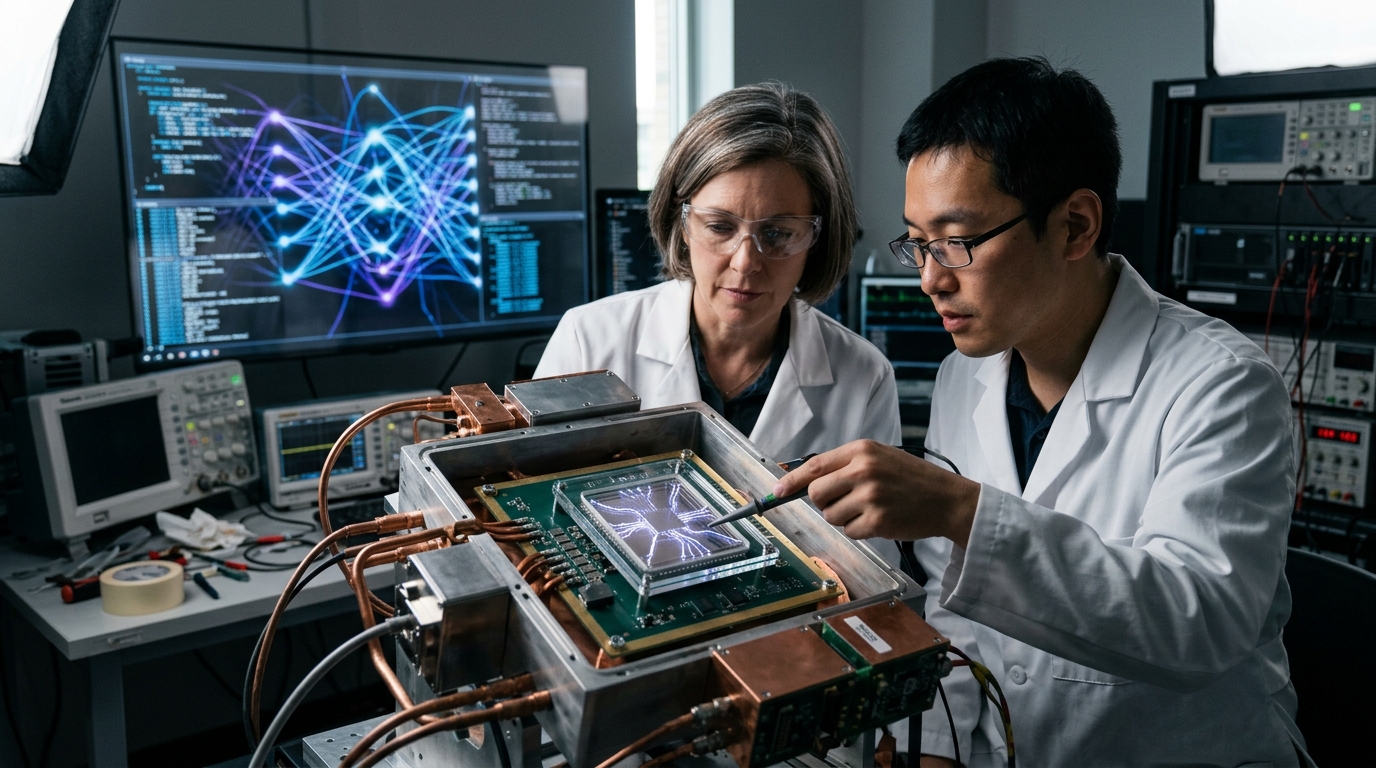
The new approach discussed in the scientific community focuses on redesigning how data is fed into the quantum system. Instead of trying to directly translate classical data into quantum states—a process that often introduces insurmountable noise—researchers are proposing the use of hybrid architectures. These structures allow the quantum component to handle only the most complex linear algebraic operations, while the classical component maintains control over optimization, thereby avoiding the barren plateaus.
The Geopolitics of Quantum Intelligence
This is not merely an academic victory. The ability to use quantum computers to boost AI is the new "Holy Grail" of global technological competition. The US, China, and the European Union are investing billions, knowing that whoever first masters Quantum AI will gain a strategic advantage in fields such as cryptography, drug discovery, and climate modeling. Europe, in particular, is striving to bridge the gap with Silicon Valley by investing in quantum accelerators to be linked with existing supercomputing centers.
- Quantum AI could reduce data center energy consumption by up to 90%.
- Discovery of new battery materials could be accelerated from decades to months.
- Banking transaction security will require a total overhaul due to quantum power.
However, the transition will not be instantaneous. We are currently in the NISQ (Noisy Intermediate-Scale Quantum) era, where computers are still error-prone. The challenge remains error correction, which requires thousands of additional qubits for every "logical" qubit performing calculations. But this new research provides a roadmap for using these imperfect systems in a way that produces meaningful results today, rather than twenty years from now.
Implications and Future Outlook
The convergence of quantum computing and AI is no longer a theoretical hypothesis but an engineering challenge starting to be solved. As algorithms become more noise-resilient and architectures more flexible, Artificial Intelligence will move from the era of "statistical prediction" to the era of "absolute simulation." The ability to understand nature at its own level—the quantum level—will allow AI to solve problems we once deemed unsolvable, altering the very fabric of our society and economy.