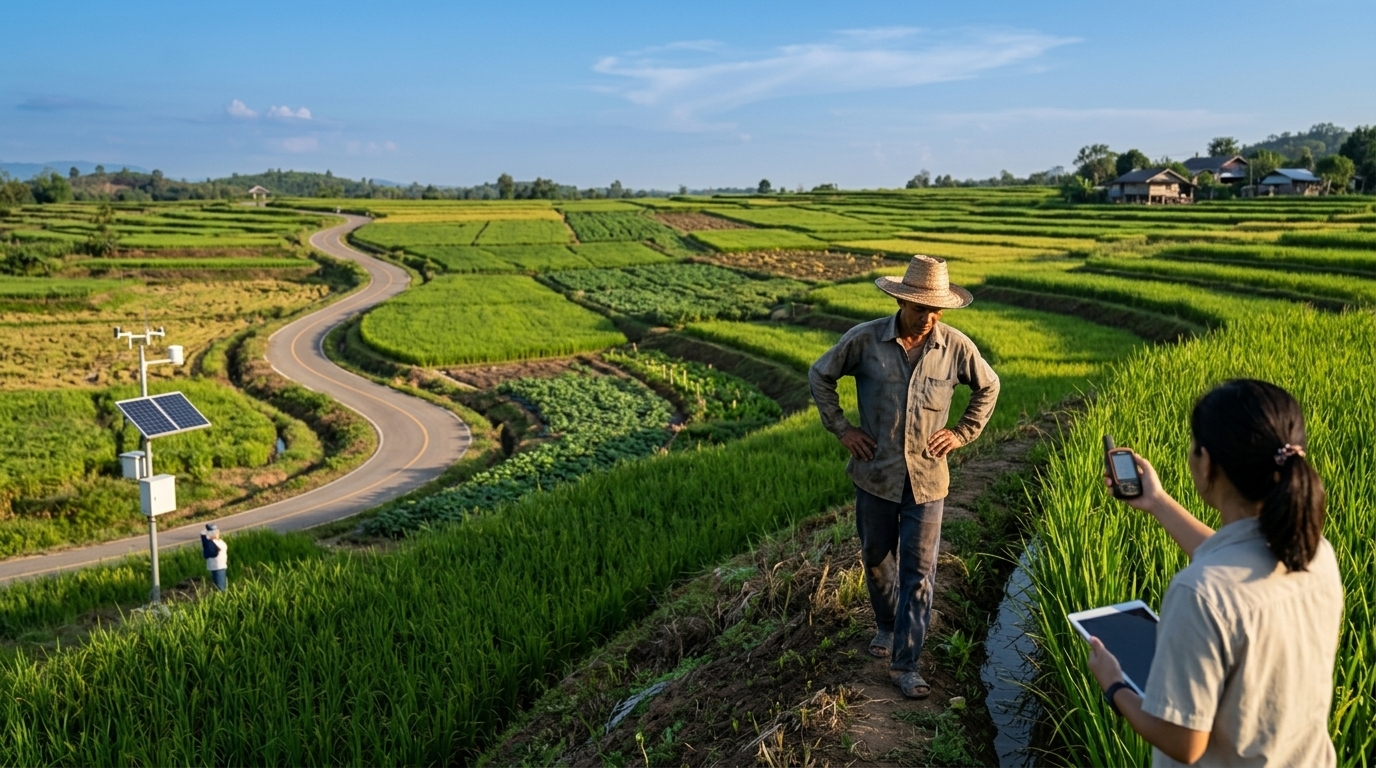
In an era where climate change and environmental degradation demand immediate and precise responses, artificial intelligence is emerging as science's most valuable ally. The Allen Institute for AI (AI2), one of the most respected organizations in open AI research, has announced the release of OlmoEarth v1.1. This represents a significant upgrade to the family of Geospatial Foundation Models (GFMs), aiming to democratize access to high-resolution planetary insights.
OlmoEarth v1.1 is not merely an incremental update; it is a statement of intent. While big tech giants often keep their models behind closed gates and expensive APIs, AI2 offers a solution that marries technical excellence with open access. Version 1.1 focuses heavily on efficiency, enabling researchers and organizations with limited computational resources to process vast amounts of satellite data with precision that previously required supercomputers.
Technical Superiority and Architectural Efficiency
The heart of OlmoEarth v1.1 beats with an architecture based on Vision Transformers (ViT), specifically optimized for the multispectral data provided by the Sentinel-2 satellites. Unlike traditional computer vision models trained on Instagram or Flickr photos, OlmoEarth understands the spectrum beyond visible light—from near-infrared to shortwave infrared.
Version 1.1 introduces key improvements in how the model handles scale and resolution. Through a process researchers call "multi-resolution pre-training," the model can now recognize patterns across different scales simultaneously. This means it can detect anything from the health of an individual crop in a field to broad changes in forest cover across an entire continent without losing its computational cool. The reduction in GPU memory requirements during both training and inference makes v1.1 up to 30% faster than its predecessor—a non-trivial feat when dealing with petabytes of data.
"Open science is the only path to tackling global challenges. With OlmoEarth v1.1, we are not just providing code, but the ability for every scientist to see the world through new eyes," states the AI2 research team.
From Space to Earth: Real-World Applications
The applications of OlmoEarth v1.1 span a wide array of critical sectors. In precision agriculture, the model can predict crop yields by analyzing moisture levels and photosynthetic activity, helping farmers optimize water and fertilizer use. In disaster response, the model's ability to compare pre- and post-event satellite imagery in near real-time allows rescue teams to identify flooded areas or damaged infrastructure within minutes.
Furthermore, carbon monitoring is a field where OlmoEarth v1.1 is expected to excel. Accurately measuring forest biomass is essential for verifying carbon credits. With its high efficiency, the model can provide continuous updates on deforestation, making environmental policies more transparent and accountable. The model's ability to run at a lower cost means that even small NGOs in developing nations can now access tools that were previously the sole province of wealthy governments.
The Importance of Open Source in the Climate Crisis
AI2’s decision to release OlmoEarth v1.1 under an open license is not just an altruistic move; it is a strategic necessity. The climate crisis is as much a data problem as it is a policy problem. By aggregating the knowledge of the global community around a common, open model, the speed of innovation increases exponentially. Researchers can fine-tune OlmoEarth for specific regions or problems, creating an ecosystem of solutions built on the same robust foundation.
However, the challenge remains: AI alone cannot plant trees or stop carbon emissions. But it is our map and our compass. OlmoEarth v1.1 offers the clearest picture we have ever had of how our planet is changing, giving decision-makers the tools to act before it is too late. The transition from v1.0 to v1.1 demonstrates that the industry is beginning to understand that raw compute power isn't the only answer; smart, efficient architecture is what will drive real-world change.