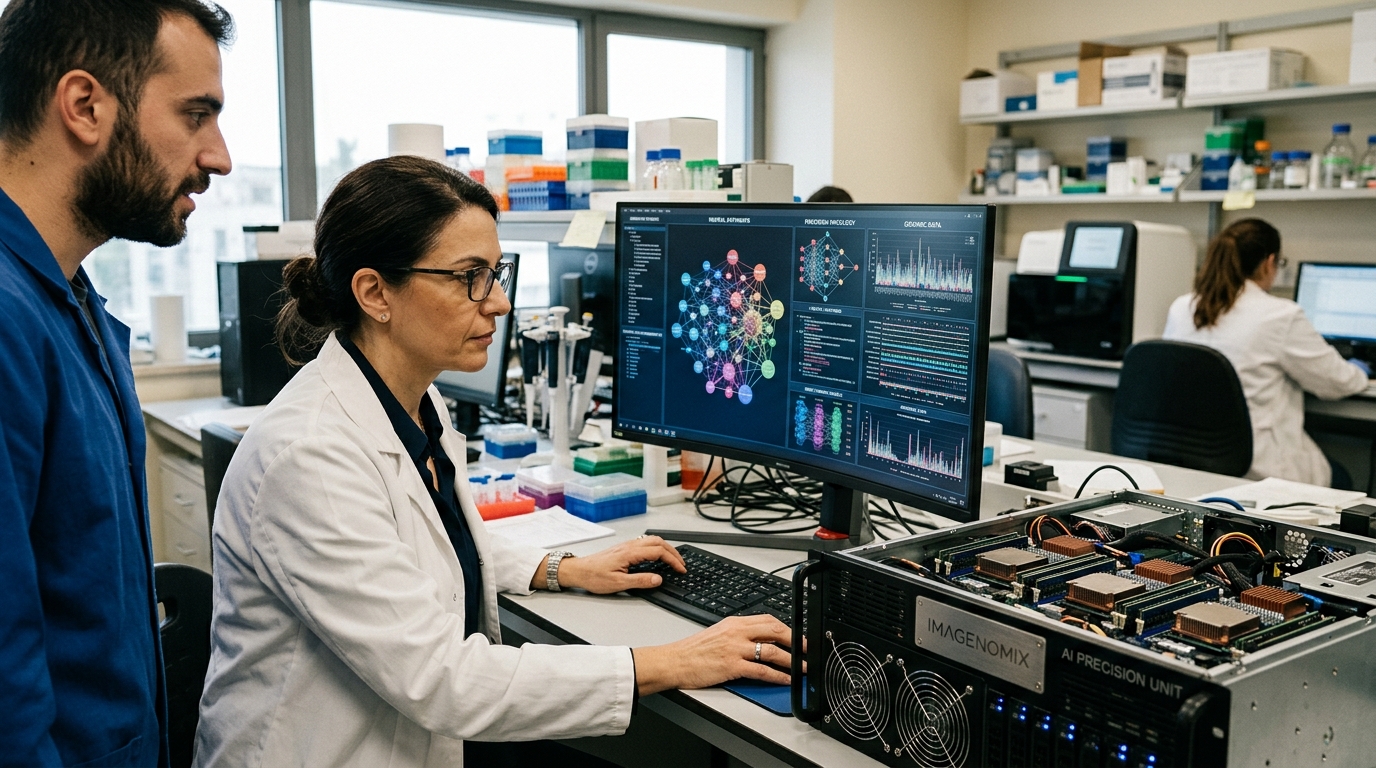
At the intersection of medical science and technological innovation, a new force is emerging, promising to fundamentally change how we understand and treat cancer. Imagenomix, a startup led by the distinguished Greek researcher Dr. Aris Tsirigos, a professor at NYU Grossman School of Medicine, is not just another biotech firm. It is the exponent of a new era where Artificial Intelligence (AI) ceases to be an experimental tool and becomes the central pillar of diagnostic precision.
Traditional pathology, which relies on examining tissue samples under a microscope, has remained largely unchanged for over a century. Despite the expertise of physicians, subjectivity and the complexity of cancer cells often lead to delays or ambiguities. Imagenomix fills this gap by using advanced deep learning algorithms that can "read" digitized tissue slides with a speed and detail that surpasses human vision.
The Power of Multimodality: From Image to Gene
The competitive advantage of Imagenomix lies in its "multimodal" approach. While many AI applications focus either solely on medical imaging or solely on genomic data, Imagenomix's platform successfully synthesizes them. The algorithm analyzes the morphological alterations of cells and directly correlates them with specific genetic mutations, without the need for costly and time-consuming DNA sequencing at every stage.
This "virtual genomics" capability allows clinicians to know the genetic profile of a tumor within minutes, rather than weeks. For a patient with aggressive cancer, this time is not just a statistic; it is the difference between the timely start of targeted therapy and the progression of the disease. Imagenomix's technology acts as a "digital consultant" that identifies patterns invisible to the human eye, offering a holistic view of tumor biology.
Greek Talent on the Global Stage
The case of Dr. Tsirigos and Imagenomix once again highlights the quality of Greek scientific talent in the diaspora. With studies at the National Technical University of Athens and a brilliant career in the US, Dr. Tsirigos serves as a bridge between Greek academic excellence and the New York innovation ecosystem. His startup does not only target the American market but seeks to democratize access to high-level diagnostic tools worldwide.
The company's strategy involves collaborating with major hospital networks and pharmaceutical companies. In drug development, Imagenomix's technology can be used to identify the right patients for clinical trials, reducing costs and increasing the success rates of new therapies. This is a multi-billion dollar market where precision translates directly into economic efficiency and, most importantly, lives saved.
Challenges and the Future of Digital Pathology
Despite the immense potential, integrating AI into clinical practice is not without obstacles. Regulatory approval from bodies like the FDA is an arduous process, as rigorous proof of algorithmic reliability is required. Furthermore, there is the issue of data interoperability: how will different hospitals with different digitization systems be able to use the same platform?
Imagenomix is investing heavily in "Explainable AI," ensuring that doctors do not just accept a prediction from a "black box" but understand the reasoning behind each diagnosis. The future Dr. Tsirigos envisions is one where the pathologist is augmented by AI, freed from repetitive tasks to focus on the most complex and critical cases. Imagenomix places Greece on the map of cutting-edge medical technology, proving that innovation has no borders when scientific knowledge meets entrepreneurial vision.