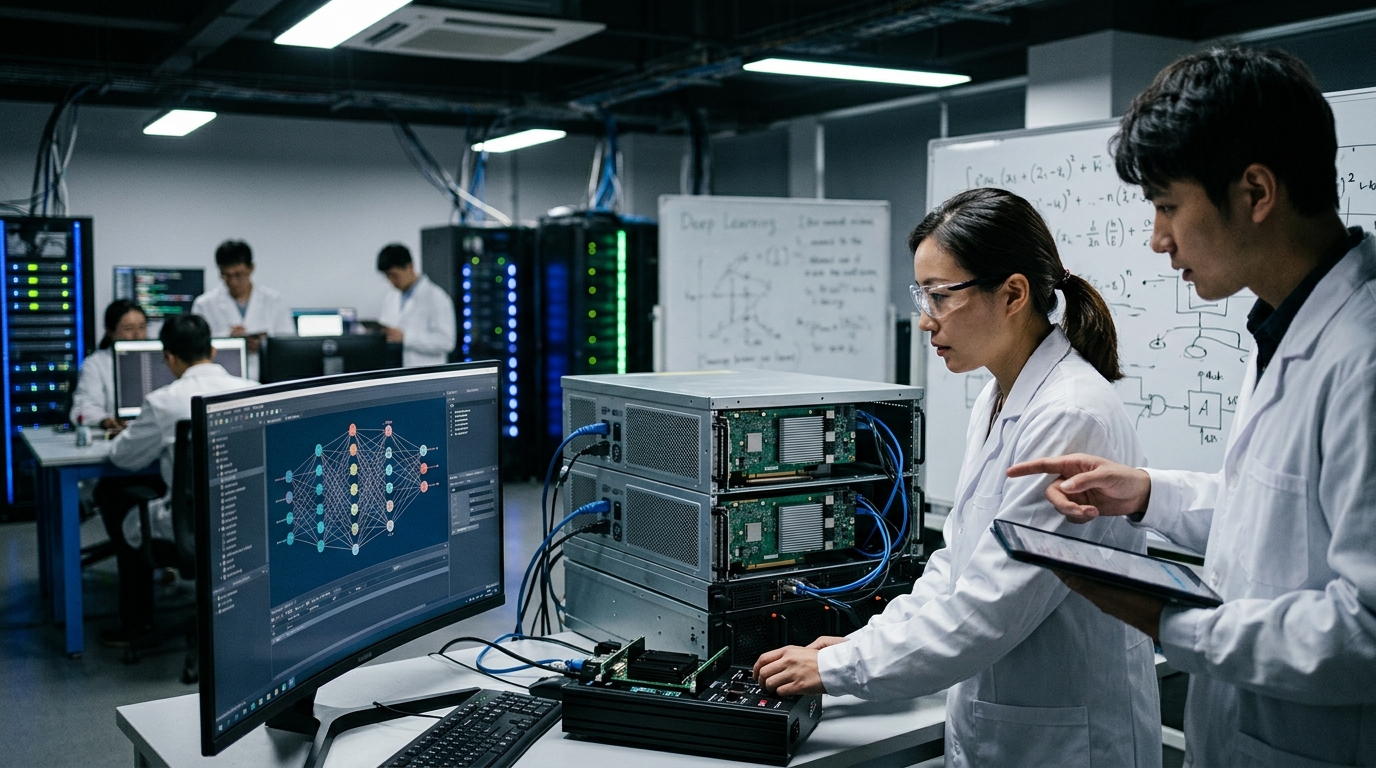
The global AI chessboard has just experienced a major tremor. DeepSeek, the Chinese research lab that has become the primary disruptor of US tech dominance, has unveiled DeepSeek V4. This is not merely another Large Language Model (LLM); it is a declaration of independence. In an era where access to high-end Nvidia GPUs is considered the mandatory entry fee for the AI elite, DeepSeek V4 proves that mathematical elegance and code optimization can outmatch brute computing power.
The Architecture of Efficiency
DeepSeek V4 is built upon the Mixture-of-Experts (MoE) architecture, but it pushes the boundaries of what is possible within that framework. Unlike monolithic models that activate their entire neural network for every query, V4 utilizes only the necessary segments, drastically reducing energy and computational overhead. The most striking innovation, however, is the implementation of Multi-head Latent Attention (MLA). This technique allows the model to process vast amounts of data with minimal memory usage, solving one of the most persistent bottlenecks in modern AI: the cost of KV cache memory.
DeepSeek’s strategy is clear: while OpenAI and Google invest billions in hardware infrastructure, the Chinese team invests in algorithmic ingenuity. V4 was reportedly trained at a fraction of the cost of its competitors, yet it achieves performance metrics that rival or exceed GPT-4o and Claude 3.5 Sonnet in critical domains such as coding, logic, and mathematics.
Defying the Nvidia Hegemony and Geopolitical Realities
The most disruptive feature of DeepSeek V4 is its ability to be trained and deployed on alternative infrastructures. US sanctions on the export of advanced chips (such as Nvidia’s H100 and B200) to China were intended to stifle Chinese AI progress. Instead, they appear to have acted as a catalyst for radical innovation. DeepSeek has optimized its software to be hardware-agnostic, allowing for the use of domestic Chinese chips or older-generation hardware with unprecedented efficiency.
- Full utilization of FP8 precision calculations for maximum speed.
- Reduced dependency on Nvidia’s CUDA through custom-built kernels.
- Seamless deployment across a broader range of cloud infrastructures.
This development changes the game for nations and corporations outside the Silicon Valley inner circle. If DeepSeek V4 can provide top-tier intelligence without the need for multi-billion dollar data centers, the democratization of AI might very well be led by Beijing rather than San Francisco.
Open Source: The Weapon of Mass Adoption
DeepSeek’s decision to release the model with open weights is a strategic masterstroke. While OpenAI moves toward increasingly closed and proprietary systems, DeepSeek is gifting its technology to the global developer community. This fosters an ecosystem where thousands of applications will be built on the Chinese model, establishing it as the de facto standard for cost-effective, high-performance AI.
"The era of brute force is coming to an end. DeepSeek V4 demonstrates that the next phase of AI will be decided by resource economy, not resource abundance," notes a senior industry analyst.
In conclusion, DeepSeek V4 is more than a technical achievement; it is a symbol of a new era. It represents a shift where geopolitical pressure has birthed a technological counter-offensive, threatening to overturn the established order of the high-tech world.