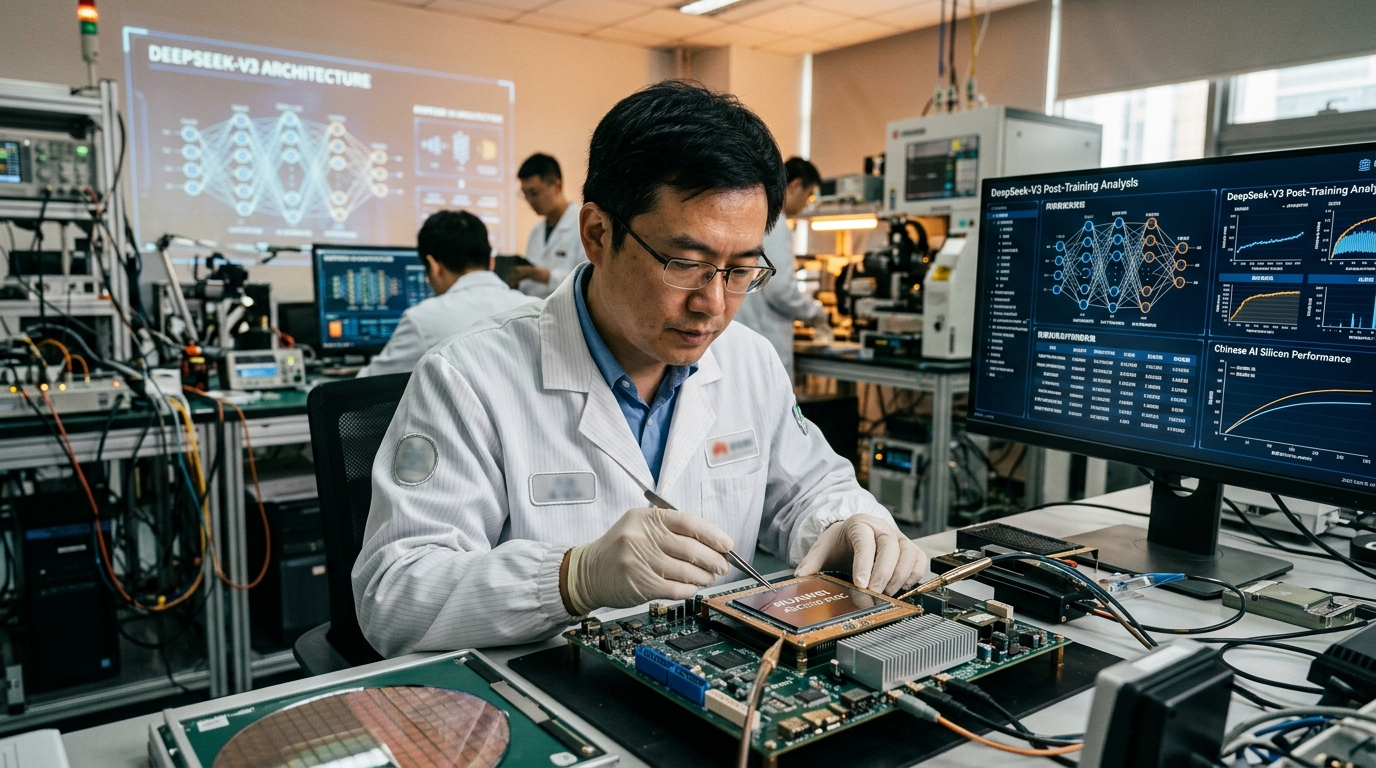
The global artificial intelligence community continues to reverberate from the impact of DeepSeek, the Chinese startup that managed to challenge Silicon Valley’s dominance with a fraction of the budget of its competitors. In a recent commentary that has sparked widespread discussion, Sir Demis Hassabis, co-founder and CEO of Google DeepMind, offered a sober and analytical perspective on the phenomenon many are calling "AI's Sputnik moment."
Hassabis, one of the primary architects of the modern AI era, did not hesitate to praise the Chinese engineers. He described DeepSeek-V3 and the subsequent R1 model as "exceptional pieces of engineering," noting that the Hangzhou-based team's ability to achieve GPT-4o level performance with a training cost of just $6 million is remarkable. However, his central thesis was clear: the hype suggesting that DeepSeek has dismantled the "compute moat" is largely exaggerated and misleading.
Misinterpreting Efficiency vs. Frontier Innovation
According to Hassabis, there is a fundamental distinction between optimizing existing architectures and discovering new frontiers. DeepSeek employed techniques such as Multi-head Latent Attention (MLA) and DeepSeekMoE (Mixture-of-Experts) to drastically reduce memory and compute requirements during both training and inference. While impressive, this approach largely builds upon ideas already circulating in the academic community, many of which originated from Google and OpenAI themselves.
"It is one thing to build a more efficient engine for a car that has already been invented, and quite another to invent flight," say analysts who echo Hassabis’s view. The DeepMind CEO argued that while DeepSeek proved that "clever engineering" can close the gap with leaders, the path to Artificial General Intelligence (AGI) will still require exponentially greater scale in terms of data and processing power. The notion that we can reach AGI using only a few thousand GPUs is, in his view, a fallacy.
The Geopolitical Chessboard and the 'Nvidia Shock'
Hassabis’s intervention comes at a time when markets are jittery about the future of hardware investment. The revelation that DeepSeek utilized older Nvidia H800 cards—due to US export restrictions—to achieve these results triggered temporary panic on Wall Street, putting pressure on Nvidia’s stock. The market feared that if high-end AI could be produced "on the cheap," the necessity for billions of dollars worth of chips would evaporate.
Hassabis countered this logic, pointing out that resource constraints often lead to creative workarounds, but those workarounds have limits. DeepSeek, in his view, did not break the Scaling Laws; it simply found the most efficient path to reach the current state of the art. To move beyond today's plateaus and achieve models capable of complex scientific discovery, massive compute remains an absolute necessity.
- DeepSeek proved that software optimization can compensate for a lack of cutting-edge hardware.
- Hassabis emphasizes that while the open-weights nature of DeepSeek is good for research, it carries security implications.
- Google DeepMind remains committed to the hypothesis that scale is the only viable path to true intelligence.
"DeepSeek's engineering prowess is admirable, but let us not confuse efficiency with pushing the boundaries of knowledge. The road to AGI remains a resource-intensive endeavor." — Demis Hassabis
The West’s Strategic Response
This stance also serves as a subtle reassurance to Alphabet (Google) investors. If DeepMind believed DeepSeek had fundamentally changed the game, it would have to reconsider its multi-billion dollar capital expenditures on data centers. Instead, Hassabis appears to be laying the groundwork for the next generation of Gemini models, which promise to show what happens when the "clever engineering" seen in DeepSeek is combined with the "brute force" of thousands of H200 and Blackwell GPUs.
Ultimately, DeepSeek achieved something no one expected: it forced the giants of Silicon Valley to be humbler and more fiscally disciplined. Even if Hassabis is correct and the hype is exaggerated, the AI industry will never be the same. The era where success was bought simply by stacking more chips is over. Now, the battle will be won by whoever can best marry superior architecture with the world's largest supercomputers.