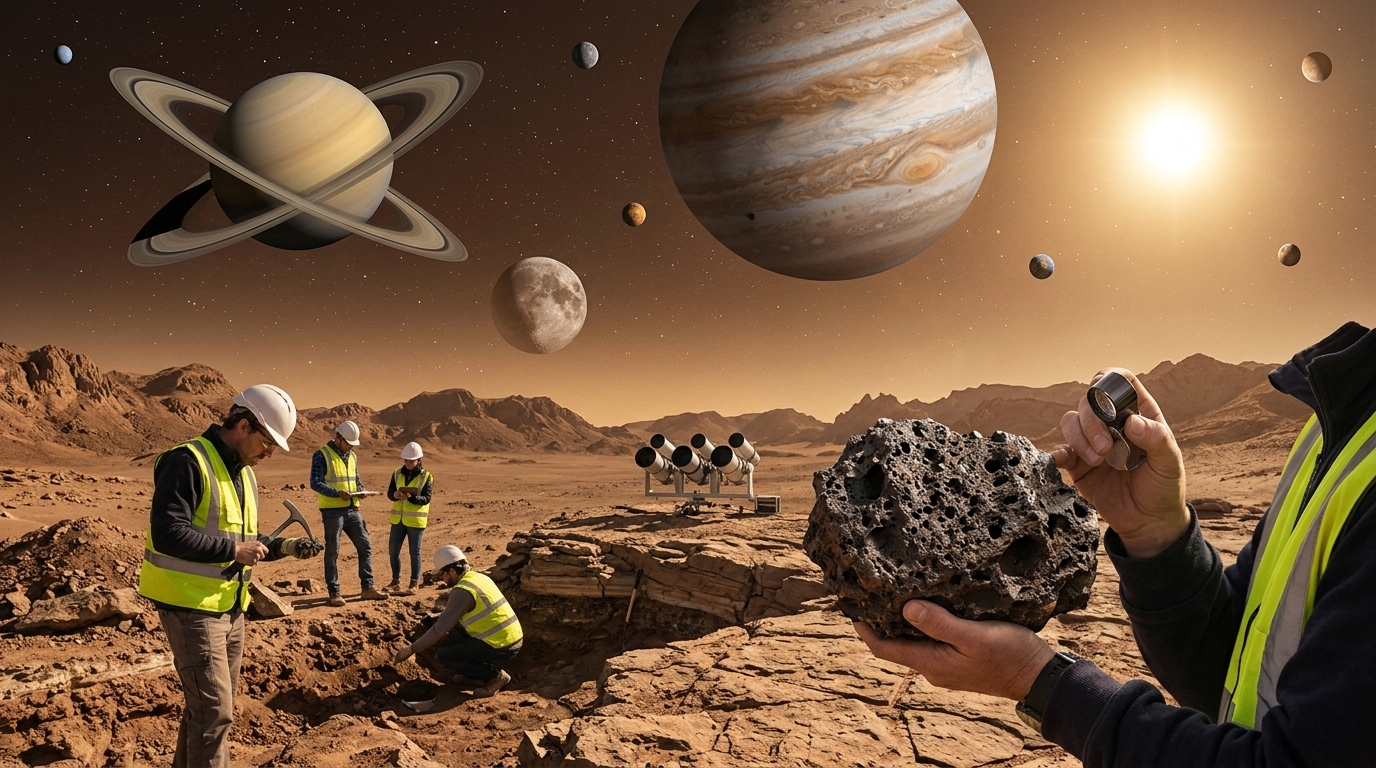
In the heart of the Algerian Sahara, in a region known as Erg Chech, the sands held a secret for billions of years that challenges our understanding of the solar system’s birth. The Erg Chech 002 (EC 002) meteorite, discovered in 2020, is not just another extraterrestrial rock. It is a 'time capsule' from an era when Earth had not yet fully formed—a fragment of a lost world that once orbited the young Sun.
The Anatomy of an Ancient Traveler
EC 002 differs radically from the vast majority of meteorites that strike Earth. While most meteorites are chondrites (accumulations of dust and grains) or basaltic achondrites, this specific specimen is composed primarily of andesite. On Earth, andesite is associated with subduction zones, where tectonic plates collide and melt. Its presence in a meteorite suggests it originates from a 'differentiated' protoplanet—a body that possessed enough internal heat to melt and form a distinct crust, mantle, and core.
By analyzing radioactive isotopes of magnesium and aluminum, scientists determined the age of the crystals to be approximately 4.565 billion years. This makes it the oldest magmatic rock ever discovered, predating Earth itself by several million years. It is, essentially, a fossil of the early crust of a planetary embryo that never reached full planetary status.
A Window into Early Solar System Chaos
The existence of EC 002 confirms a theory astrophysicists have held for decades: the early solar system was an incredibly violent and crowded place. Some 4.5 billion years ago, hundreds of protoplanets, ranging in size from the Moon to Mars, were in constant collision. Some were absorbed by larger planets like Earth and Venus, while others were completely obliterated, leaving only debris behind.
- Rare Composition: Andesite is extremely rare in space, suggesting that the crusts of most protoplanets were either destroyed or integrated into larger bodies.
- Thermal History: The rock's crystallization indicates that the parent body had a complex geological history, similar to that of the inner terrestrial planets.
- Extinction: The fact that we haven't found other similar meteorites suggests that this type of planetary crust has almost entirely vanished from our solar system.
The 'lost world' from which EC 002 originated was likely destroyed by a titanic collision shortly after its formation. Fragments of this world were either ejected into deep space or fell into the Sun. That such a piece managed to survive in the asteroid belt for eons and eventually land in the African desert is a statistical miracle.
Scientific Significance of Dating
Studying Erg Chech 002 is not just about the past; it's about understanding the chemistry of life itself. Its isotopic analysis allows us to recalibrate our models of how elements were distributed in the nebula that birthed the Sun. The presence of Aluminum-26, a short-lived radioactive isotope, acts as a 'cosmic clock,' enabling researchers to date the events of the solar system's birth with a precision of thousands of years rather than millions.
"This meteorite is the closest thing we have to a sample from the 'laboratory' where the planets were built," researchers note.
In conclusion, EC 002 reminds us that Earth is a survivor. We live upon the ruins and remnants of a multitude of worlds that perished before they could flourish. Every time a geologist examines this meteorite, they are looking into a mirror of what could have happened to our own planet had cosmic collisions taken a different turn. The Sahara, with its vast silence, continues to provide the keys to understanding the tumultuous beginning of our existence.