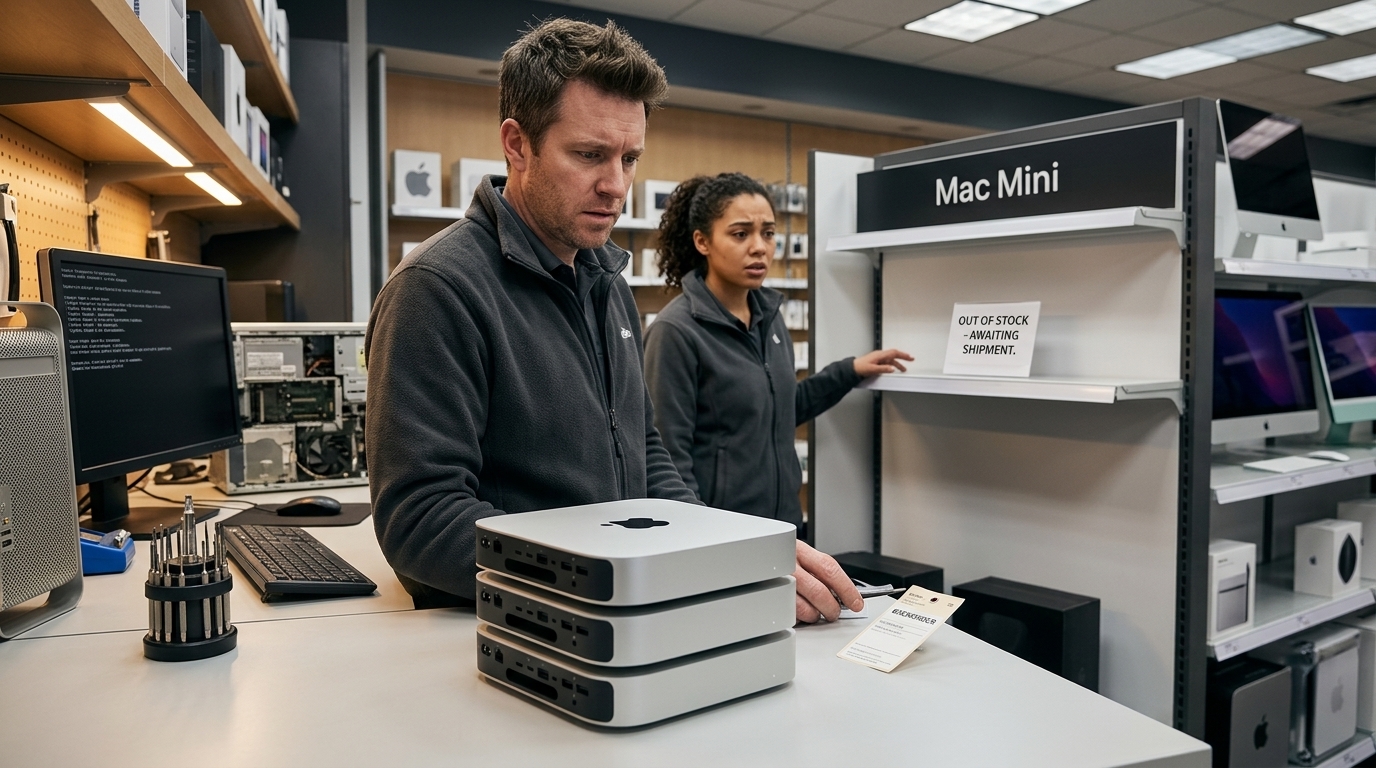
In a rare admission during Apple's latest earnings call, CEO Tim Cook confirmed what many industry observers and tech enthusiasts had begun to suspect: the Mac Mini, once the humble and affordable entry point into the macOS ecosystem, has become a scarce commodity. Demand for the compact desktop has surged to such levels that consumers are being warned they may struggle to find units available for the next "several months." The catalyst? An explosion in AI adoption that caught even the Cupertino giant off guard.
The Transformation into an AI Powerhouse
For years, the Mac Mini was viewed as the practical choice for those who wanted a Mac without the premium cost of an iMac’s display or a MacBook’s portability. However, as we move through 2026, the landscape has shifted fundamentally. With the introduction of the latest Apple Silicon generations, featuring dedicated Neural Processing Units (NPUs) and high-bandwidth unified memory, the Mac Mini has emerged as the ideal vehicle for "Local AI." Its ability to run Large Language Models (LLMs) locally, bypassing the latency and privacy concerns of the cloud, has made it an essential tool for developers, researchers, and privacy-conscious enterprises.
Tim Cook told analysts that the adoption of Apple Intelligence features and third-party AI applications happened "much faster than we had anticipated in our demand models." This admission highlights a broader market trend: artificial intelligence is no longer a theoretical promise but a daily productivity driver that demands specific hardware. The Mac Mini, with its small footprint and exceptional performance-per-watt, has become the de facto choice for AI clusters and personal AI workstations.
The Supply Chain Bottleneck
Despite Apple's immense liquidity and leverage over global suppliers, production cannot be scaled instantaneously. Reports suggest the bottleneck lies in the procurement of specific components for Unified Memory and the production constraints of 2nm nodes at TSMC. As Apple attempts to balance silicon allocation between the high-volume iPhone, the flagship MacBook Pro, and the surging Mac Mini, the latter appears to be falling behind in priority despite the massive demand spikes.
Furthermore, the rise of OpenClaw and other open-source AI frameworks optimized for Apple’s architecture has fueled a secondary market frenzy. On platforms like eBay, prices for lightly used Mac Minis equipped with M4 or M5 chips have already exceeded their original retail value, reminiscent of the GPU shortages during the cryptocurrency boom. Enterprises that planned fleet-wide upgrades are now stuck in a holding pattern, desperately seeking alternatives that often lack the efficiency and software integration of the Apple ecosystem.
Implications for the Market and Consumers
This shortage is more than just a logistical hiccup; it is a signal of where the industry is heading. The pivot back toward desktop computing—a segment many thought was dying in the age of the tablet—is being driven by the sheer computational requirements of AI. The need for sustained power and large memory pools for AI inference is putting the Mac Mini back at the center of the conversation. For the average consumer, this means that orders placed today might not be fulfilled until late summer or even autumn of 2026.
While Apple promises to optimize production, the reality is that the global competition for advanced silicon is relentless. Analysts suggest that if Apple cannot bridge this gap, it may inadvertently open the door for Windows-on-ARM competitors, though Apple’s vertical integration remains a formidable moat. The takeaway for anyone looking to upgrade is clear: if you see a Mac Mini in stock, do not hesitate.
- AI demand has transformed the Mac Mini from a budget option to a professional necessity.
- Supply chain issues are rooted in advanced silicon and unified memory shortages.
- Secondary market prices are currently exceeding MSRP due to scarcity.
- The shortage highlights the rapid shift toward local AI processing over cloud-based solutions.