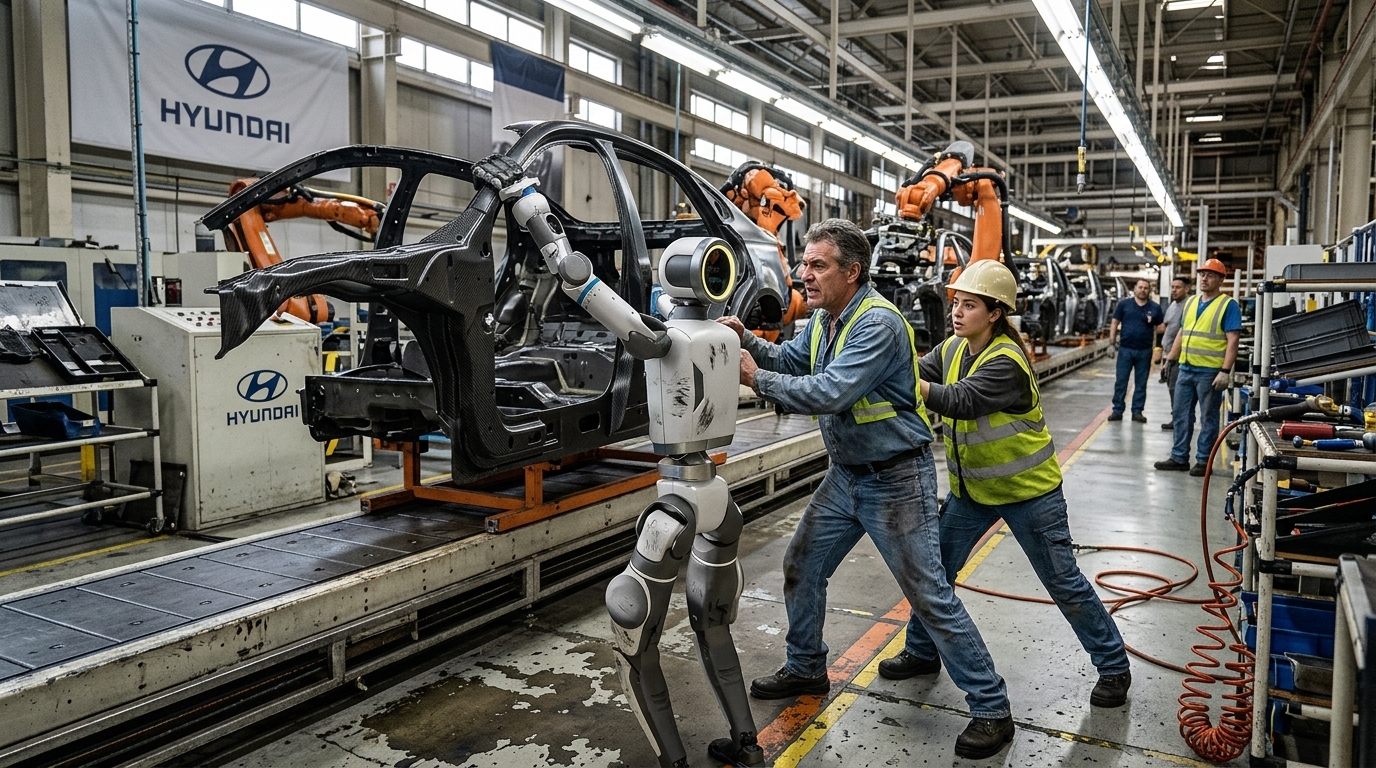
Thousands of unionized Hyundai auto workers began walking off the job after negotiations with the South Korean automaker broke down over plans to deploy humanoid robots. This represents the most significant pushback from organized labor so far against the latest wave of robotic automation.
The Industry's First Humanoid-Related Strike
The partial strike at Hyundai’s production complex in Ulsan, South Korea, is the car industry’s first factory stoppage specifically addressing humanoid robots. Workers ended their day and night shifts two hours early from July 13 through July 15. Following 15 rounds of failed negotiations, four-hour strikes are planned for July 20 to 22.
Union pushback intensified following the unveiling of the latest Atlas humanoid robot by Boston Dynamics, now a Hyundai subsidiary. Standing over 6 feet tall and capable of lifting more than 100 pounds, the Atlas is at the center of Hyundai's plan to deploy 25,000 units across its manufacturing plants, starting with US facilities in 2028.
The Economics of Robotic Labor
Each Atlas robot carries an estimated price tag of $130,000, with analysts projecting a return on investment within approximately two years. Financial experts suggest that if the cost drops to $100,000, the robot's operational cost could fall below the US federal minimum wage of $7.25 per hour, significantly undercutting traditional human salaries.
In response, the union representing 39,000 workers is demanding a shift from hourly pay to a fixed salary to protect against automation-driven reductions in work hours. They are also seeking to raise the retirement age from 60 to 65 and requesting larger bonuses.
The Georgia Test Case
Hyundai’s Metaplant America in Georgia is set to be the first to implement Atlas robots in 2028 for sorting and organizing parts. While the facility is currently non-unionized, the United Auto Workers (UAW) is actively attempting to organize its workforce. Hyundai executives maintain that human hands remain necessary for handling soft components like hoses and wires, which require a sense of touch that robots currently lack. The company has also committed to maintaining 8,100 human roles at the Georgia site by 2031 as part of an economic deal with the state.