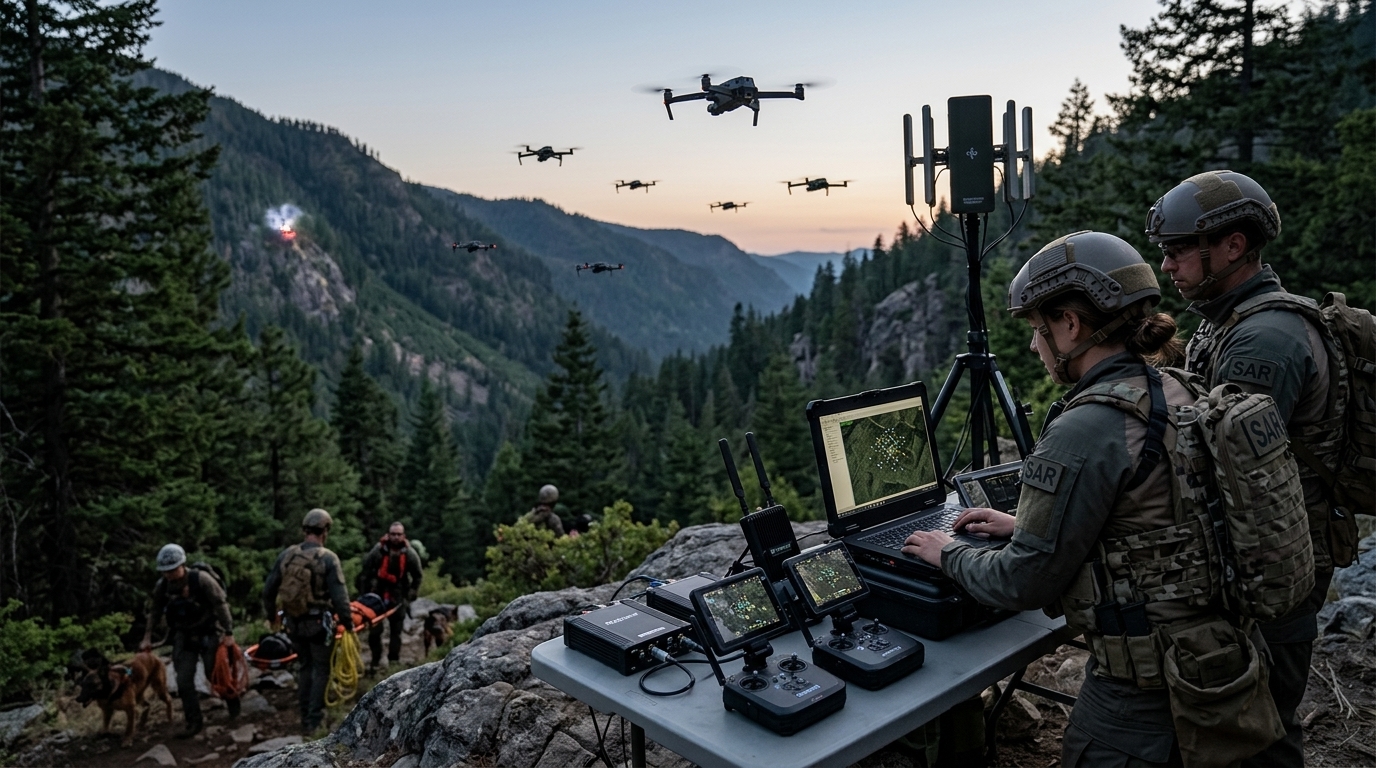
A new research paper introduces a novel three-level hierarchical learning architecture designed for autonomous UAV swarms in search and rescue (SAR) operations. Moving away from conventional single-paradigm approaches, this architecture integrates three distinct learning mechanisms that mirror the biological hierarchy of reflexes, skills, and reasoning.
The Three-Level Hierarchy
The proposed system organizes learning into three qualitative levels:
- Reflexes: Employs Hebbian neuroplasticity for individual agent adaptation.
- Skills: Utilizes multi-agent reinforcement learning (MARL) combined with graph neural networks (GNN) and behavior trees for tactical coordination.
- Reasoning: Implements model-agnostic meta-learning (MAML) with BDI (Belief-Desire-Intention) reasoning and a digital twin for high-level strategic decision-making.
Formal Guarantees and Swarm Meta-Cognition
The architecture is formalized through twenty-two architectural contracts across six components, providing six classes of formal guarantees: safety, budget correctness, optimality, liveness, starvation freedom, and inter-level consistency. A key contribution is the concept of "Swarm Meta-Cognition," a compositional property that enables the swarm to monitor its own cognitive state and switch between different strategies autonomously.
For dynamic environments involving active learning, the framework includes additional contracts to ensure cognitive resilience and graceful degradation. Theoretical analysis suggests this hybrid neuro-symbolic system successfully addresses five fundamental limitations found in existing hierarchical reinforcement learning approaches.