In the high-stakes environment of emergency departments, where time is measured in heartbeats and a single oversight can be fatal, human intuition has long been considered the gold standard. However, a provocative new study from Beth Israel Deaconess Medical Center (BIDMC), the primary teaching hospital of Harvard Medical School, is challenging this long-held belief. The findings, published in the prestigious journal JAMA Network Open, reveal that OpenAI’s GPT-4 large language model didn't just compete with experienced physicians—it significantly outperformed them in the critical task of differential diagnosis.
The Methodology: A Head-to-Head Trial
The research was not a simple trivia test; it was a rigorous simulation of complex clinical reality. Researchers selected 50 challenging clinical cases that had previously been treated at BIDMC. A total of 50 physicians, ranging from junior residents to senior attending doctors, were tasked with diagnosing these cases. The participants were split into two groups: one had access to standard clinical resources (like UpToDate or Google), while the other was provided with GPT-4 as a diagnostic aid.
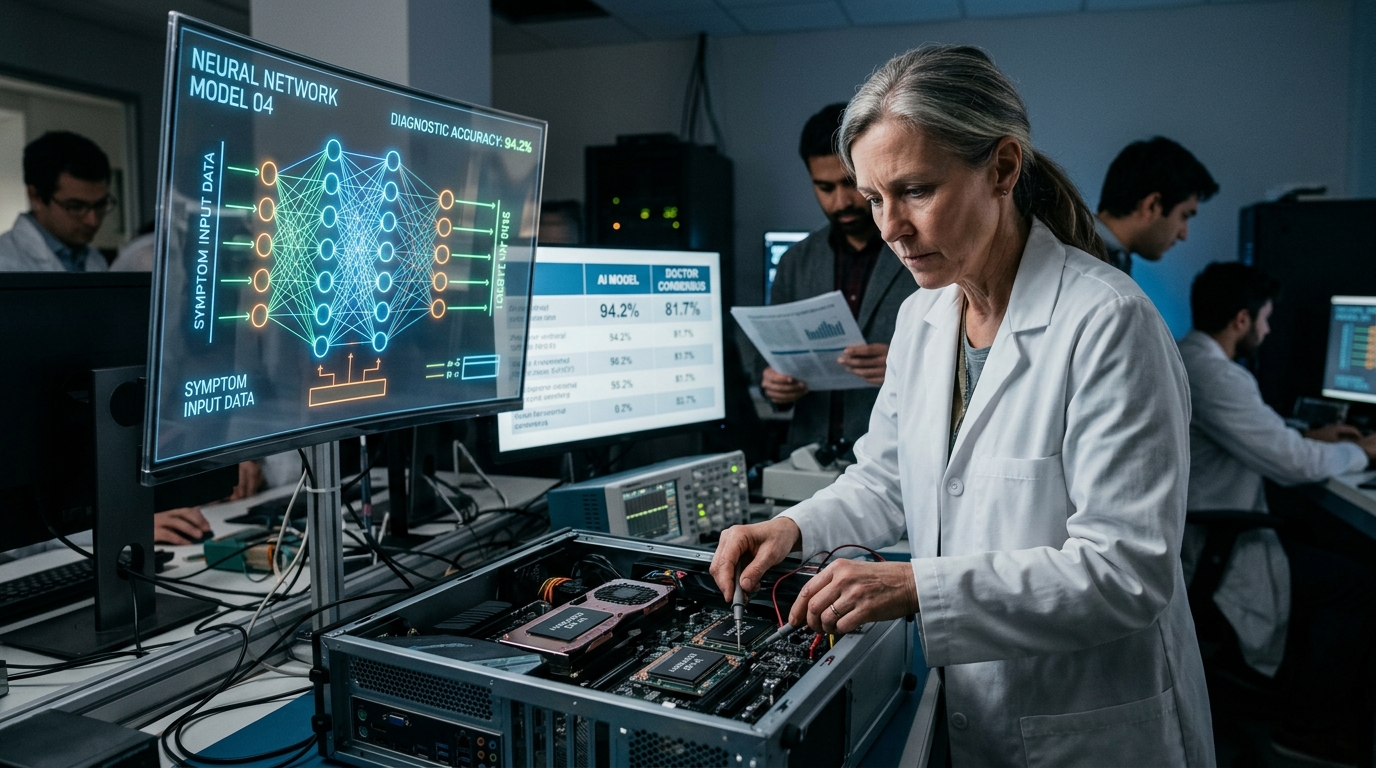
The results were startling. GPT-4, acting autonomously, achieved a mean diagnostic accuracy score of 88%. In contrast, physicians using the AI assistant scored 76%, while the group of physicians without AI assistance reached 74%. The statistical gap between the autonomous machine and the human experts was profound, highlighting a new era in medical data processing and pattern recognition.
The Collaboration Paradox: Why Doctors Didn't Improve
Perhaps the most significant finding of the study was not the AI's brilliance, but the human failure to leverage it. Despite having GPT-4 at their fingertips, the physicians' performance did not show a statistically significant improvement over their colleagues who worked without it. This "collaboration paradox" suggests that healthcare professionals either lacked the skills to effectively prompt the model or, more likely, suffered from confirmation bias.
"Doctors tend to anchor to their initial diagnosis, even when presented with AI-generated alternatives that are demonstrably more accurate," the researchers noted.
This observation underscores a critical hurdle: the technology is ready, but the human infrastructure is not. The ability to pivot and question one's own clinical judgment in the face of an algorithmic suggestion requires a new form of professional humility and a fundamental shift in medical education. The study found that doctors often ignored the correct diagnosis provided by the AI in favor of their own incorrect conclusions.
Ethical Dilemmas and the Weight of Responsibility
The AI’s superior performance in the ER raises urgent questions about liability and the future of the medical hierarchy. If an AI suggests a correct diagnosis that a physician subsequently rejects, who is responsible for the resulting patient harm? The Harvard study demonstrates that AI is exceptionally good at connecting disparate symptoms and rare conditions that a human brain might miss due to fatigue, cognitive load, or "availability heuristic" (the tendency to think of recent or common cases first).
- AI excels at cross-referencing massive medical databases in milliseconds.
- Physicians remain superior in executing physical exams and interpreting non-verbal cues.
- The study suggests AI could serve as a vital "second opinion" to catch diagnostic errors before they reach the patient.
The Future: From Competition to Augmented Medicine
This Harvard study is not a eulogy for the medical profession; rather, it is a clarion call for evolution. The integration of AI into clinical workflows seems inevitable, particularly in high-pressure environments like the Emergency Room where cognitive shortcuts are most dangerous. The focus must now shift from building better algorithms to building better human-computer interfaces.
The physicians of tomorrow will need to be as proficient with large language models as they are with stethoscopes and scalpels. We are entering the era of "augmented medicine," where the goal is not to replace the doctor, but to enhance human capability. The success of this transition will depend on whether the medical establishment can embrace AI as a powerful, albeit soulless, consultant that can safeguard patient health through the sheer power of data processing.