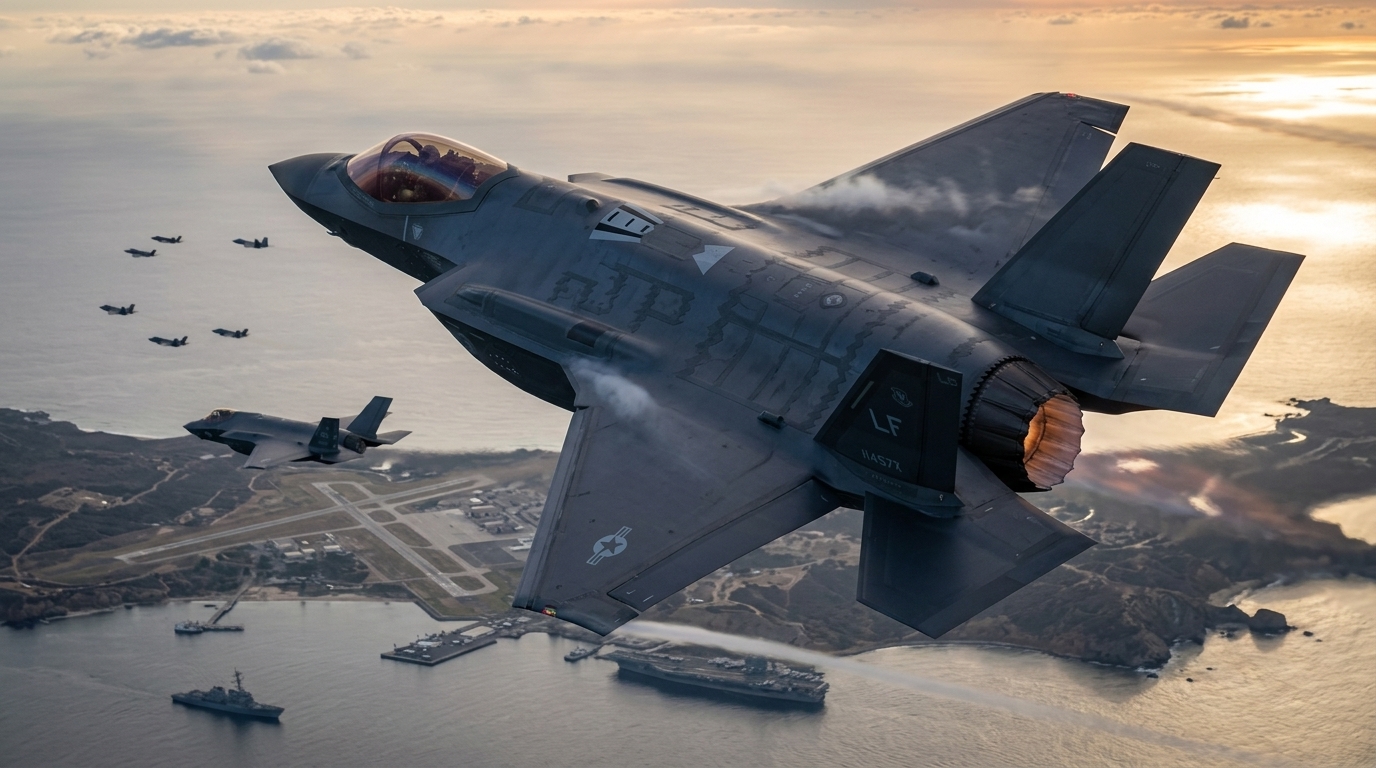
In a move that underscores escalating geopolitical tensions and an irreversible shift toward high-tech warfare, the United States Air Force and Navy have announced plans to drastically increase their F-35 Lightning II fleet. Following a record defense budget for fiscal year 2027, U.S. military branches are now requesting 85 aircraft, nearly doubling the 47 jets approved by Congress for the current year. This development is not merely a financial boon for Lockheed Martin; it is a strategic declaration regarding the future of aerial dominance in an era defined by Artificial Intelligence and systemic competition with near-peer adversaries.
The Return to Mass and the Quality Challenge
For years, the F-35 program has been under intense scrutiny due to delays, technical glitches, and significant cost overruns. Specifically, the Technology Refresh 3 (TR-3) upgrade—the foundational hardware for the more advanced Block 4 software—caused substantial delivery pauses throughout 2024 and 2025. However, the new budget request suggests that the Pentagon has regained confidence in the platform's maturity. The jump to 85 aircraft reflects a critical need to replace aging fourth-generation platforms, such as the F-15 and F-16, with fifth-generation fighters capable of surviving in high-threat environments.
The distribution of these 85 jets spans all three variants: the Air Force's F-35A, the Marine Corps' short-takeoff/vertical-landing F-35B, and the Navy's carrier-based F-35C. This fleet homogeneity allows for unprecedented interoperability but also creates a massive dependence on a single platform. Analysts suggest this pivot is partly driven by the need for "mass"—the ability to deploy enough airframes to sustain high-intensity operations in the Pacific, where vast distances and potential attrition rates demand a robust numerical presence.
Artificial Intelligence: The Flying Computer
The F-35 of 2026 is fundamentally different from the aircraft that first entered service. The integration of advanced AI algorithms for sensor fusion allows the pilot to maintain a comprehensive picture of the battlespace without being overwhelmed by raw data. The aircraft now functions as a "flying server," capable of processing petabytes of data in real-time and distributing it to ground forces, naval assets, and other airborne platforms.
- Autonomous Decision Support: New software assists in target identification and prioritization, significantly reducing the pilot's cognitive load.
- Predictive Maintenance: AI is utilized to forecast mechanical failures before they occur, thereby increasing fleet readiness and mission-capable rates.
- Collaborative Combat Aircraft (CCA): The F-35 is being positioned as a "mothership" for swarms of loyal wingman drones, which will perform high-risk reconnaissance or strike missions.
This digital superiority is key to countering Chinese Anti-Access/Area Denial (A2/AD) systems. The F-35 is no longer just required to be stealthy to radar; it must be dominant in the electromagnetic spectrum, jamming enemy communications while maintaining its own encrypted data links.
Economic Implications and Lockheed Martin's Dominance
The announcement had an immediate impact on the markets, with Lockheed Martin’s stock seeing a notable uptick. With a total program cost expected to exceed $1.7 trillion over its lifecycle, the F-35 remains the most expensive weapon system in history. Increasing annual production to 85 aircraft offers potential economies of scale, yet it also raises questions regarding the long-term sustainability of maintenance costs, which run into the billions annually.
"Investing in the F-35 isn't just about buying an airplane; it's about securing a node in the digital ecosystem of future warfare," Pentagon sources noted during the budget briefing.
However, critics in Congress warn that over-committing resources to the F-35 might drain funding from the Next Generation Air Dominance (NGAD) program—the sixth-generation fighter intended to succeed the F-35 in the 2030s. The balance between maintaining current readiness and investing in future "leap-ahead" technologies remains the most difficult gamble for U.S. leadership.
Geopolitical Deterrence and Global Alliances
The production ramp-up has profound international implications. As more F-35s roll off the production line in Fort Worth, availability for international partners—including NATO allies and Indo-Pacific partners—increases. The F-35's presence in Europe and Asia serves as a powerful cohesive force, as these nations share the same technological backbone and logistics tail. In an era where Russia continues its aggression and China rapidly modernizes its own stealth forces (such as the J-20 and J-35), Washington views the mass production of the F-35 as an essential counterweight for maintaining global stability and deterring conflict through overwhelming technical and numerical superiority.