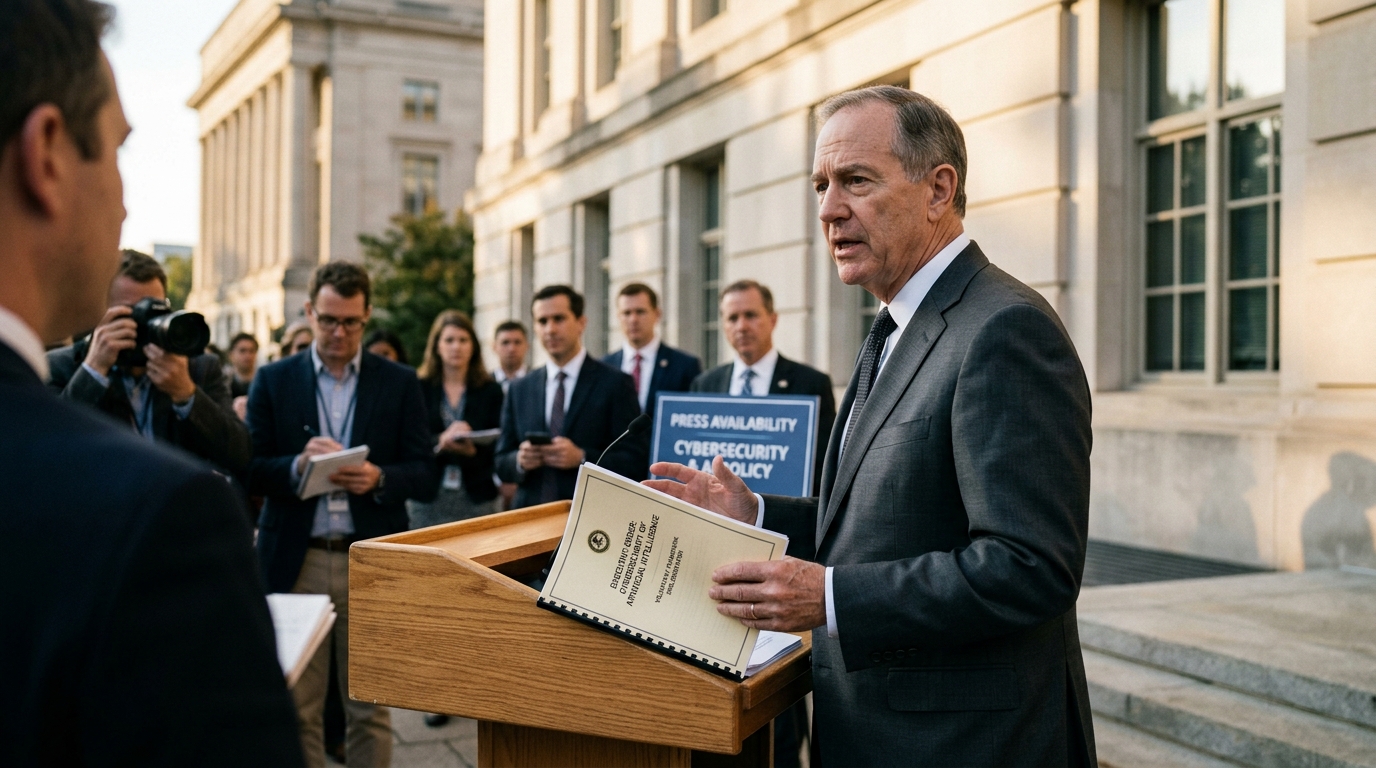
In the shifting landscape of global technological hegemony, the United States government under Donald Trump has made a move that redefines the relationship between the state and Silicon Valley. The new Executive Order on AI Cybersecurity, analyzed in depth by the law firm Ropes & Gray, is officially presented as a "voluntary framework." However, beneath the surface of optional compliance lies a mechanism that renders these guidelines essentially mandatory for any serious player in the technology market.
This approach marks a radical shift from the Biden era, where the emphasis was on "safety" and ethical safeguards. Today, the doctrine is "security." Artificial Intelligence is no longer treated as an academic achievement or a productivity tool, but as critical national infrastructure, on par with the power grid or telecommunications. Washington is sending a clear message: innovation is desirable, but vulnerability is unacceptable.
The "Voluntary" Smoke Screen
The order uses the language of incentives and best practices, a tactic traditionally preferred by the Republican wing to avoid accusations of over-regulation. As Ropes & Gray analysts point out, the "voluntary" nature of the framework is largely a legal phrasing. In reality, the order links compliance with cybersecurity standards to federal procurement contracts. Given that the U.S. government is the world's largest buyer of technology, any company wishing to maintain or bid for government contracts must align itself fully.
Furthermore, the framework creates a new "standard of care." In the event of a cyberattack or data breach, companies that failed to follow the "voluntary" guidelines will find themselves exposed to massive legal liabilities and lawsuits. Courts and insurance companies are expected to use this framework as the benchmark for what constitutes "reasonable security" in the AI sector. Thus, the choice of non-compliance becomes a form of economic and legal suicide.
National Security as the Catalyst
The driving force behind this policy is the intensifying competition with China. The Trump administration believes that protecting the "AI stack"—from semiconductors to algorithms and training data—is a matter of national survival. The order places particular emphasis on supply chain security, requiring developers to know the origin of every line of code and every chip used in their systems.
- Stricter controls on open-source models that could be utilized by adversarial states.
- Mandatory reporting of serious security incidents within 72 hours.
- The creation of "red-teaming" protocols under the supervision of government agencies to test model resilience.
This focus on security against external threats sidelines concerns about AI social bias, which dominated public discourse in previous years. For today's Washington, whether an AI is "fair" takes a back seat to whether it is "impenetrable" by foreign agents.
Economic Implications and the Market
For big tech companies, the cost of compliance is manageable and may even serve as a barrier to entry for smaller competitors. Big Tech already possesses the resources to implement complex security protocols. Conversely, startups may find themselves in a difficult position, trying to balance rapid growth with the stringent requirements of the order.
"This is not just a technical directive, but a realignment of the AI market around the concepts of trust and state certification," the Ropes & Gray report states.
In conclusion, the Trump order is a clever use of the state's "soft power." Without passing new restrictive laws through Congress, the administration is imposing a strict regulatory framework through its purchasing power and legal threat. The "Wild West" era of AI is ending, not with a law, but with a contract.