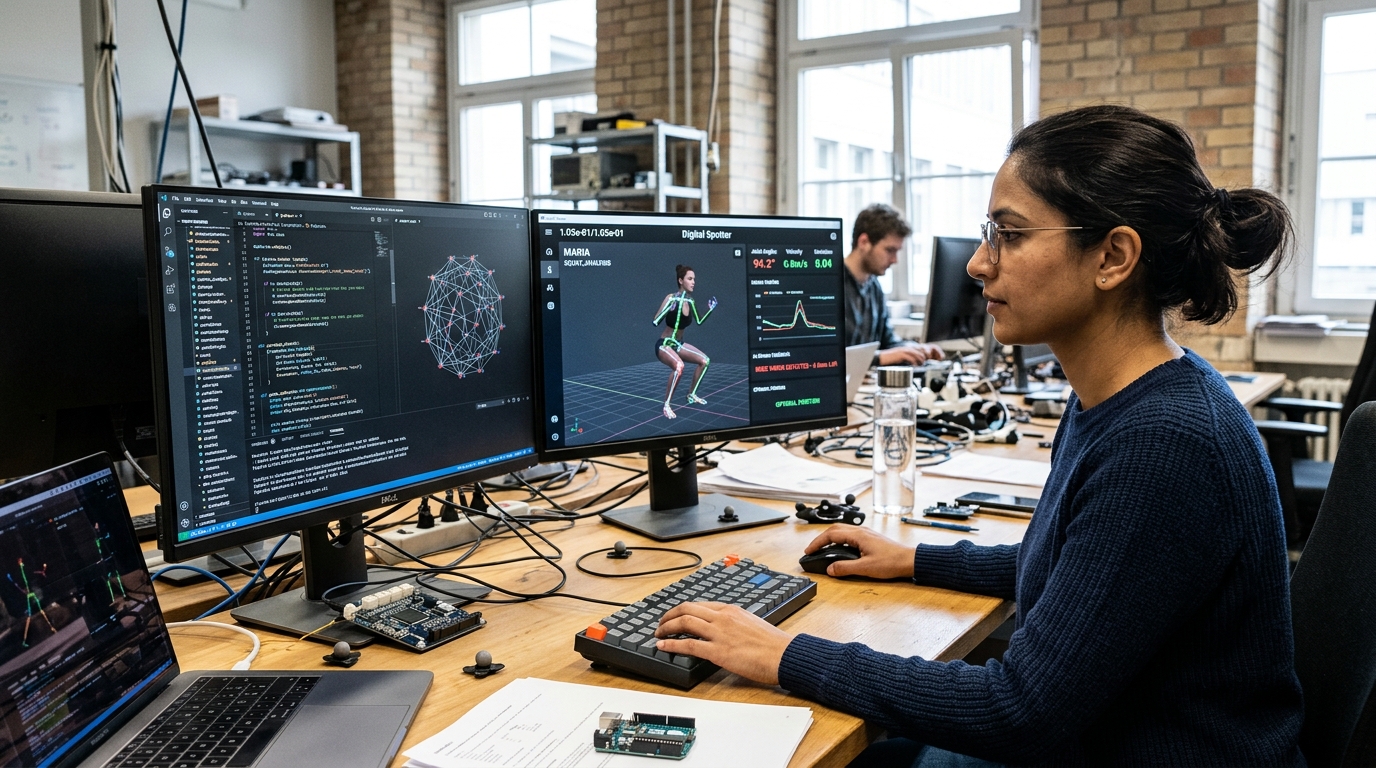
The image of a fitness enthusiast trying to perfect their squat or deadlift in front of a mirror is a classic one. However, in 2026, that mirror is no longer a simple reflective surface; it is a sophisticated computing system. The integration of Artificial Intelligence (AI) into movement analysis is not merely a technological luxury; it is evolving into a critical tool for injury prevention and performance optimization, democratizing access to high-level coaching guidance.
The Science Behind the Digital Gaze
The technology that allows AI to function as a coach is primarily based on "pose estimation." Using RGB cameras—even those on standard smartphones—and advanced machine learning algorithms, the system identifies specific key points on the human body, such as the knees, hips, and shoulder joints. Within milliseconds, the AI compares the angles and trajectory of the user's movement against an ideal model trained on millions of data points from professional athletes.
According to recent research highlighted via EurekAlert!, the accuracy of these systems has reached levels that rival human observation. While an experienced trainer can spot a faulty movement, AI can quantify that error with degree-level precision, providing immediate visual or auditory feedback. This allows the trainee to correct their posture during the exercise itself, dramatically reducing the likelihood of acute or chronic injuries.
Democratizing Coaching and Accessibility
One of the most significant benefits of this evolution is the reduction of costs. Personal training has historically been a service for the few, due to the high hourly rates of specialists. With the advent of AI coaching assistants, the possibility of proper technical guidance becomes accessible to anyone with a camera and an app. This is particularly crucial for individuals just starting their fitness journey, who are often discouraged by the complexity of movements or the fear of getting hurt.
- Real-time Correction: AI doesn't wait for the end of a set to give advice; it intervenes the moment the technique falters.
- Personalized Programs: By analyzing the mobility and weaknesses of each individual, the system suggests corrective exercises.
- Data Consistency: Progress is recorded with mathematical accuracy, allowing for long-term tracking of technical improvement.
"Artificial Intelligence is not replacing the trainer, but giving them the eyes of a superhuman to see details that human vision simply cannot capture," notes one prominent researcher in the field.
Challenges and the Privacy Question
Despite the excitement, the use of AI in exercise is not without its hurdles. The most significant concern involves data privacy. The continuous filming of the body in sensitive poses and the transmission of this data to the cloud for processing raises serious questions about who has access to this information and how it is used. Tech companies must guarantee that processing occurs locally on the device (edge computing) or that data is fully anonymized.
Furthermore, there is the risk of "over-reliance." Fitness is a process that requires the development of proprioception—the individual's ability to perceive their body's position in space without external aid. If a trainee relies exclusively on an AI voice to tell them when to straighten their back, they may fail to develop that internal mind-body connection essential for true athletic literacy.
Conclusion: Toward a Hybrid Approach
The future of fitness appears to be hybrid. Artificial Intelligence will take over the tedious task of continuous technique monitoring and data logging, allowing human coaches to focus on psychological support, strategy, and motivation. For the average user, AI will act as a vigilant guardian angel, ensuring that every repetition counts and, above all, that every movement is safe. Technology is not moving us away from our physical nature; instead, it is providing us with the tools to understand and protect it better.