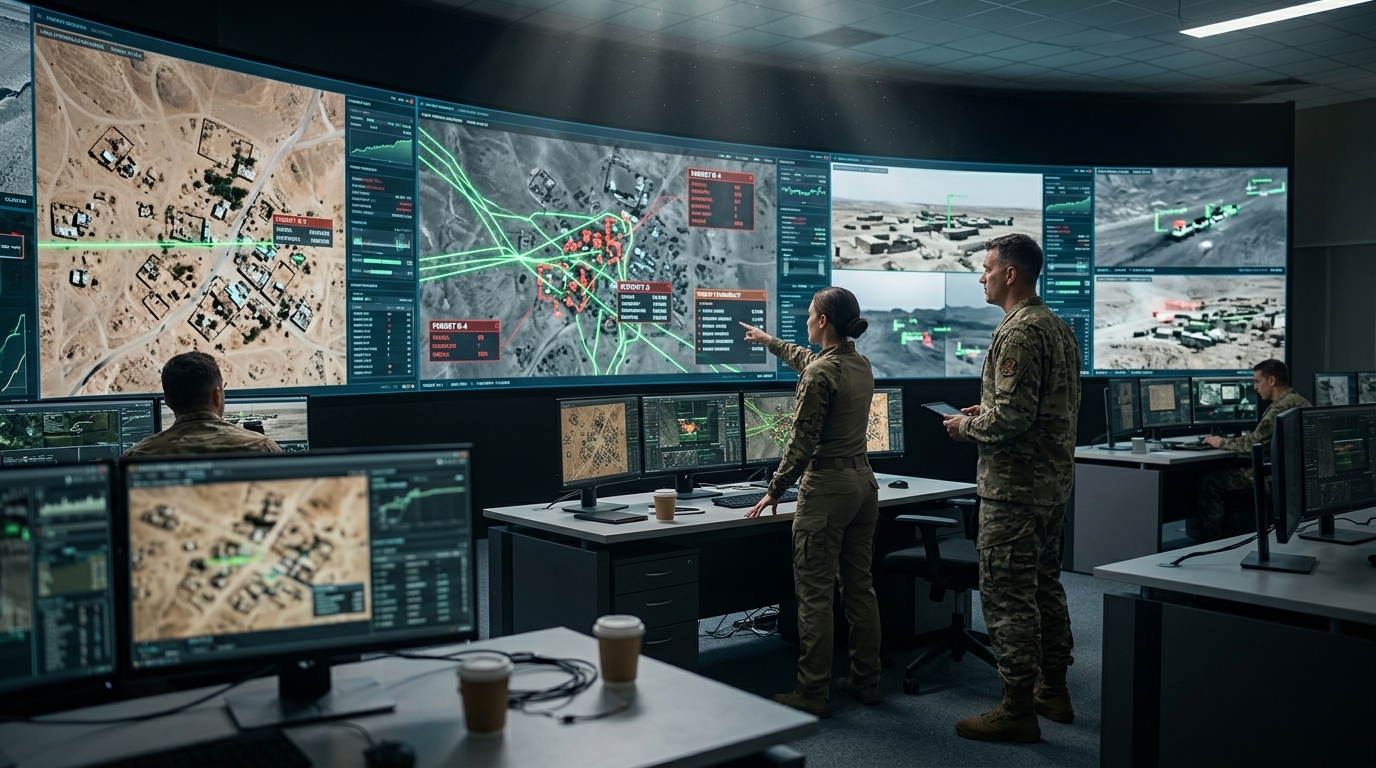
The dawn of February 2, 2024, marked a new epoch in the history of warfare. As US aircraft launched strikes against Iranian-backed forces in Iraq and Syria, something fundamental had shifted behind the scenes. In just 24 hours, the US military struck more than 1,000 targets. To grasp the scale, this is nearly double the intensity of the famous "Shock and Awe" campaign in Iraq over two decades ago. This unprecedented acceleration wasn't due to more planes or bombs, but to an algorithm: Project Maven.
The Genesis of a Controversial Alliance
Project Maven began in 2017 as a Pentagon effort to solve a very practical problem: the overwhelming volume of drone video footage that no human could fully monitor. The initial partnership with Google sparked a firestorm of controversy. Thousands of employees signed protest letters, arguing that their technology should not be used for the "business of war." Google eventually withdrew, but the void was quickly filled by companies like Palantir and Amazon, signaling a new, tighter relationship between Silicon Valley and the Department of Defense.
Maven is not just a piece of software; it is an ecosystem. It utilizes computer vision technology to automatically identify objects in satellite imagery and drone footage. What once required hours of analysis by dozens of intelligence officers is now accomplished in seconds. The system can distinguish a truck from a tank, or an armed fighter from a civilian, feeding the "kill chain" with real-time data.
Ukraine: The Living Laboratory
If Maven was born in laboratories, it reached maturity on the battlefields of Ukraine. The conflict with Russia provided the ideal "living laboratory" to test these systems under high-intensity conditions. In Ukraine, the need for speed is a matter of survival. Ukrainian commanders, utilizing Western systems based on Maven, managed to combine data from commercial satellites, drones, and ground intelligence into a single digital picture of the battlefield.
"Artificial intelligence does not replace the soldier, but it allows them to see through the fog of war with a clarity that was unthinkable ten years ago," Pentagon sources state.
However, this "clarity" brings new risks. The speed at which Maven Smart—the latest evolution of the system—suggests targets creates immense pressure on human operators. When the system presents 100 potential targets per minute, how meaningful can human oversight truly be? This is the central question haunting tech ethicists.
The Ethics of Automated Targeting
The Pentagon insists there is always a "human-in-the-loop." Every decision to strike is ultimately made by an officer. However, critics warn of "automation bias": the tendency of humans to blindly trust a machine's suggestions, especially under extreme stress.
- Accountability: Who is responsible if an algorithm mistakes a school bus for a military vehicle?
- Transparency: Maven's algorithms are "black boxes" to most users, making it difficult to audit errors.
- Escalation: The ability to conduct war at such speed might make the resort to violence an "easy" fix for political leaders.
The case of Maven shows that the military hasn't just learned to "love" AI; it has become dependent on it. The era where war was conducted at human speed is gone forever. Now, a superpower's strength is measured not just in nuclear warheads, but in flops and data quality.
The Future: From Recognition to Prediction
The next step for Project Maven and similar programs is predictive analysis. The military no longer just wants to know where the enemy is now, but where they will be in two hours. By utilizing massive databases of historical movements, AI is beginning to model human behavior on the battlefield. This evolution transforms war from a series of tactical engagements into a giant data optimization problem. The challenge for humanity remains: how will we ensure that, within this digital storm, human judgment and moral values are not dismissed as mere "noise" in the system.