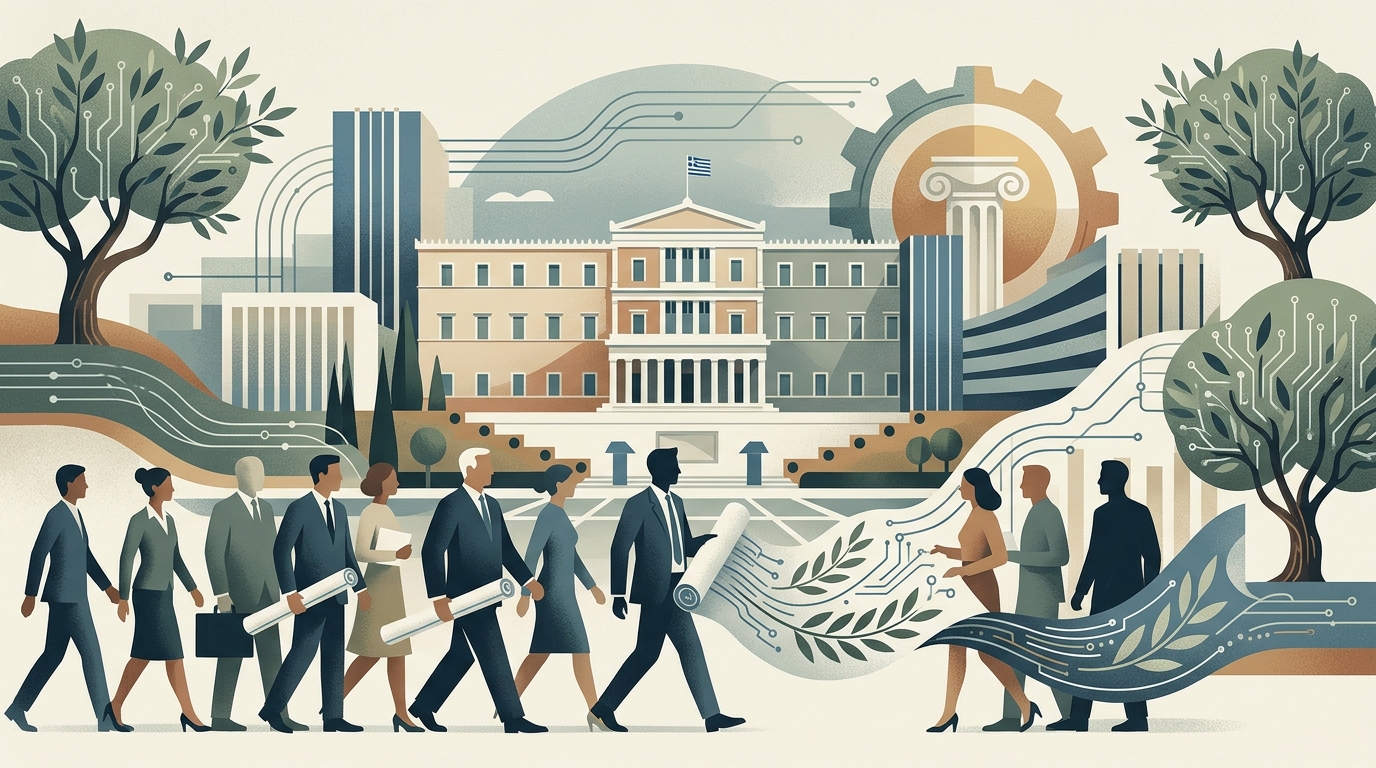
Greece stands at the threshold of a historic transformation, finally leaving behind the long shadows of the past decade's financial crisis. In a recent address, Kyriakos Pierrakakis outlined the framework for what he terms the "decade of investment, technology, and production." This is not merely a political promise; it is a strategic roadmap built on the convergence of a digital state, educational reform, and the attraction of foreign capital intended to overhaul the nation's productive model.
Digital Transformation as the Bedrock of Growth
The success of the digital state in recent years was never the final destination—it was the necessary foundation. According to Pierrakakis, the reduction of bureaucracy via platforms like gov.gr has served as the best "ambassador" for attracting investment. When a global giant decides to invest in a country, the first things they evaluate are procedural speed and state transparency. Greece has successfully transitioned from a cautionary tale of red tape into an environment friendly to entrepreneurship, where technology acts as an accelerator for economic activity.
The next phase involves the full integration of Artificial Intelligence into public administration. This will enable the automation of complex audits, the reduction of tax evasion, and the provision of hyper-personalized services to citizens. The "decade of technology" implies that Greece will no longer be a mere consumer of digital products but a producer of solutions that can be exported globally.
Education: Bridging the Gap with the Labor Market
A central pillar of the Pierrakakis strategy is the radical overhaul of education to align it with the demands of the modern economy. The establishment of non-state universities and the strengthening of public institutions through international partnerships are strategic moves to retain human capital within the country. The "brain drain" phenomenon is gradually being reversed into "brain gain," as high-specialization jobs are created in sectors such as IT, biotechnology, and green energy.
- Enhancing digital skills across all levels of education.
- Creating innovation hubs within university campuses.
- Linking academic research directly with industrial production and enterprises.
The Minister emphasizes that knowledge is the new currency of the global economy. If Greece succeeds in training the next generation in the skills required by the market in 2030, growth will be structural rather than circumstantial. The focus is now on "future-proof skills," with critical thinking and technological adaptability at the core.
Investment and Productive Reconstruction
The challenge of production is perhaps the most daunting. For decades, the Greek economy relied excessively on consumption and tourism. The new strategy seeks diversification. Attracting data centers from giants like Microsoft, Google, and Amazon is just the beginning. These investments act as magnets for an entire ecosystem of smaller companies and startups.
"We don't just want capital; we want added value. We want Greece to become the data hub of Southeast Europe and a center of technological excellence," Pierrakakis notes.
Industry 4.0, agri-food utilizing cutting-edge technology, and renewable energy sources are the sectors where Greece holds a comparative advantage. The coming decade will be judged by the country's ability to absorb Recovery Fund resources and direct them toward projects that multiply GDP. Political stability and the regaining of investment-grade status are the essential guarantees for this transition.
In conclusion, the "Pierrakakis decade" is not an abstract slogan but a concerted effort for a total rebranding of Greece. From a country in crisis to a nation leading digital transformation in Europe. Challenges remain—from geopolitical shifts to demographic decline—but the direction has been set with clarity and determination.