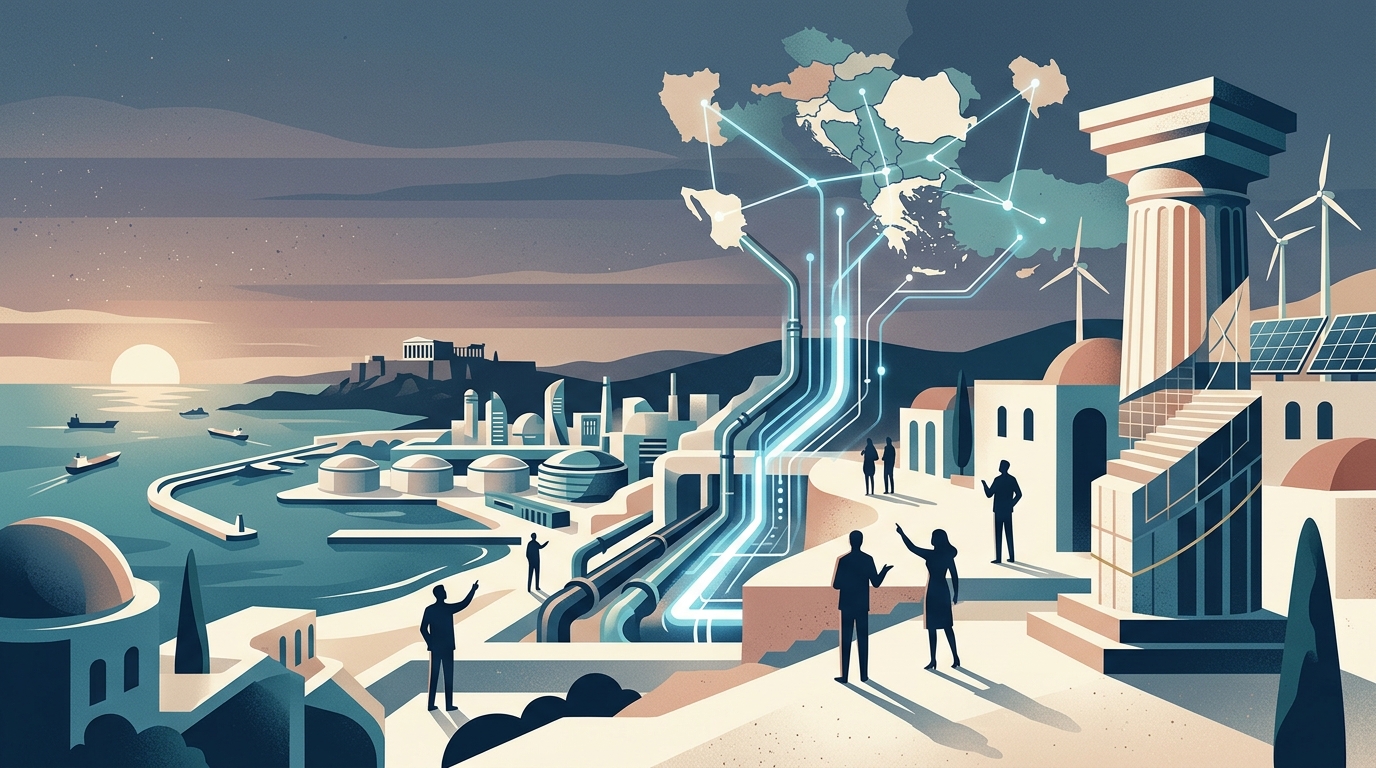
The geopolitical chessboard of Southeast Europe is undergoing one of its most radical realignments in decades, with energy at the very heart of this transformation. In this context, recent statements by Alexandros Exarchou, Chairman and CEO of the Aktor Group (formerly Intrakat), highlight a critical reality: Greece is no longer a passive observer of developments, but a strategic player capable of capitalizing on the energy crisis for the benefit of national and regional stability.
The Vertical Corridor: More Than Just Pipelines
At the center of Exarchou’s strategic analysis is the "Vertical Corridor." This is not merely a technical project for interconnecting pipelines; it is a geopolitical artery connecting Greece with Bulgaria, Romania, Moldova, and Ukraine. Its significance is twofold: first, it allows natural gas to flow from South to North—reversing the historical dependence on Russian flows—and second, it establishes Greece as the primary gateway for Liquefied Natural Gas (LNG) into the European hinterland.
According to Mr. Exarchou, the Vertical Corridor creates the conditions for a new era of geopolitical stability. When the energy needs of neighboring countries are met through Greek infrastructure, Greece acquires a "regulator" role that transcends narrow economic metrics. The energy security of Central Europe now passes through Alexandroupolis and Revithoussa, making the country an indispensable partner for the EU and the United States.
The Transformation of Construction into an Energy Pillar
Exarchou’s stance also reflects a broader shift in the DNA of major Greek conglomerates. Aktor Group, under his leadership, has evolved from a traditional construction firm into a diversified group with a strong footprint in Renewable Energy Sources (RES) and network infrastructure. This shift is not accidental. Implementing the "green" transformation requires massive investments in energy transmission and storage networks—areas where the expertise of construction companies is irreplaceable.
Mr. Exarchou emphasized that Greece has the advantage of being able to implement these projects faster and more efficiently than other countries in the region, thanks to the maturity of its technical sector and strategic alignment with the European goals of REPowerEU. Investments in wind and solar parks, combined with electrical interconnections, are turning the country into a net exporter of energy, strengthening the current account balance.
Challenges and the Need for Speed
Despite the optimism, Mr. Exarchou did not fail to point out the challenges. Bureaucracy, licensing delays, and the need to upgrade electrical grids remain significant hurdles. For Greece to fully exploit the crisis, national consensus and speed in absorbing Recovery and Resilience Facility (RRF) funds are required. The energy transition is not an endless marathon, but a race where the first to install the necessary infrastructure will set the market rules for decades to come.
Furthermore, Greece's emergence as an energy hub requires maintaining strong diplomatic relations with all regional players. Mr. Exarchou argued that economic diplomacy, through major infrastructure projects, is the most effective tool for preventing conflict and promoting prosperity in the Balkans.
Conclusion: A Historical Opportunity
Alexandros Exarchou’s analysis leads to a clear conclusion: the energy crisis, while economically painful for consumers, has acted as a catalyst for highlighting Greece's comparative advantages. The country no longer offers just sun and sea, but security, networks, and stability. The success of this endeavor will be judged by the ability of the private sector and the state to cooperate in completing landmark projects like the Vertical Corridor, transforming Greece into the undisputed energy lung of the region.