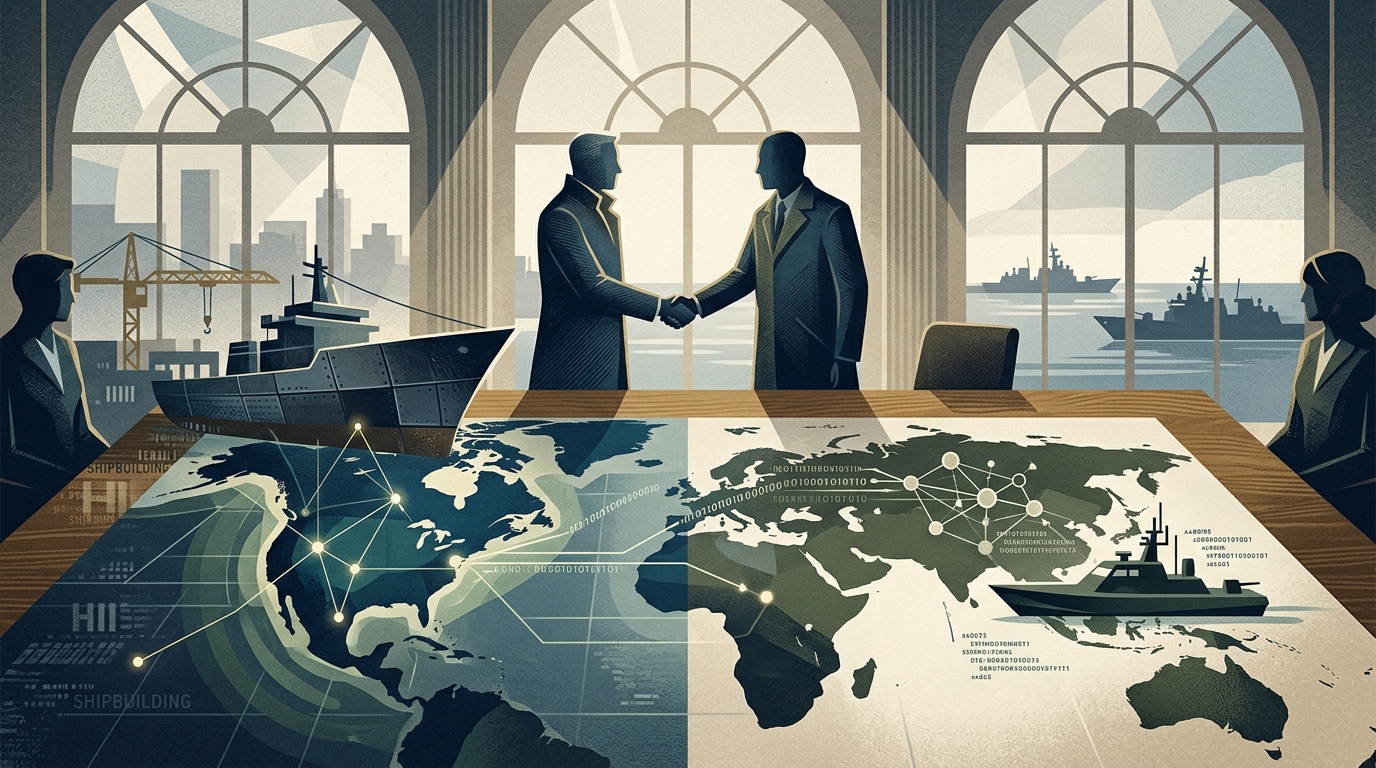
The era when naval power was measured solely by ship displacement and gun caliber is fading. Today, dominance at sea is decided by billions of lines of code and the speed of real-time data processing. The recent announcement of a partnership between Huntington Ingalls Industries (HII), the United States' largest military shipbuilder, and Applied Intuition, a Silicon Valley software pioneer, marks a historic turning point for the U.S. Navy and the global geopolitical balance.
The Convergence of Tradition and Innovation
HII, responsible for building the Gerald R. Ford-class nuclear-powered aircraft carriers and Virginia-class submarines, represents the heavy industrial backbone of American defense. However, traditional shipbuilding is no longer sufficient to counter modern threats. Applied Intuition, on the other hand, brings its expertise from the world of autonomous vehicles to the defense sector, offering tools for simulation, validation, and artificial intelligence (AI) development.
This partnership is not just about adding a few "smart" features to existing vessels. It is a radical overhaul of naval architecture. The goal is to create "software-defined ships," where AI manages everything from autonomous navigation and collision avoidance in compliance with international regulations (COLREGs) to sensor fusion from hundreds of sources to detect enemy submarines or drones.
The Geopolitical Chessboard and the Race with China
This move does not happen in a vacuum. The Pentagon is in a race with China, which now possesses the world's largest navy by ship count. The U.S. strategy, known as "Replicator," aims to deploy thousands of cheap, autonomous, and interconnected systems to offset China's numerical advantage. The HII-Applied Intuition partnership is key to realizing what the Navy calls the "Ghost Fleet"—ships that can operate for weeks without a human crew in high-threat zones like the South China Sea.
Utilizing AI allows the Navy to implement the strategy of "Distributed Maritime Operations" (DMO). Instead of a few high-value targets, the fleet transforms into a network of smaller, autonomous units that communicate instantly, making it extremely difficult for an adversary to target them effectively. Applied Intuition provides the digital environment where these systems can be tested across millions of virtual scenarios before hitting the ocean, drastically reducing development timelines.
Challenges, Ethics, and the Future of Warfare
Despite the technological promises, integrating AI into warships raises serious questions. The most critical is the reliability of decision-making under the "fog of war." What happens when an algorithm misinterprets a merchant vessel's movements as a threat? Applied Intuition argues that its simulation tools ensure safety, but the complexity of the maritime environment remains a daunting challenge.
Furthermore, there is the issue of cybersecurity. A software-defined ship is inherently vulnerable to hacking. HII and Applied Intuition must prove that their algorithms are immune to digital interference. As we move toward 2030, this alliance demonstrates that control of the oceans will belong to whoever possesses the best algorithms, turning shipbuilders into tech firms and naval officers into AI managers.
"The integration of advanced autonomy into our naval platforms is not just an upgrade; it is a fundamental shift in how we project power and protect global trade routes in the 21st century."
The implications of this deal extend beyond the US borders. Allied nations in the Indo-Pacific and NATO are watching closely, as the software developed here will likely become the standard for Western naval operations. The fusion of Silicon Valley's agility with the military-industrial complex's scale is the new blueprint for national security.