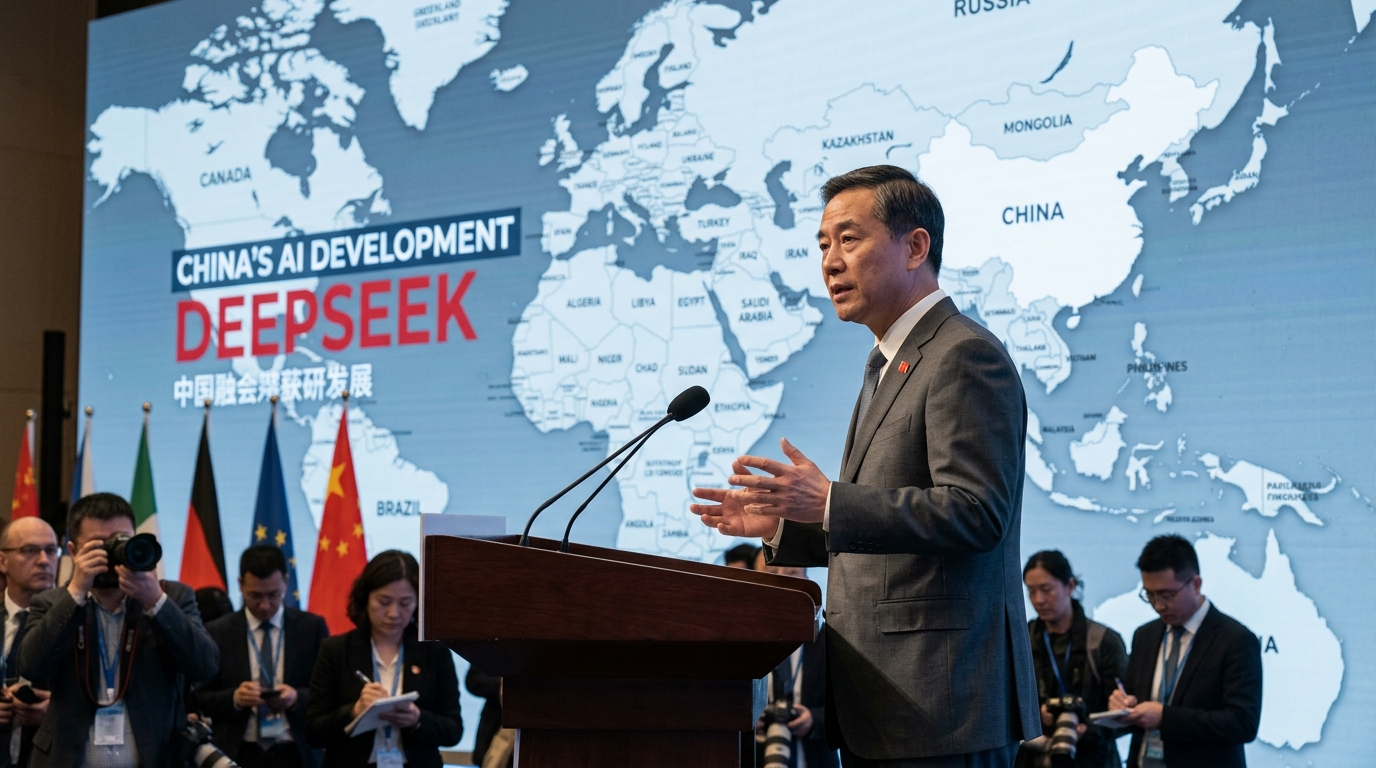
The global AI chessboard experienced a significant tremor recently with the official unveiling of DeepSeek V4. The new model from the Hangzhou-based research lab is not merely another software iteration; it is a declaration of technological sovereignty and a testament to the fact that the 'decoupling' strategy pursued by the United States may be yielding the exact opposite results of those intended. The revelation that DeepSeek V4 was trained entirely on Huawei’s infrastructure underscores a critical turning point: China no longer depends on Nvidia to remain at the forefront of Artificial Intelligence.
Technical Prowess and the MoE Architecture
DeepSeek V4 is built upon the Mixture-of-Experts (MoE) architecture, an approach that allows the model to utilize only a fraction of its parameters for any given task. This translates into staggering computational efficiency and lower operational costs compared to the monolithic models favored by OpenAI or Google. Initial benchmarks suggest that V4 outperforms GPT-4o in mathematical reasoning and coding—areas where the Chinese AI school of thought has traditionally excelled.
However, the real story lies 'under the hood.' Utilizing Huawei’s Ascend chips to train a model of this magnitude shatters the myth that a lack of access to Nvidia’s H100 or Blackwell GPUs would lead Chinese AI into a stalemate. Huawei, under the intense pressure of international sanctions, has managed to build a software ecosystem (CANN) that rivals Nvidia’s CUDA, allowing Chinese researchers to optimize their code directly on domestic hardware.
Geopolitical Implications: The Failure of Sanctions?
The alliance between DeepSeek and Huawei represents the ultimate example of Chinese 'technological self-reliance.' While Washington continuously tightens export controls on semiconductors, Beijing responds with vertical integration. The success of DeepSeek V4 sends a clear message: innovation cannot be confined by geographical borders or trade embargoes. In fact, these restrictions acted as a catalyst, forcing Chinese firms to invest billions into domestic production and chip design.
- Decoupling from the Western supply chain bolsters China's national security.
- DeepSeek V4 is offered as an 'open weights' model, gaining traction across the Global South.
- Huawei cements its position as the only serious competitor to Nvidia in the AI infrastructure space.
This development forces the EU and the US to rethink their strategies. If China can produce superior AI using 'inferior' hardware (according to Western analyses), then Western dominance is no longer based on hardware superiority, but perhaps only on data access and ethical framing.
The Model of the Future and Market Disruption
DeepSeek’s strategy of releasing its models with licenses that allow broad usage is disrupting the market. While OpenAI retreats behind subscription walls and proprietary APIs, DeepSeek V4 is becoming the tool of choice for developers worldwide seeking high performance without the 'vendor lock-in' of Silicon Valley. Huawei’s backing provides the necessary scale: cloud infrastructures capable of hosting millions of concurrent users, making Chinese AI accessible from Africa to Latin America.
"DeepSeek V4 is not just an algorithm; it is proof that the multipolar tech world is already here," state market analysts in Beijing.
In conclusion, the arrival of DeepSeek V4 signals the end of American unipolarity in AI. With Huawei providing the 'brawn' and DeepSeek providing the 'brain,' China has demonstrated it can win the tech war by playing by its own rules. The challenge for the West is no longer how to stop China, but how to keep up with its breakneck pace of innovation.