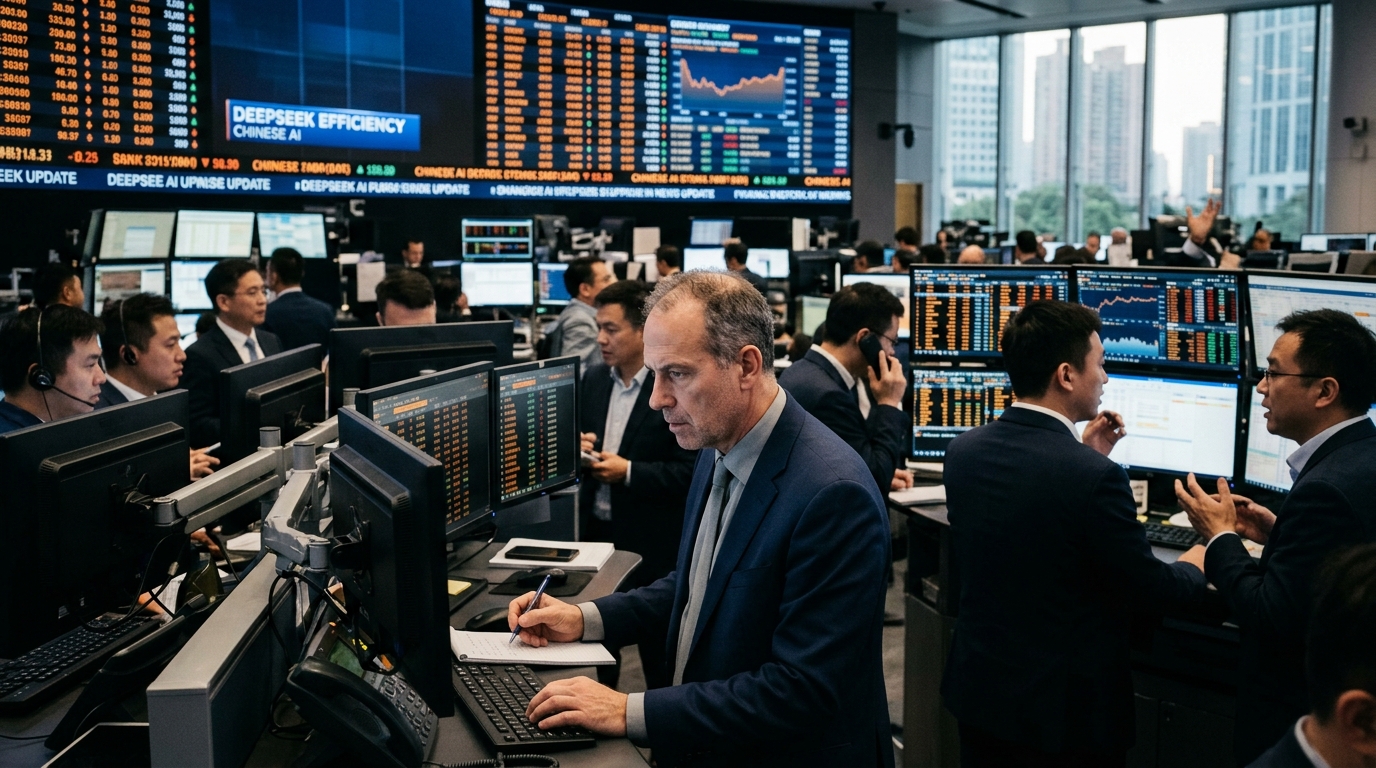
In the global AI chessboard, where power is measured in billions of parameters and costs in millions of dollars, China's DeepSeek has triggered an earthquake felt from Silicon Valley to Brussels. The recent announcement of its new models, led by DeepSeek-V3 and the disruptive R1, is not merely a technical upgrade. It is a declaration of economic warfare. By offering performance that rivals OpenAI’s GPT-4o and Anthropic’s Claude 3.5, but at a fraction of the inference cost, DeepSeek is proving that efficiency can be just as vital as raw computational power.
The Architecture of Economy: How They Did It
The question haunting the market is how a company with significantly fewer resources than Microsoft or Google managed to offer such low prices on its APIs. The answer lies in architectural innovation. DeepSeek utilized Multi-head Latent Attention (MLA), a technique that drastically reduces memory requirements during inference. Unlike traditional models that require massive amounts of VRAM to maintain context, MLA allows the model to "remember" more while consuming less.
Furthermore, the use of DeepSeekMoE (Mixture-of-Experts) has been refined to the point where only a small percentage of total parameters are activated for each request. While the model boasts hundreds of billions of parameters, the "active" computational effort is comparable to much smaller models. This translates directly into lower energy consumption and, consequently, pricing that is often 10 to 20 times cheaper than its American counterparts.
Geopolitics and the Response to GPU Restrictions
DeepSeek’s rise takes on even greater significance when considering the geopolitical context. With the US imposing strict restrictions on the export of advanced NVIDIA chips (such as the H100 and B200) to China, Chinese researchers were forced to become more resourceful. The need for optimization was not a choice, but a necessity for survival. DeepSeek has demonstrated that a lack of access to infinite hardware can lead to algorithmic innovations that eventually outperform the "wasteful" methods often seen in the West.
"DeepSeek didn't just build a better model; they built a model that makes AI economically viable for the mass market," industry analysts state.
This development puts OpenAI in a difficult position. While Sam Altman’s company focuses on increasingly complex reasoning models, DeepSeek offers similar reasoning capabilities (via R1) at a price point that allows startups and developers to experiment without burning through their capital. DeepSeek’s "open weights" strategy for many of its models further bolsters adoption across the global community.
Market Impact and the Road Ahead
Reducing inference costs is the "Holy Grail" for AI commercialization. If the cost per million tokens continues to drop at this rate, we will witness an explosion of new applications that were previously deemed economically unfeasible. From automated customer service with deep understanding to the analysis of thousand-page legal documents in seconds, DeepSeek is opening the door.
However, challenges remain. Reliance on Chinese models raises questions about data security and censorship, especially for Western enterprises. Nevertheless, DeepSeek’s technological lead in efficiency is undeniable and is forcing Silicon Valley players to rethink their strategies. The "price war" has only just begun, and the winners will be the end-users and developers who gain access to top-tier intelligence at a minimal cost.
- Drastic API price reductions, up to 90% cheaper than competitors.
- Innovative MLA architecture optimizing memory usage.
- Proof that China can lead in AI despite hardware restrictions.
- Pressure on the profit margins of American Big Tech firms.