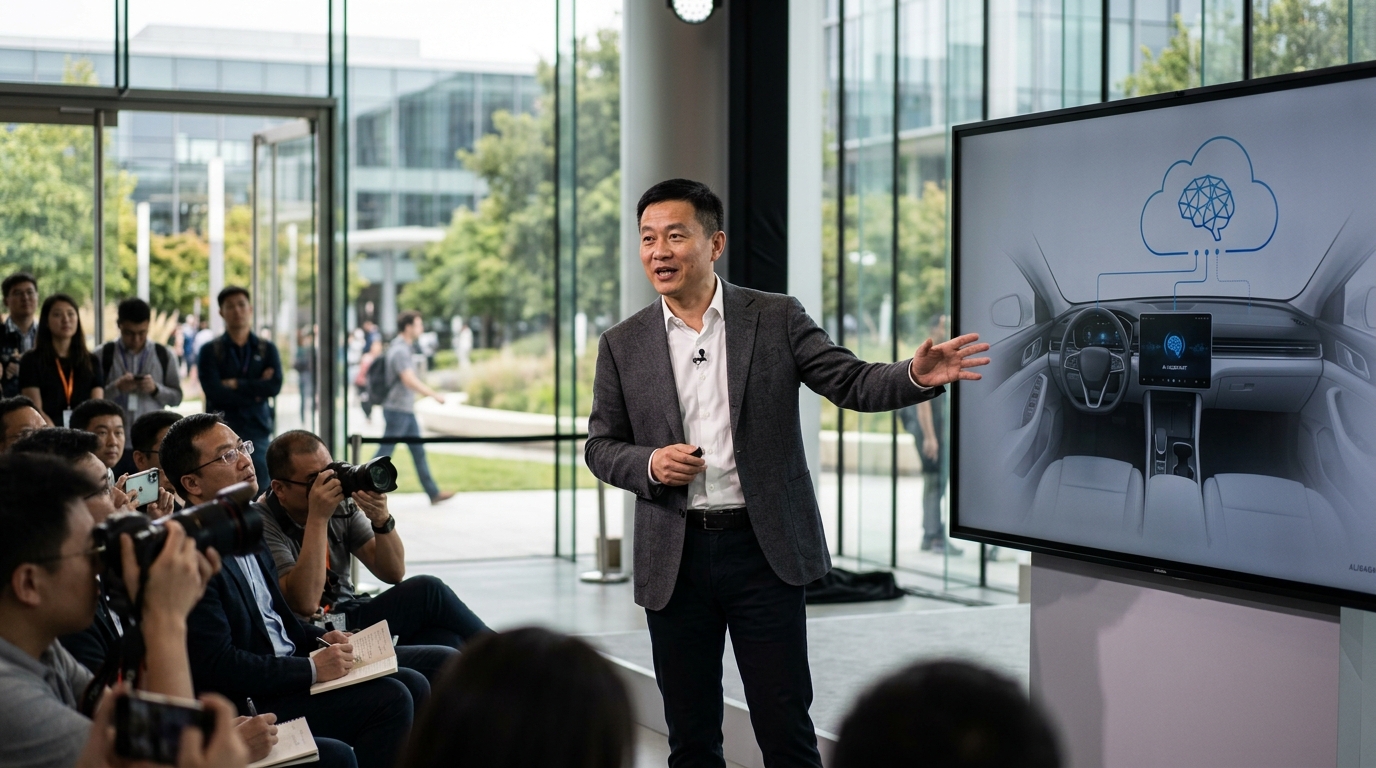
At the heart of a technological revolution redefining the concept of mobility, Chinese giant Alibaba has announced the full integration of its advanced artificial intelligence models into modern vehicles. This is not merely an upgrade to the infotainment system, but a fundamental shift in how the car interacts with the driver, the environment, and the digital ecosystem. This move by Alibaba, through its Alibaba Cloud arm, marks the next phase in the war of "Software-Defined Vehicles" (SDVs), where engine horsepower is giving way to cloud computing power.
The Intelligent Digital Co-pilot: Tongyi Qianwen on the Road
Alibaba's large language model (LLM), known as Tongyi Qianwen, is the core of this strategy. Unlike traditional voice assistants limited to simple commands like "open the window" or "play music," Alibaba's AI promises a multimodal experience. The system can understand complex contexts, conduct natural dialogues, and suggest real-time solutions, from booking a restaurant to optimizing the route based on the driver's emotional state.
The integration begins with IM Motors, the luxury electric vehicle joint venture between Alibaba and SAIC Motor. These vehicles will be equipped with capabilities allowing the car to "see" and "understand" the world through cameras and sensors, converting visual information into text or voice guidance. For example, a driver could ask, "What is that building on my right?" and the AI would provide historical information or reviews if it’s a business.
The Battle of Ecosystems: Alibaba vs. Huawei and Xiaomi
Alibaba's entry into the automotive industry does not happen in a vacuum. China has become the battlefield for the fiercest confrontation between tech companies seeking to dominate the car's interior. Huawei has already established its presence with HarmonyOS and the Aito vehicle series, while Xiaomi sent shockwaves through the market with the release of the SU7, an electric car that connects seamlessly with its device ecosystem.
Alibaba's strategy focuses on its Cloud advantage. As the largest cloud service provider in China, it possesses the infrastructure to support the massive volumes of data required to train autonomous driving models and personalized experiences. The company is not necessarily looking to build its own car—as Xiaomi did—but to become the "intelligence operating system" for any manufacturer wanting to remain competitive in the digital age.
Geopolitical Challenges and the Future of Mobility
While the technological progress is impressive, the expansion of Chinese AI in cars faces significant geopolitical hurdles. The European Union and the United States are expressing growing concerns over data security and privacy protection. A car equipped with Alibaba's AI, continuously collecting visual and audio data, could be viewed as a surveillance tool on Western soil.
Nonetheless, the trend is irreversible. The car is ceasing to be a mere means of transport and is becoming a "third living space," after the home and the office. AI integration will allow vehicles to become safer by predicting hazards that human vision fails to detect, while simultaneously offering a level of productivity previously unthinkable during a commute. Alibaba is betting that the future of motoring lies not in the wheels, but in the code.
- Integration of Tongyi Qianwen offers natural language and real-time image recognition capabilities.
- The partnership with IM Motors serves as a blueprint for future collaborations with international automakers.
- Competition with Huawei and Xiaomi is accelerating innovation in "Smart Cockpits."
- Cybersecurity concerns remain the primary obstacle to the global expansion of Chinese AI solutions.