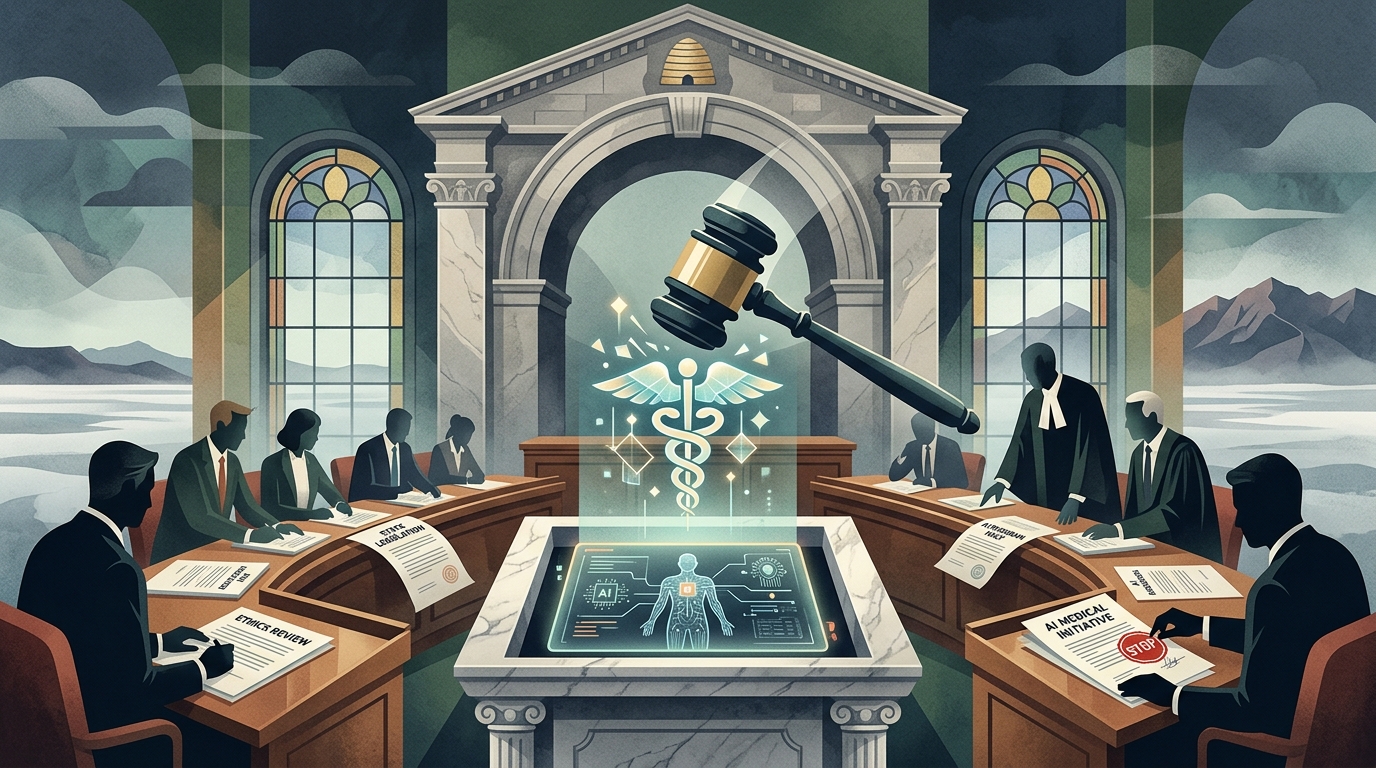
Utah, long celebrated as the 'Silicon Slopes' for its booming tech sector, has find itself at the epicenter of a profound legal and ethical storm. The Utah Medical Board has issued a stark demand for the immediate suspension of a controversial state-led experiment that allows Artificial Intelligence (AI) to perform medical tasks traditionally reserved for licensed human physicians. This move signals a significant pushback from the medical establishment against the rapid, and some say reckless, integration of automation in healthcare.
The conflict centers on Utah’s 'regulatory sandbox'—a legislative framework designed to foster innovation by allowing companies to test new technologies under relaxed regulatory oversight. While the state aims to address doctor shortages and lower costs through AI, the Medical Board argues that the 'move fast and break things' ethos of the tech industry is fundamentally incompatible with the Hippocratic Oath. When things 'break' in medicine, the consequences are measured in human lives, not software bugs.
The Sandbox Strategy and the Erosion of Oversight
The regulatory sandbox was intended to be a breeding ground for cutting-edge solutions. By bypassing some of the stringent licensing requirements, the state hoped to attract AI healthcare startups. However, the Medical Board’s intervention highlights a critical flaw: the lack of transparency in how these AI models operate. Many of these systems are 'black boxes,' providing diagnoses or treatment recommendations without a clear, auditable trail of logic.
Medical professionals argue that clinical judgment is more than just pattern recognition across vast datasets. It involves nuance, physical examination, and an understanding of a patient’s unique socio-economic context—elements that current AI models cannot replicate. The Board's report suggests that the state's experiment essentially treats citizens as 'guinea pigs' for unproven algorithms that have not undergone the rigorous clinical trials required for traditional medical devices or pharmaceuticals.
Safety Concerns and the Liability Vacuum
A primary concern cited by the Board is the unresolved question of legal liability. In the traditional medical model, the chain of accountability is clear. If a surgeon errs, there are established legal and professional pathways for redress. In the AI experiment, the lines are dangerously blurred. If an AI misdiagnoses a critical condition, who is held responsible? The developer who wrote the code? The company that deployed the service? Or the state that authorized the sandbox?
- The high risk of AI 'hallucinations,' where the system generates false but authoritative-sounding medical advice.
- Potential biases in training data that could lead to substandard care for marginalized populations.
- The lack of a 'human-in-the-loop' requirement for critical decision-making processes.
The Board emphasizes that AI should serve as a tool for physicians, not a replacement. They argue that allowing non-physicians to use AI to 'practice medicine' effectively devalues the years of rigorous training required to earn a medical degree and threatens to lower the standard of care across the state.
A National Precedent for AI Governance
The standoff in Utah is being watched closely by regulators across the United States and the European Union. As the Biden administration grapples with federal AI guidelines, the actual regulation of medical practice remains largely a state-level responsibility. Utah's Medical Board's decision to demand a halt could serve as a bellwether for other states considering similar 'innovation' programs.
"We are not anti-technology," the Board stated in its communication. "But we are pro-safety. Innovation must not come at the expense of the fundamental standards of care that have protected the public for centuries."
This clash underscores a broader societal tension: the desire for technological progress versus the need for human-centric safeguards. As AI continues to permeate sensitive sectors like healthcare, the Utah case highlights that the path forward must be paved with caution, transparency, and a steadfast commitment to professional ethics. The 'digital doctor' may be inevitable, but the medical community is making it clear that it will not happen without a fight for the soul of the profession.