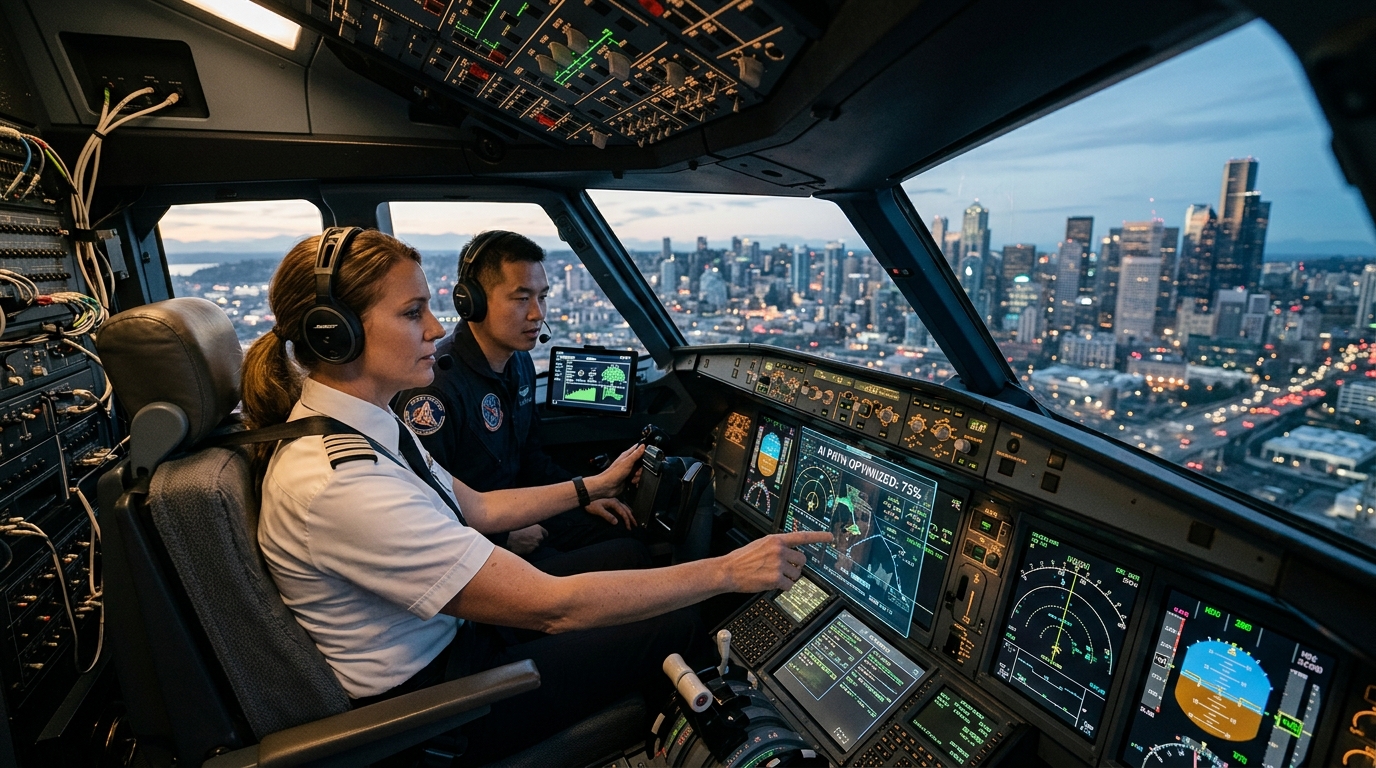
American aviation stands at a critical juncture. Following a string of harrowing "close calls" on the runways of the world’s busiest airports and a chronic staffing shortage that is pushing current air traffic controllers to their breaking point, Washington has decided to play its high-tech card. Transportation Secretary Pete Buttigieg recently announced an ambitious, albeit controversial, plan: integrating Artificial Intelligence (AI) tools into the very core of Air Traffic Control (ATC).
A Crisis Born of Necessity
For decades, the U.S. air traffic control system has relied on technologies that many experts now consider obsolete. Despite modernization efforts through the NextGen program, controllers are still managing an ever-increasing volume of flights with tools that often cannot process real-time data at the speed required by the modern era. The shortage of controllers—estimated to be in the thousands—has led to grueling schedules, significantly increasing the risk of human error due to fatigue.
The introduction of AI is not being framed as a replacement for humans, but rather as a "digital co-pilot." The idea is for AI to handle the processing of massive amounts of data from radar, weather stations, and aircraft sensors, identifying potential collisions or delays long before they become visible to the human eye. However, the term "AI" sends shivers down the spines of those who remember past automation failures, most notably the Boeing 737 MAX MCAS disaster.
Prediction Over Reaction
The primary advantage of AI in the ATC sector is the shift from a reactive model to a predictive one. Currently, a controller reacts to a situation as it unfolds. AI, through machine learning, can simulate thousands of scenarios per second, suggesting optimal routes that reduce fuel consumption and emissions while ensuring necessary safety margins.
- Trajectory Management: AI can calculate the precise position of every aircraft in a four-dimensional horizon (latitude, longitude, altitude, and time).
- Meteorological Analysis: Predicting weather micro-events that affect landings, allowing for flight rerouting before congestion builds up.
- Workload Reduction: Automating communication routines and administrative tasks that distract controllers from their primary mission.
Nevertheless, the Federal Aviation Administration (FAA) faces a significant "trust" issue. How can a controller rely on an algorithmic decision when hundreds of lives are at stake? The transparency of these algorithms—so-called "Explainable AI"—is the key to the system's acceptance and integration into the high-stress environment of the tower.
Risks and Public Pushback
Critics of Buttigieg’s plan point out that the rush to adopt AI might mask an attempt to cut costs at the expense of safety. The National Air Traffic Controllers Association (NATCA) remains cautious, emphasizing that technology must be supportive, not directive. There is also the looming shadow of cybersecurity: an AI-based ATC system represents a primary target for state and non-state actors looking to cause chaos in global transportation networks.
"We cannot allow our skies to become a testing ground for algorithms that have not been proven infallible," stated a senior aviation industry executive.
In conclusion, the U.S. move to integrate AI into flight control is an inevitable evolution in a rapidly digitizing world. If it succeeds, it will set the standard for the entire globe, potentially ending the era of flight delays and near-misses. If it fails, the consequences will be catastrophic, not just for aviation safety, but for the public's fundamental trust in the marriage of technology and human life.