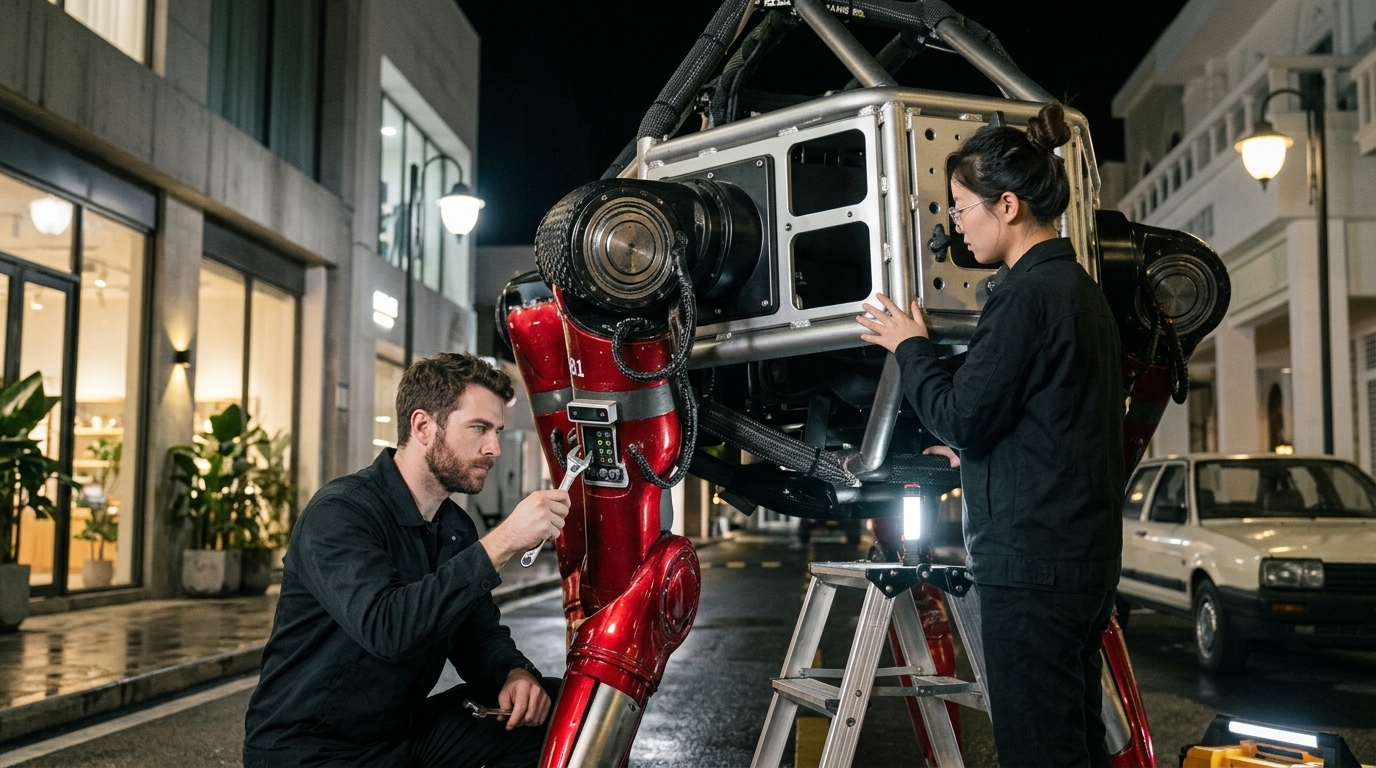
For decades, giant humanoid robots—commonly known as "mecha"—were the exclusive domain of Japanese anime and Hollywood blockbusters. From "Gundam" to "Pacific Rim," the concept of a massive, human-controlled machine possessing superhuman strength has always been the ultimate symbol of technological prowess. Today, China’s Unitree Robotics, a company that gained worldwide fame for its agile and affordable robotic dogs, has announced its entry into this heavyweight category with the GD01. This is not a toy, nor a mere concept for a tech show, but a functional, giant mecha designed for the commercial market.
The Technological Leap: From Go1 to GD01
Unitree’s trajectory has been nothing short of meteoric. Starting as an ambitious startup aiming to compete with the likes of Boston Dynamics, it successfully democratized quadruped robotics by offering models like the Go1 at price points accessible even to private individuals. With the GD01, the company is making a massive leap in scale. This new creation is not just a larger version of its predecessors; it is a radically different platform that combines advanced hydraulics and electric propulsion to manage the immense weight and forces involved in its movement.
The GD01 stands out for its ability to interact with the environment in ways no previous commercial robot has achieved. In demonstration videos, the machine is seen smashing through walls and moving heavy debris, showcasing a raw power that is both impressive and intimidating. The use of high-torque motors and a sophisticated balance control system allows the GD01 to maintain stability even during intense physical activity—one of the most difficult problems to solve in large-scale robotics.
China’s Strategy for Robotics Dominance
The release of the GD01 is not an isolated event but part of a broader Chinese national strategy to dominate the robotics sector. While Western companies often focus on research and development of specialized, hyper-expensive prototypes, Chinese firms like Unitree aim for mass production and cost reduction. This "democratization" of heavy robotics could shift the landscape in sectors such as construction, disaster management, and security.
- Construction Sector: The GD01 could replace traditional machinery in rugged terrains where humanoid locomotion offers distinct advantages.
- Search and Rescue: Its ability to breach obstacles and navigate rubble makes it ideal for post-earthquake operations.
- Entertainment: The theme park and live performance industry is expected to be among the early adopters of such spectacle-heavy machines.
However, the ease of access to such powerful machines raises serious questions about safety and regulation. A robot capable of smashing walls is a potential weapon if it falls into the wrong hands or if its software glitches in a public space.
The Challenge of Control and Autonomy
One of the most intriguing aspects of the GD01 is its control mechanism. While Unitree promotes AI-driven autonomy, the GD01 supports remote operation and even "pilot-in-the-loop" systems. Integrating AI allows the robot to recognize objects and adjust its force based on the resistance it encounters, preventing unnecessary property damage or, more importantly, human injury.
Ethically, the existence of mechas brings us face-to-face with a new reality. As these machines become more affordable, the distinction between an industrial tool and a war machine becomes increasingly blurred. The international community may soon need to establish rules for the use of "heavy humanoids," similar to those governing heavy vehicles or drones.
"We are not just building machines; we are building humanity’s new partners for the toughest jobs on the planet," say sources close to the company.
In conclusion, the Unitree GD01 marks the end of the era where mechas were only for the silver screen. It is the beginning of a new industrial revolution where robotic scale meets raw power, and where China appears to be holding the reins, driving developments at a pace the West is struggling to match.