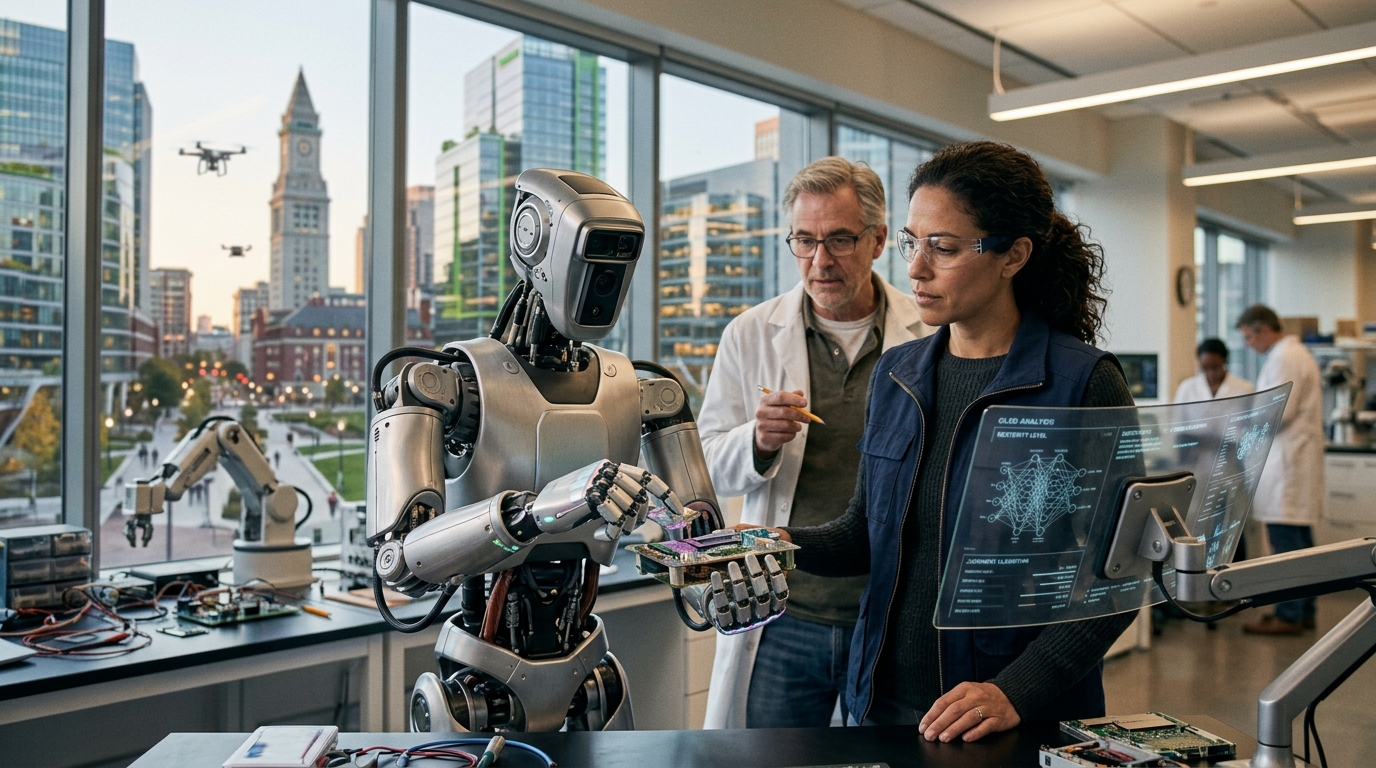
The image of an industrial robot performing the same motion with mathematical precision 24/7 has been familiar for decades. However, what is currently unfolding in advanced technology facilities in Massachusetts represents a radical departure from the past. We are no longer talking about machines following predetermined lines of code, but entities that are 'learning' to perceive the physical world, adapt to unpredictable changes, and perform tasks that until recently required exclusively human dexterity and judgment.
The Transition from Programming to Learning
Traditional robotics relied on absolute control of the environment. If an object moved a few centimeters from its expected position, the robot would fail. In the factory featured by CBS News, the approach is diametrically opposite. Utilizing technologies similar to those powering ChatGPT, researchers are developing 'Large Behavior Models.' These systems allow robots to watch videos of humans performing tasks—such as sorting packages, assembling small parts, or handling flexible materials—and then replicate those movements, correcting their errors in real-time.
This shift toward 'imitation learning' dramatically reduces the time and cost required to develop new industrial applications. Instead of weeks of programming by specialized engineers, a robot can now be 'trained' within hours, making automation accessible even to small and medium-sized enterprises that produce goods in small batches.
Moravec's Paradox and Its Overcoming
For years, robotics faced 'Moravec's Paradox': the fact that tasks difficult for humans (like chess or advanced mathematics) are easy for computers, while simple sensorimotor skills (like grabbing a cup or walking on uneven ground) are extremely difficult. The AI in Massachusetts is beginning to solve this paradox.
- Depth Perception: Robots use high-definition cameras and LiDAR sensors to understand 3D space.
- Haptic Feedback: New sensors in the grippers allow the robot to sense if it is pressing too hard or if an object is slipping.
- Generalization: The ability to apply knowledge from one task to another similar one without needing to be retrained from scratch.
These developments are not just about speed, but flexibility. In a factory environment, this means robots can now work side-by-side with humans, taking over the most tedious, repetitive, or dangerous tasks, while humans focus on supervision and complex problem-solving.
Social Implications and the Future of Work
The introduction of these 'smart' robots brings to the fore the eternal question: Will machines replace humans? Proponents of the technology in Massachusetts argue that the goal is not replacement, but filling gaps in a labor market suffering from severe shortages. In the US, thousands of manufacturing jobs remain vacant as younger generations avoid manual labor in factories.
"We are not building human replacements, but tools that allow humans to be more productive and avoid injuries," says one of the project's lead engineers.
However, the economic reality is more complex. As robots become more capable and cheaper, the pressure on unskilled workers will increase. The need for workforce retraining is becoming imperative. The workers of the future will not operate tools but will oversee fleets of robots, acting more as orchestral conductors than executive agents.
The Geopolitics of Automation
There is also a significant geopolitical dimension. The ability to produce goods at a low cost through AI robots could bring manufacturing back to Western economies (reshoring). If labor costs cease to be the deciding factor, then proximity to the market and technological infrastructure become the new comparative advantages. Massachusetts, with the ecosystem of MIT and numerous startups, is positioning itself at the center of this new industrial strategy.
In conclusion, the robots learning at the Massachusetts factory are the harbingers of a new era. Artificial Intelligence is no longer confined to our screens. It has gained a body, movement, and the ability to interact with the physical world in ways that were until recently in the realm of science fiction. The challenge for society will be to ensure that this increased productivity translates into prosperity for all, not just for the owners of capital.