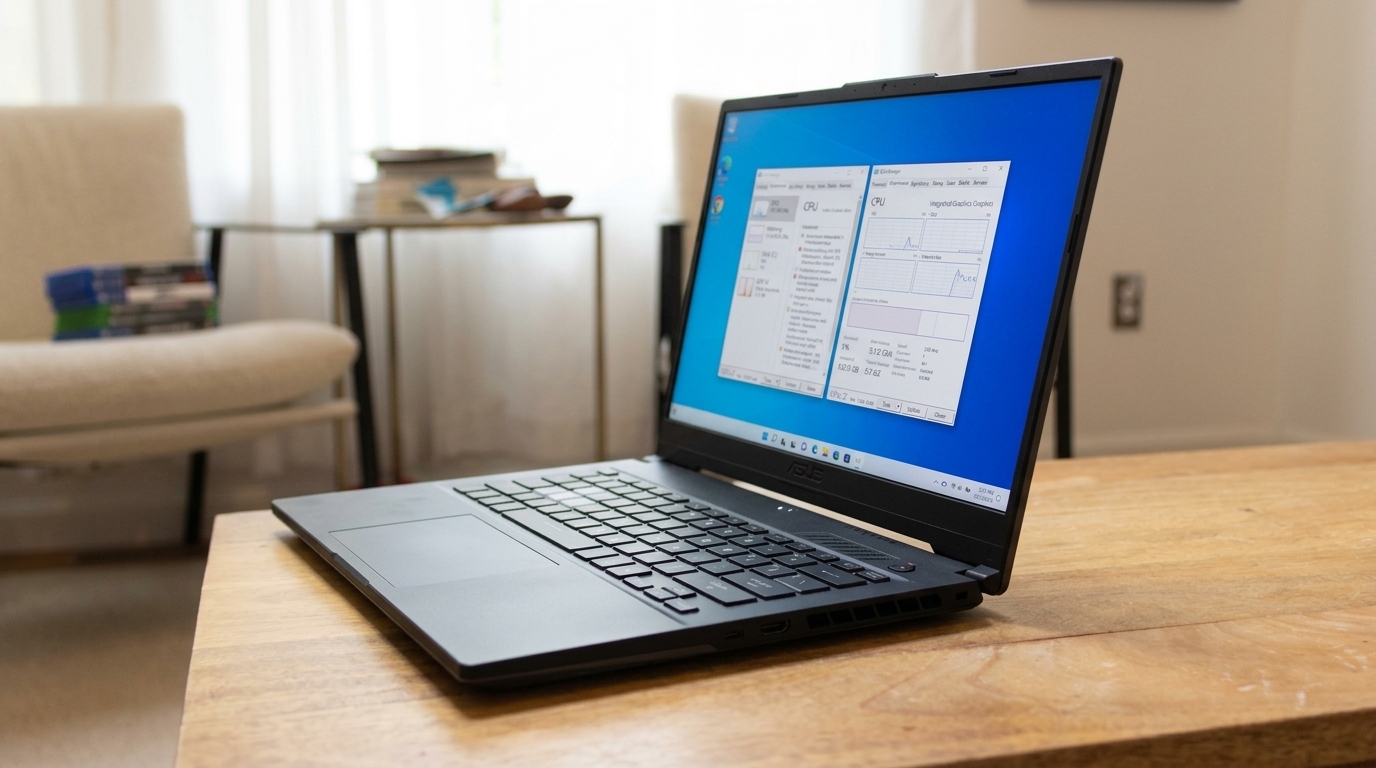
For decades, the identity of a "gaming laptop" was defined by the presence of a noisy, power-hungry, and bulky discrete graphics card (dGPU). With the release of the TUF Gaming A14 (2026 model), Asus is attempting to dismantle this status quo. Powered by AMD’s revolutionary Strix Halo architecture, the A14 promises high-end performance without the need for a separate graphics chip. This is a gamble that concerns not just hardware, but the very philosophy of mobile computing power.
The APU Revolution: Ending the Silicon Divide
The heart of the TUF Gaming A14 beats to the rhythm of AMD's new processor, which integrates the power of a traditional graphics card directly into the CPU silicon. This approach, known as an APU (Accelerated Processing Unit), isn't new, but in 2026, it has finally reached maturity. With RDNA 3.5+ architecture and massive memory bandwidth, the A14 manages to eliminate the need for a communication bus between CPU and GPU, dramatically reducing latency and power consumption.
"This isn't just about saving space. It's about redefining computer architecture for the era of AI and efficient gaming," says an Asus representative.
In practice, this means the laptop can maintain a slim profile, similar to an ultrabook, while simultaneously running AAA titles at 1440p resolution. The absence of a dGPU allows Asus to redesign the cooling system, using the freed-up space for a larger battery and quieter fans. However, this integration brings challenges, primarily in managing shared RAM, which must now serve both system needs and graphical demands.
Design and Portability: The New TUF Aesthetic
The TUF series has always been known for its durability and somewhat "rugged" design. The 2026 model, however, adopts a more refined approach. Without the weight of the heatsinks required by an RTX 50-series card, the A14 weighs just 1.4 kg. Build quality remains up to MIL-STD-810H standards, but the in-hand feel is much more premium than its predecessors.
- Thickness under 18mm.
- Magnesium-aluminum alloy chassis.
- 14-inch OLED display with 165Hz refresh rate.
- Battery life reaching up to 12 hours in mixed use.
The display is where the A14 truly shines. Utilizing an OLED panel with G-Sync support ensures that, despite the lack of a discrete card, the experience remains fluid. AMD’s AI-driven upscaling (FSR 4) plays a crucial role here, utilizing the integrated NPU (Neural Processing Unit) to upscale images in real-time without taxing the graphics cores.
Performance and the Ray Tracing Hurdle
In our testing, the TUF A14 performed exceptionally in titles like Cyberpunk 2077 and Starfield, consistently achieving 60+ FPS on High settings. Where the system begins to show its limits, however, is in demanding Ray Tracing scenarios. While the Strix Halo architecture is powerful, it cannot yet fully compete with the specialized RT cores found in Nvidia’s discrete cards.
The major advantage remains thermal behavior. Unlike traditional gaming laptops that become scorching hot after an hour of play, the A14 remains impressively cool around the keyboard deck. This is due to the single heat source (the APU) allowing for more targeted and efficient heat dissipation.
Conclusion: Is the Future Here?
The Asus TUF Gaming A14 (2026) is more than just a laptop; it is a statement of intent. Asus’s move to remove the dGPU in a price bracket that traditionally relied on it shows that semiconductor technology has reached a critical tipping point. For the average gamer seeking portability, style, and satisfactory performance, the A14 is a revelation. For hardcore players demanding every ounce of power for 4K gaming, the dGPU will remain necessary for a while longer. But the path is now clear: the future of gaming is integrated, intelligent, and above all, light.