In an era where algorithms and Artificial Intelligence (AI) dominate stock market transactions, the traditional art of short selling—betting on a stock's decline—is undergoing an existential crisis. In a recent live recording of "Masters in Business" at the Future Proof festival, Carson Block, the legendary founder and CEO of Muddy Waters Capital, shared his insights with Barry Ritholtz on how the new technological landscape is reshaping investment strategies. The discussion was more than just a financial analysis; it was a deep dive into the clash between human intuition and raw computational power.
Fundamentals vs. Technicals: The Widening Chasm
Block argued forcefully that the distinction between fundamentals and technicals has become more critical than ever. In the past, short sellers could rely on exposing accounting irregularities or business failures, expecting the market to react rationally. Today, the advent of AI has amplified the "technical" side of the market to such an extent that a stock's price can become entirely decoupled from reality for extended periods. High-frequency algorithms and machine learning models are fed by momentum, often ignoring the red flags in a company’s financial ledgers.
According to Block, AI has created an environment where technical factors—such as capital flows into passive funds and algorithmic buy orders—override classical analysis. This makes short selling exceptionally dangerous, as a short seller can be fundamentally right about a company’s insolvency but get "steamrolled" by a wave of AI-driven trend-following purchases. The "tape" no longer reflects the business, but rather the behavior of the bots trading it.
The Dark Side of the AI Boom
The conversation inevitably turned to the current AI boom. While Wall Street celebrates the limitless potential of LLMs and generative AI, Block maintains a more skeptical stance. He warns that AI serves as the perfect "shroud" for companies seeking to mask structural weaknesses. Much like the dot-com bubble or the crypto craze, adding the term "AI" to an investor presentation can skyrocket a company's valuation without a corresponding business model or path to profitability.
Block pointed out that the massive capital expenditures (CapEx) by tech giants on AI infrastructure might not yield the expected returns in the near term. There is a risk of a "return gap," where the cost of the technology exceeds the revenue it generates, leading to a violent market correction. For a short seller, this asymmetry between inflated expectations and underlying reality is where opportunities are born—but also where the greatest risks lie. He suggests that the market is currently in a phase of "willful blindness" regarding the monetization of these tools.
AI as a Tool for the Financial Forensic Investigator
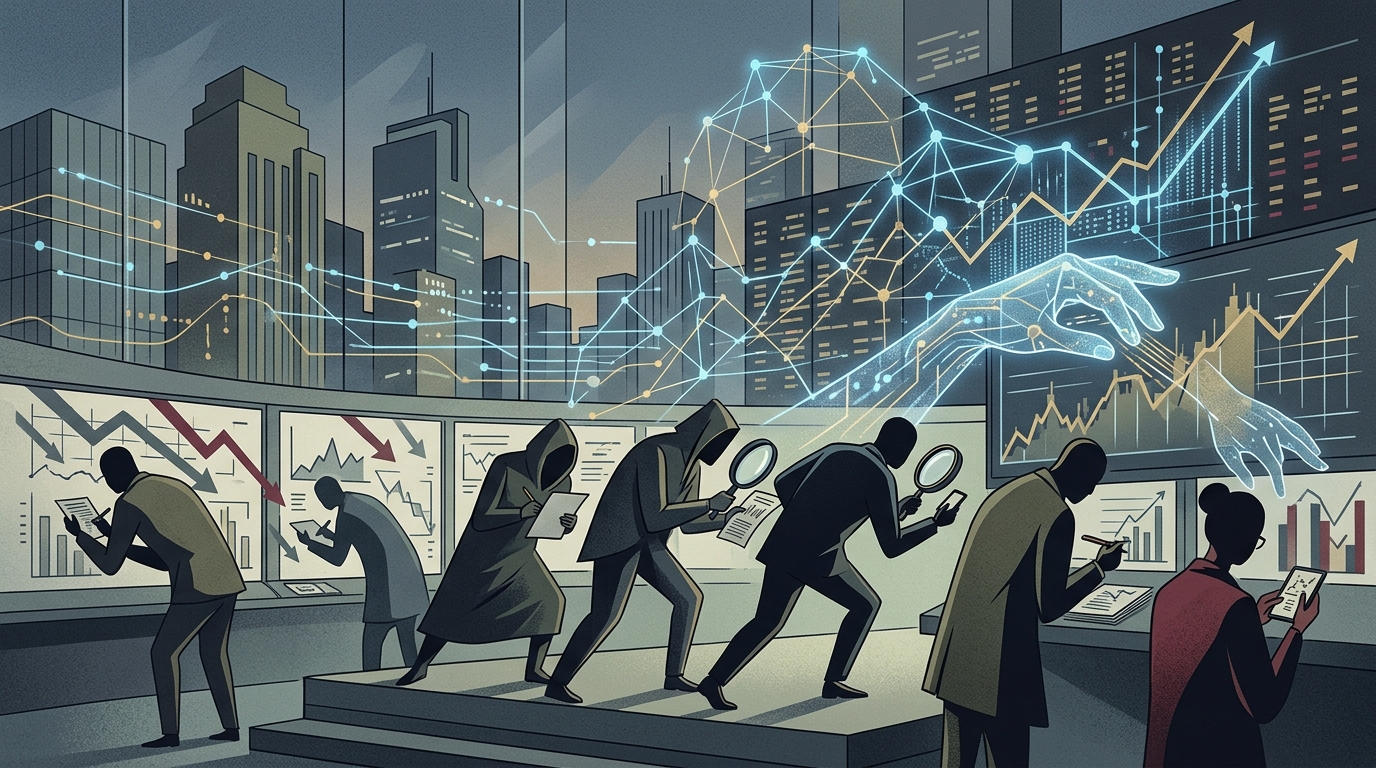
Despite his reservations, the founder of Muddy Waters does not dismiss technology. On the contrary, he acknowledges that AI can be an ally in uncovering fraud. The ability of models to scan thousands of pages of financial reports, detect linguistic inconsistencies in CEO statements, and connect data points across global jurisdictions is a game-changer for investigative analysts. However, Block insists that the final judgment must remain human. The intuition required to sense when an executive is lying or when a corporate structure is a "house of cards" cannot—yet—be fully automated.
- AI can process data at scale, identifying patterns human eyes might miss.
- Human analysts are still superior at understanding context and motive.
- The combination of the two represents the future of forensic finance.
In conclusion, the battle of short sellers in the AI age is a fight for truth in a world full of noise. Carson Block reminds investors that no matter how sophisticated algorithms become, the laws of financial gravity remain relentless. The challenge for the new generation of investors is to learn how to wield AI as a weapon for transparency rather than becoming victims of the euphoria it generates. Short selling remains a vital organ for market hygiene, even if the environment has become more hostile than ever.