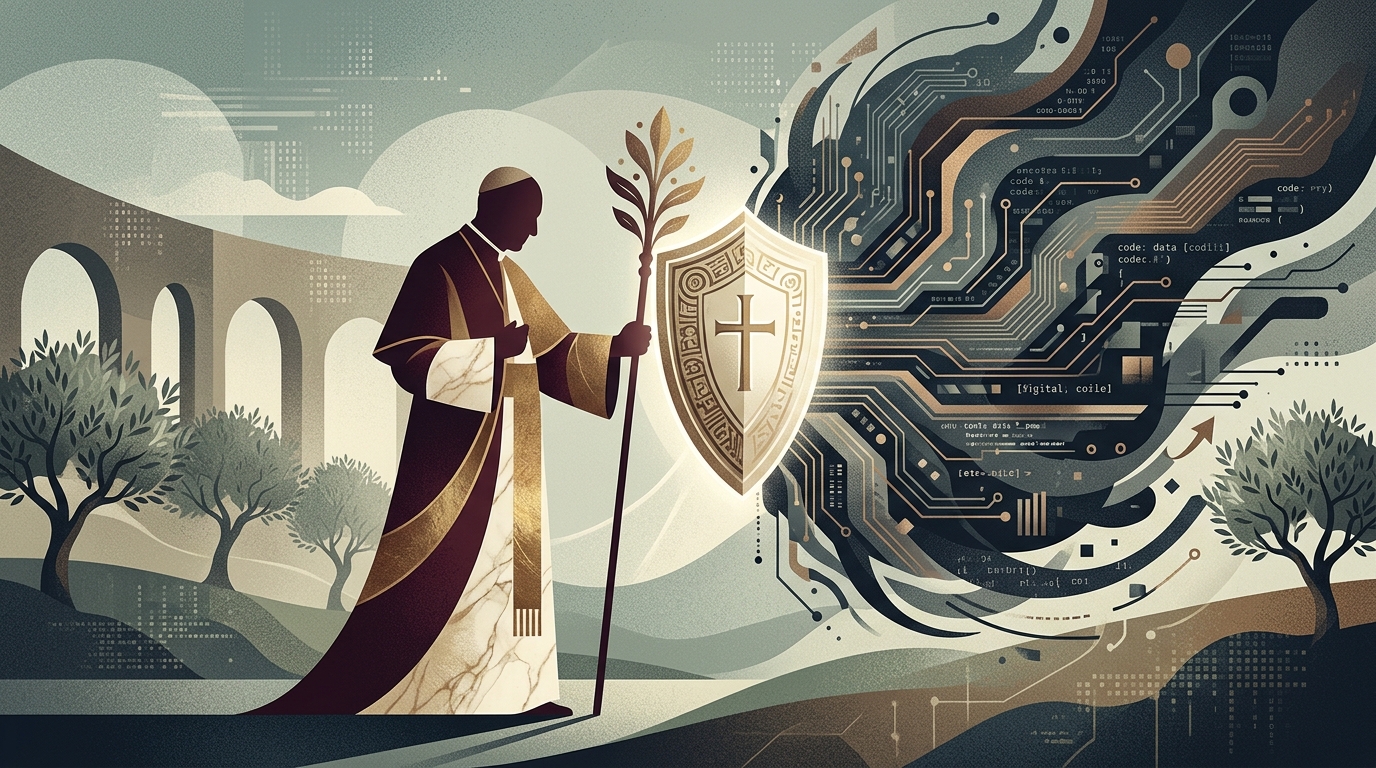
In an era where Artificial Intelligence (AI) is radically transforming social, economic, and political realities, the Vatican is emerging as an unexpected yet decisive player on the international stage of technological ethics. Pope Francis, through a series of powerful interventions, poses the question many avoid: Can a machine possess a moral compass? The Holy See’s answer is categorical: No, but its creators are duty-bound to impose one upon it.
The Emergence of 'Algor-ethics'
The term 'Algorethics,' coined by the Vatican, is not merely a linguistic invention but a comprehensive framework for action. Its goal is to integrate ethical principles into the very design of algorithms. According to the Pontifical Academy for Life, technology must serve the human person and not the other way around. This intervention comes at a critical moment, as 2026 sees humanity grappling with the integration of generative AI into every facet of daily life.
The Vatican argues that algorithms are not neutral. They embody the biases of their creators and the gaps in the data on which they are trained. 'Algor-ethics' demands transparency, inclusivity, and accountability. It is not enough for technology to be efficient; it must also be just. The Pope has repeatedly called on tech leaders—from Silicon Valley to Beijing—to sign the 'Rome Call for AI Ethics,' an initiative already supported by giants like Microsoft and IBM.
The Threat to Human Dignity and Agency
One of the greatest concerns expressed by the Pontiff is the gradual erosion of human judgment. When we allow machines to decide who qualifies for a loan, who is a criminal suspect, or who should be hired, we cede our freedom to 'black boxes' of code. Pope Francis warns that the 'dictatorship of the algorithm' could lead to a new form of social exclusion.
"We must not allow algorithms to determine the value of a human being. Human dignity is non-negotiable and cannot be quantified by any software," he has stated emphatically.
Particular emphasis is placed on autonomous weapons systems. The Vatican leads the movement for a total ban on 'killer robots,' arguing that the decision over life and death should never be delegated to a machine. Ethical responsibility requires a human face behind every trigger, even a digital one.
Digital Justice and the Global South
Beyond philosophical questions, the Pope’s intervention has a strong political and social dimension. AI threatens to widen the gap between rich and poor nations. While developed economies reap the benefits of automation, the Global South risks falling further behind, lacking access to technological infrastructure and necessary education.
- Marginalization of low-skilled workers due to automation.
- Strengthening of monopolies by a few technological superpowers.
- Manipulation of public opinion through sophisticated disinformation systems.
For the Vatican, the solution is not technophobia but the 'democratization of knowledge.' The Pope proposes international governance of AI that ensures the fruits of technological progress are distributed fairly across humanity, while protecting the rights of the most vulnerable.
Toward a Binding International Framework
The Vatican’s intervention culminates in a call for a global, binding treaty on Artificial Intelligence. Following the implementation of the AI Act in the European Union, the Holy See is pushing for something even broader: a 'Global Ethical Code.' In a world divided by geopolitical rivalries, the Vatican seeks to play the role of a moral mediator, reminding us that technology must be a tool for peace and not a means of dominance.
In conclusion, Pope Francis’s stance on AI is not a regressive reaction but a proactive cry for help. In a world moving at the speed of light toward the unknown, the need for stable values becomes more urgent than ever. 'Algor-ethics' may be our last chance to preserve our humanity in a future dominated by silicon.