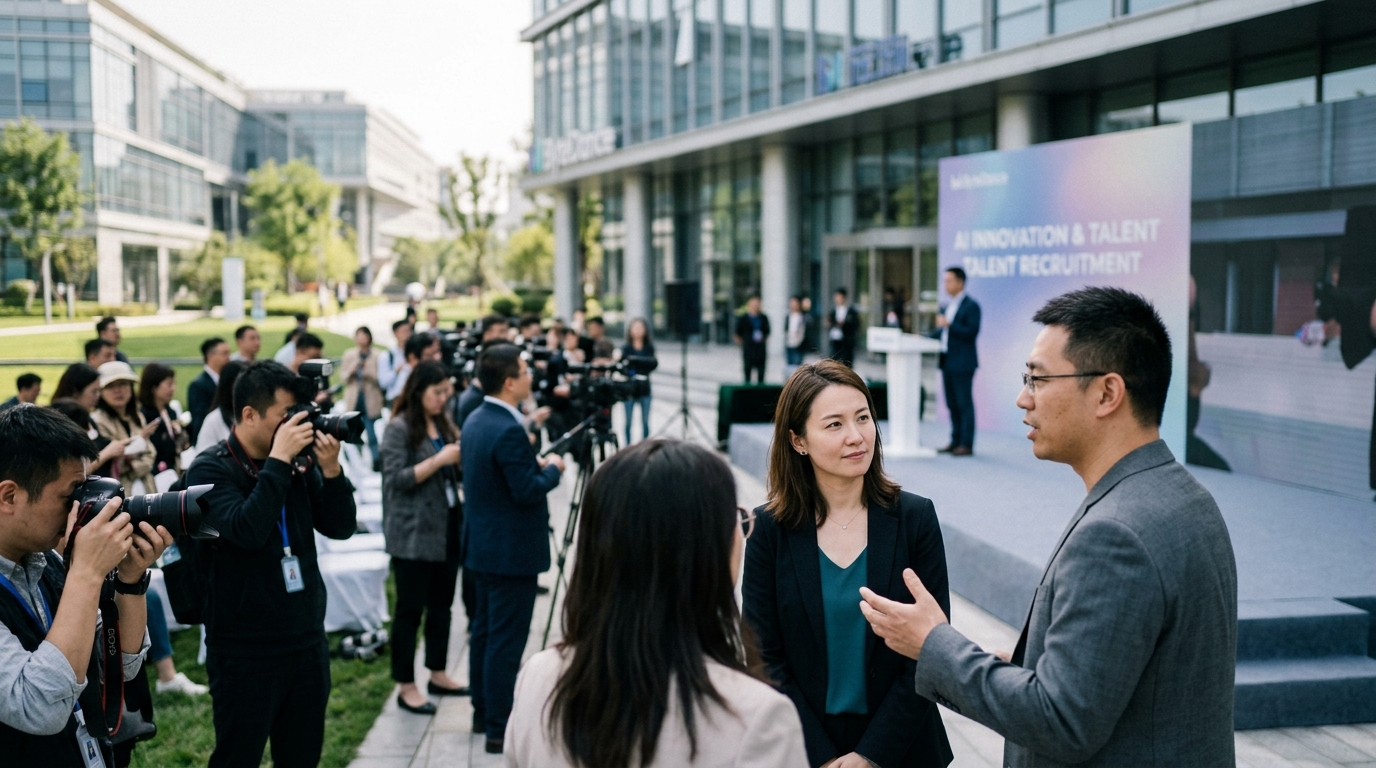
In a strategic move that highlights the critical importance of artificial intelligence to its future, ByteDance, the parent company of TikTok, is reportedly offering attractive stock option packages to employees within its AI unit. This development is not merely an internal administrative decision; it is a clear statement of intent at a time when the global war for tech talent has reached a fever pitch. As Washington escalates pressure on the Chinese giant and competition from OpenAI, Google, and Meta intensifies, ByteDance is attempting to fortify its most valuable asset: its human capital.
The Talent War and the 'Golden Handcuffs'
Offering stock options to employees of a specific department, rather than the entire company, is a tactic aimed at directly linking the personal success of executives and engineers with the progress of AI technology. In the tech industry, stock options traditionally function as "golden handcuffs." Employees are incentivized to remain with the company for a specific period to vest their rights, thereby ensuring continuity in research and development. For ByteDance, this is vital, as the departure of even a few top researchers to rivals like Baidu or Alibaba—or even to American startups—could set back its ambitious plans by years.
- Retaining top-tier researchers in a highly mobile labor market.
- Aligning the incentives of the AI unit with long-term corporate objectives.
- Offsetting uncertainty caused by potential TikTok bans in the United States.
The Geopolitical Chessboard and AI Autonomy
ByteDance's decision unfolds against an incredibly complex geopolitical backdrop. With the U.S. imposing strict restrictions on the export of advanced semiconductors (such as Nvidia’s H100 chips) to China, Chinese tech firms are forced to become more creative. ByteDance doesn't just need hardware; it needs the people who can optimize algorithms to perform at their peak with available resources. ByteDance's Doubao model has already seen significant success in China, outperforming many domestic rivals in user numbers, and the company is keen to maintain this momentum.
"Artificial intelligence is no longer an experiment for ByteDance, but the central pillar of its survival in a world increasingly divided along technological lines."
Furthermore, the internal restructuring and focus on the AI unit suggest that the company is preparing for any eventuality regarding TikTok. If the app is forced to divest its U.S. operations, ByteDance will need to rely on its technological superiority in AI to maintain its valuation and global market influence. Stock options in the AI unit may serve as a form of "insurance" for employees, signaling that the company's future lies in generative AI models rather than just social media platforms.
The Valuation Challenge and the Path Ahead
One of the biggest questions arising is the actual value of these options. ByteDance remains a private company with a valuation hovering around $225 billion, making it the world's most valuable unicorn. However, the lack of an Initial Public Offering (IPO) makes liquidating these shares difficult. The company frequently conducts share buyback programs to provide liquidity to its employees, a practice expected to continue for the AI unit. The success of this move will be judged by whether ByteDance can deliver innovations that rival OpenAI's Sora or Google's Gemini, proving that Chinese innovation can flourish despite external constraints.
In conclusion, ByteDance’s move to offer stock options to its AI unit is a high-stakes, high-reward gambit. It is an attempt to build a "digital fortress" around its scientists, ensuring that the heart of its technological empire remains intact regardless of the political storms raging across the Pacific. For the rest of the world, it is a reminder that the race for AI supremacy is not just decided in laboratories, but also in the accounting offices and boardrooms of the world's tech titans.