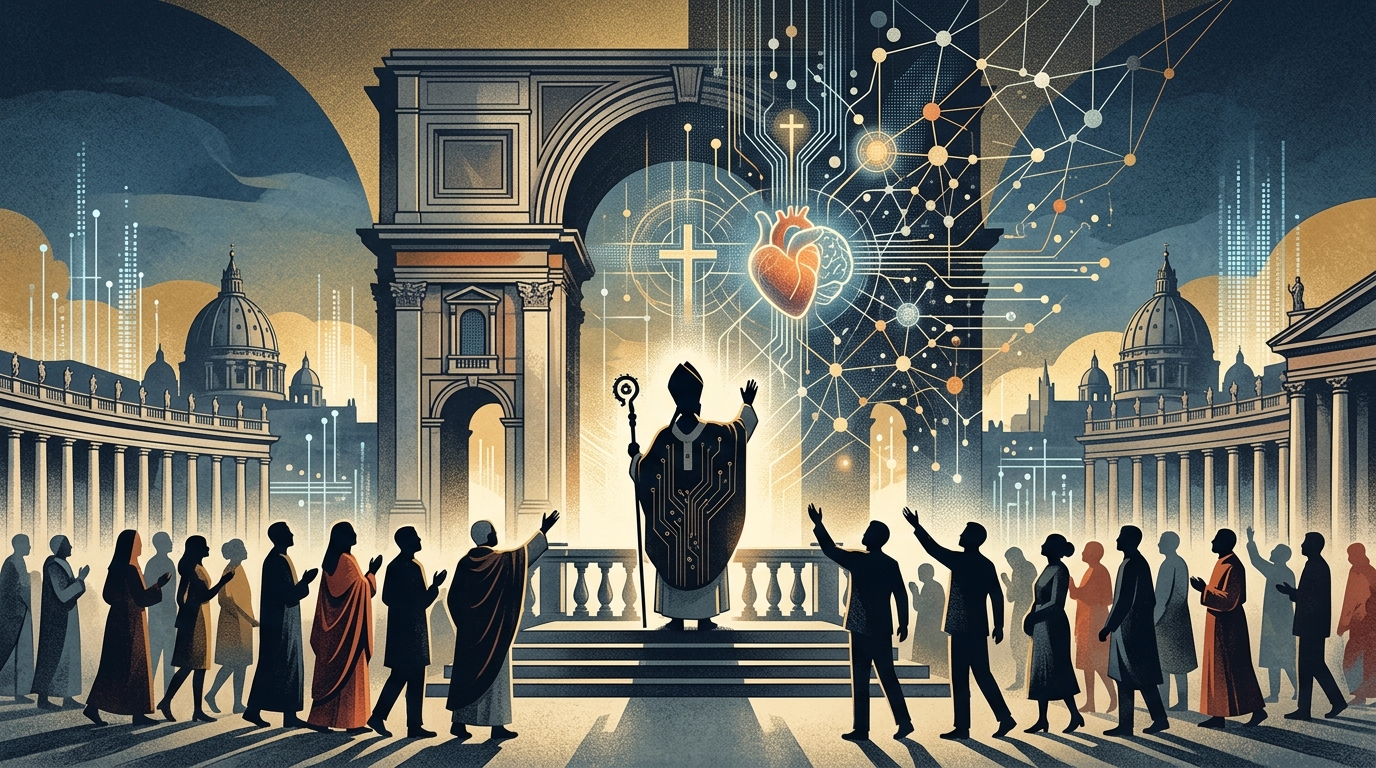
In the heart of Rome, within the sovereign walls of the Vatican, a new spiritual and political frontier is being drawn—not over ancient dogmas, but over the lines of code that will define the future. Pope Francis, recognizing that Artificial Intelligence (AI) represents the most significant turning point in human history since the Industrial Revolution, has established a specialized study group. This move serves as a precursor to the release of a historic papal encyclical dedicated entirely to digital ethics and the governance of algorithms.
The Emergence of 'Algorethics'
The term "algorethics," championed by the Vatican, is more than a linguistic curiosity. It represents the Catholic Church's systematic attempt to embed a moral framework into the development of AI. The newly formed study group, comprising theologians, data scientists, and philosophers, is tasked with addressing questions that secular governments often bypass: How is human dignity preserved when decisions are outsourced to machines? Who is accountable for the errors of an autonomous system? Pope Francis has consistently warned against a "technocratic paradigm" that prioritizes efficiency over equity, potentially exacerbating global marginalization.
The upcoming encyclical is poised to be the Church’s most consequential document on technology. Papal encyclicals are high-level teaching documents that traditionally address not just the Catholic faithful, but "all people of good will." Following the precedent of 'Laudato Si', which centered on environmental stewardship, this new intervention seeks to provide a universal moral compass for Silicon Valley executives and regulators in Brussels and Washington alike.
Strategic Alliances with Big Tech
The Vatican's approach is notably pragmatic. Through the Pontifical Academy for Life, it has already spearheaded the "Rome Call for AI Ethics," an initiative signed by top executives from Microsoft, IBM, and Cisco, alongside UN representatives. The involvement of these corporate giants suggests a growing realization that technological power requires a form of moral legitimacy that only an institution with the Church’s historical weight can confer.
- Transparency: Algorithms must be explainable and avoid the "black box" phenomenon.
- Inclusion: AI development must account for the Global South, preventing a new form of digital colonialism.
- Impartiality: Proactive measures must be taken to eliminate bias in training datasets.
- Accountability: There must always be a "human-in-the-loop" for critical decisions.
The study group will specifically analyze the implications of AI in warfare and mass surveillance. The Pope has expressed profound concern over the loss of "human judgment" in life-and-death scenarios, advocating for a global treaty to ban Lethal Autonomous Weapons Systems (LAWS), often referred to as "killer robots."
Theological Challenges: Machines and the Soul
Beyond ethics and policy, AI presents profound theological challenges. If a machine can simulate creativity, empathy, or even the act of prayer, what does that imply for the concept of the soul? The Vatican committee is exploring how AI impacts the understanding of "Imago Dei" (the Image of God). While the Church maintains that consciousness and free will are uniquely human attributes, the rise of Generative AI blurs these boundaries, creating a sophisticated facsimile of personhood that requires a rigorous theological response.
"Artificial intelligence is both a gift and a responsibility. We cannot allow algorithms to replace human proximity and the pursuit of social justice," a source close to the Vatican's Secretariat of State noted.
This initiative also reflects the Vatican's broader diplomatic strategy. In a world fractured by geopolitical rivalries for AI supremacy, the Holy See is positioning itself as a neutral arbiter, promoting what it calls a "digital peace." The forthcoming encyclical will not merely be a religious treatise; it will be a manifesto for maintaining humanity's essence in an increasingly automated world.