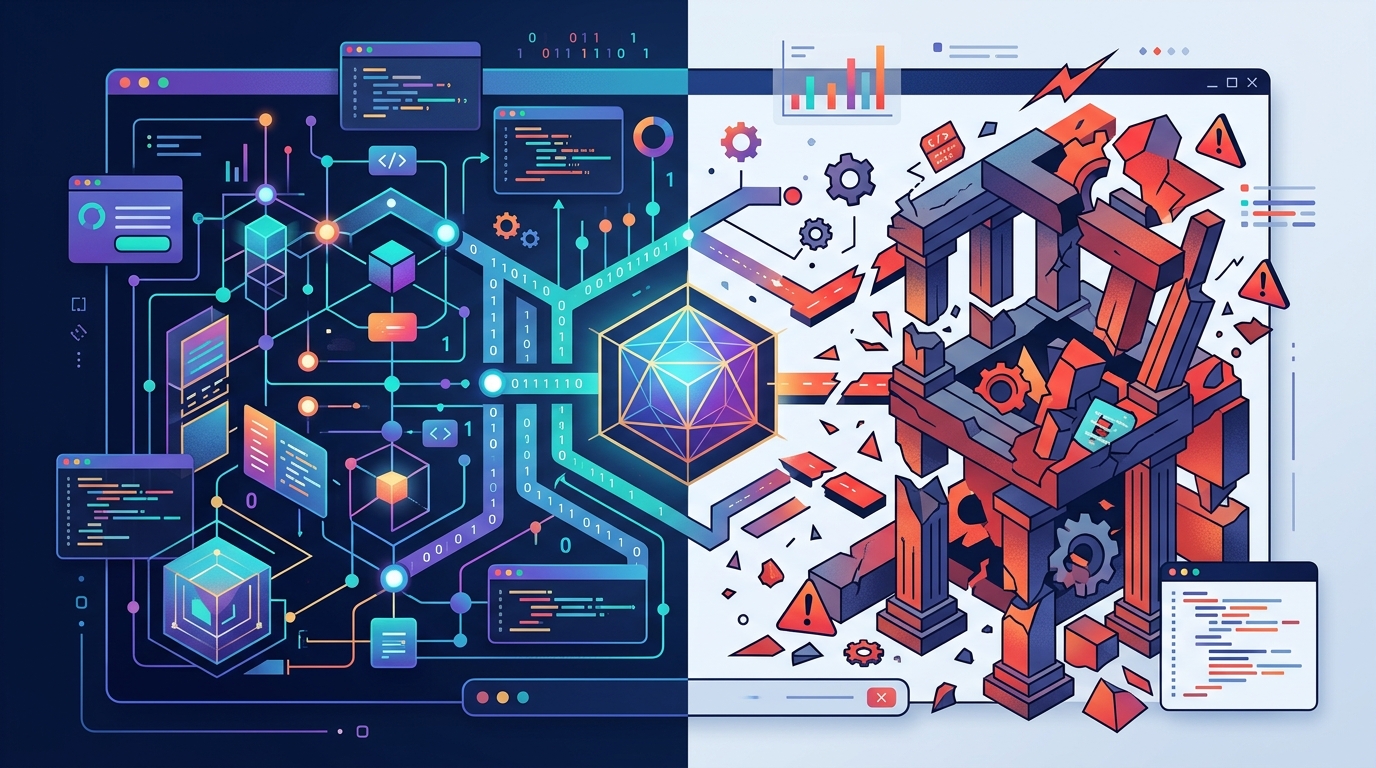
The era of the software developer as a mere writer of code is drawing to a close, not because the demand for software has diminished, but because the ability to generate it has become virtually limitless. The emergence of Agentic AI—systems that don't just suggest code but plan, execute, and debug entire workflows—has shifted the industry's center of gravity. However, this technological explosion has exposed an uncomfortable truth: writing code was never the only, nor even the most significant, problem in software engineering.
The Automation of Syntax and the Rise of Agents
Until recently, the bulk of a software engineer's time was spent on syntax, debugging, and wiring libraries together. First-generation tools like GitHub Copilot functioned as sophisticated autocomplete systems. But the new generation of "agents," such as Devin or GitHub Copilot Workspace, operate autonomously. They can take a natural language request, analyze an existing codebase, create a plan of action, and implement it across multiple files simultaneously.
This evolution means that execution leverage has skyrocketed. A single developer can now manage a workload that previously required an entire team. Yet, as a recent analysis in VentureBeat points out, this abundance of code brings organizational structural problems to the surface. If we can write code 10 times faster, why aren't our products becoming 10 times better? The answer lies in the gap between "code production" and "value creation."
The Digital Landfill Phenomenon
The ease with which code is now produced carries a significant risk: the proliferation of technical debt. When AI generates thousands of lines of code in seconds, the responsibility for maintenance still rests with humans. Without rigorous architectural oversight, companies risk filling their systems with code that no one fully understands, creating "black boxes" that will be impossible to upgrade in the future.
Furthermore, the speed of production exposes bottlenecks in Quality Assurance (QA) and approval processes. In many organizations, code written in five minutes by an AI might wait five days to be reviewed by a senior engineer or pass through bureaucratic security protocols. The congestion has shifted from the keyboard to the decision-making process.
The Crisis of 'What' vs. 'How'
The most significant problem exposed by Agentic AI is the inability of many companies to define exactly what they want to build. For decades, the difficulty of writing code acted as a natural filter: because programming was expensive and slow, companies were forced to think carefully about what they would implement. Now that the cost of implementation is trending toward zero, the lack of strategic vision is becoming glaringly obvious.
- Requirement Ambiguity: AI agents require clear instructions. If business leaders cannot accurately describe the problem, the AI will produce perfect solutions for the wrong problem.
- Product Strategy: Speed is no substitute for innovation. Adding features at a breakneck pace does not necessarily improve the user experience.
- Organizational Culture: Structures based on hierarchy and endless meetings are unable to keep up with the pace of AI.
The Role of the Software Engineer in 2026
The developer's role is transforming from "builder" to "architect" and "curator." An engineer's value is no longer measured by lines of code, but by their ability to orchestrate AI agents, ensure security, and align technology with business goals. Critical thinking and a holistic understanding of systems are becoming the most sought-after skills.
"AI isn't replacing the programmer; it's replacing the need for programmers who only program," industry analysts note.
In conclusion, Agentic AI has solved the "how" of software construction. Now, humanity must solve the much harder problem: deciding "what" is truly worth building and how to manage the complexity it has created. The companies that thrive will not be those with the most AI tools, but those with the intellectual clarity to direct them properly.