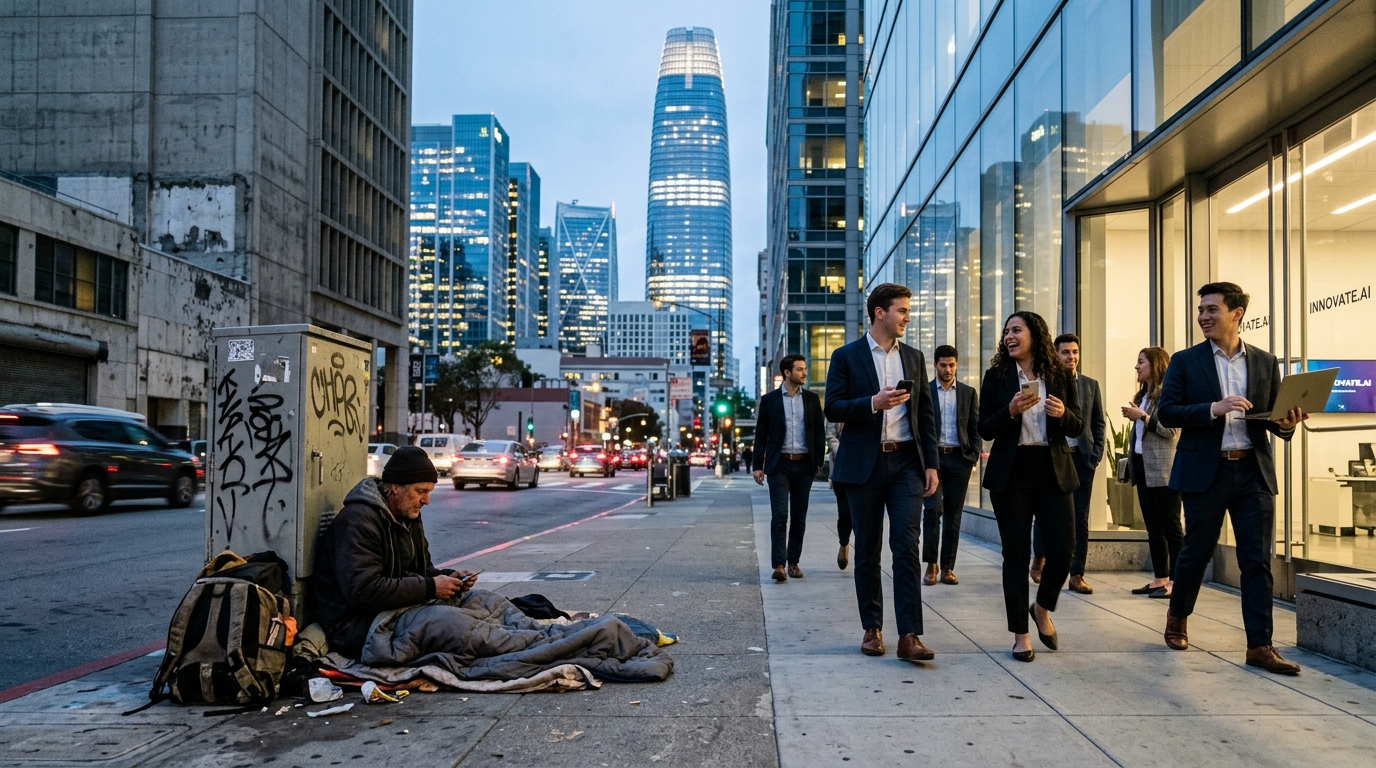
San Francisco, the city that once stood as the cradle of the hippie movement and counterculture, is transforming today into the epicenter of a new, relentless economic reality. The rise of Artificial Intelligence (AI) has brought not only a technological renaissance but also a profound social fracture that threatens to dismantle the city's social fabric. As AI giants like OpenAI and Anthropic draw billions of dollars in investment, just meters away from their state-of-the-art offices, the homelessness crisis and drug addiction paint a dystopian picture.
The Gilded Age of AI and the Class Chasm
The current AI boom has created a new class of 'tech barons.' Salaries for software engineers specializing in Large Language Models (LLMs) often exceed $500,000 per year, excluding stock options. This influx of capital has sent the cost of living skyrocketing, making San Francisco one of the most expensive cities in the world. However, this wealth is not 'trickling down' to the rest of society, as older economic models promised.
Instead, we are observing a 'technological ghettoization.' AI workers live, work, and socialize within closed ecosystems, while traditional small businesses and middle-class residents are driven out by high rents. The paradox is tragic: the very people developing algorithms to solve global problems often ignore the humanitarian crisis unfolding right outside their doorstep.
A City of Two Speeds: From Hayes Valley to the Tenderloin
The geography of inequality is stark. In the Hayes Valley neighborhood, now dubbed 'Cerebral Valley,' cafes are packed with young entrepreneurs discussing 'generative AI' and 'model alignment.' A few blocks away, in the Tenderloin district, the image changes dramatically. There, poverty, abandonment, and the fentanyl crisis resemble third-world conditions.
"We are creating the most powerful technology in human history, yet we cannot find a way to house our fellow citizens," says a local activist.
The city is in a state that many analysts call a 'Doom Loop.' The exodus of traditional retail businesses and the decline in property tax revenue in the city center create a budget hole that the new AI industry does not seem inclined to fill immediately. Despite the massive capitalization of these companies, their contribution to local infrastructure remains disproportionately small.
The Ethics of Progress and Political Responsibility
The issue is not just economic, but deeply ethical. AI promises to automate labor and increase productivity globally. However, if San Francisco is the 'laboratory' for our future, the early results are concerning. The concentration of power and wealth in so few hands, combined with the absence of effective social policy, creates an explosive mixture.
- Displacement of Communities: The city's historic communities are losing their identity as real estate prices become inaccessible.
- Digital Divide: Access to the opportunities offered by AI remains limited to a highly specialized elite.
- Social Isolation: The development of technologies that replace human interaction intensifies the sense of loneliness in urban areas.
The solution requires a new approach to governance. Local authorities must implement taxes that reflect the profits of the tech industry, while simultaneously investing in affordable housing and educational programs that will allow locals to participate in the new economy. Without such intervention, San Francisco risks becoming a fortress city for the few, surrounded by the desperation of the many.