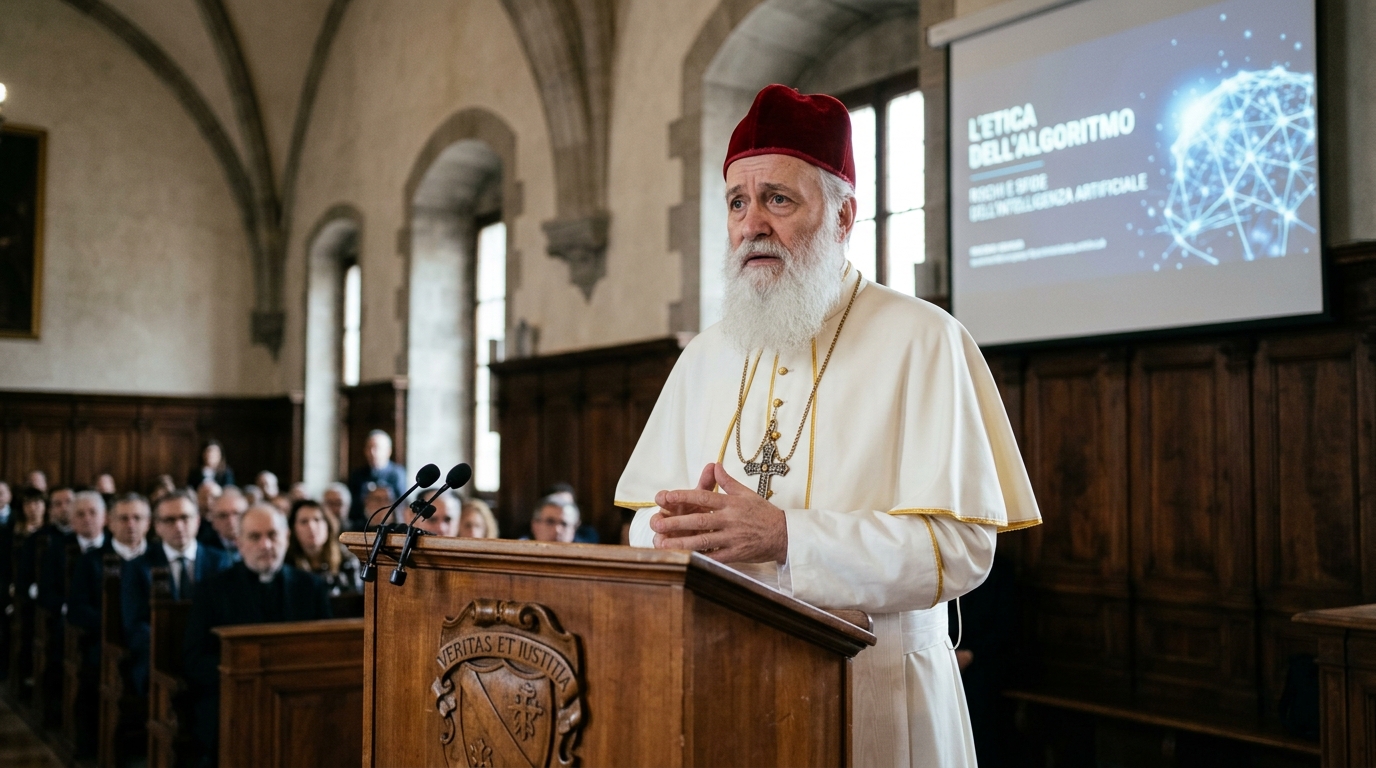
In an era where technological progress appears to move at speeds exceeding human processing capacity, the Vatican has intervened with a warning that resonates far beyond the walls of Rome. Pope Leo, continuing the work of his predecessors but with a new, more urgent tone, has issued a stern warning regarding the dangers lurking in the unbridled development of Artificial Intelligence (AI). His intervention is not merely a religious exhortation but a profound philosophical and political analysis of the risks facing the very concept of human dignity.
The Concept of 'Algor-ethics' and Moral Responsibility
A central point of the Pope's speech was the need for what he calls 'Algor-ethics'—a framework where ethics are integrated into the very design of algorithms. The Pontiff emphasized that technology is never neutral. "Every code written carries with it the values, biases, and aspirations of its creator," he noted. His concern focuses on the fact that major tech companies often prioritize profit and speed over social cohesion and respect for individuality.
According to Pope Leo, the danger lies not just in the possibility of a "machine uprising," as often depicted in science fiction, but in something far more insidious: the gradual ceding of human judgment to automated systems. When decisions about health, employment, justice, or even war are made by opaque algorithms, the concept of moral responsibility begins to fade. Who is responsible when an AI system makes a fatal mistake? The answer remains elusive, and this uncertainty is what troubles the Vatican.
Autonomous Weapons and the Dehumanization of Conflict
One of the sharpest points of the warning concerned the use of AI in military applications. Pope Leo called on the international community to ban Lethal Autonomous Weapons Systems (LAWS), which he described as an "affront to humanity." The idea that a machine can decide on the life or death of a human being, without the direct intervention of a moral subject, represents for the Church the ultimate line that must not be crossed.
The Pontiff highlighted that war is already a tragedy, but "algorithmic warfare" removes even the last trace of compassion or hesitation that a soldier might show on the battlefield. The detachment offered by AI could make the use of force easier and less politically costly for governments, leading to a vicious cycle of endless conflicts fueled by anonymous data and cold calculations.
Social Inequality and Digital Exclusion
Beyond security issues, the Pope focused on the socio-economic impacts of AI. He warned that this technology risks widening the gap between the rich and the poor, both at the individual and national levels. The concentration of technological power in the hands of a few corporations and nations creates a new form of "digital colonialism," where less developed countries become mere consumers or data sources, without having a say in shaping the future.
Furthermore, the automation of labor threatens to displace millions of workers, depriving them not only of income but also of the sense of purpose that work provides. Pope Leo called for a "new social contract" that would ensure the benefits of increased productivity through AI are distributed fairly and do not merely accumulate at the top of the pyramid. "Technology must serve man, not man serve technology," he concluded, reminding that progress is measured by the well-being of the most vulnerable members of society.
Conclusion: A Call for Global Cooperation
Pope Leo's intervention comes at a critical moment as governments worldwide struggle to establish regulatory frameworks for AI. His message is clear: regulation must not only be technical; it must be deeply ethical. The call for an international body to oversee AI development, similar to that for nuclear energy, is gaining momentum, and the Vatican's voice adds significant moral weight to this effort. Humanity stands at a crossroads, and the choice of path will determine not only the future of the economy but the very essence of human nature.