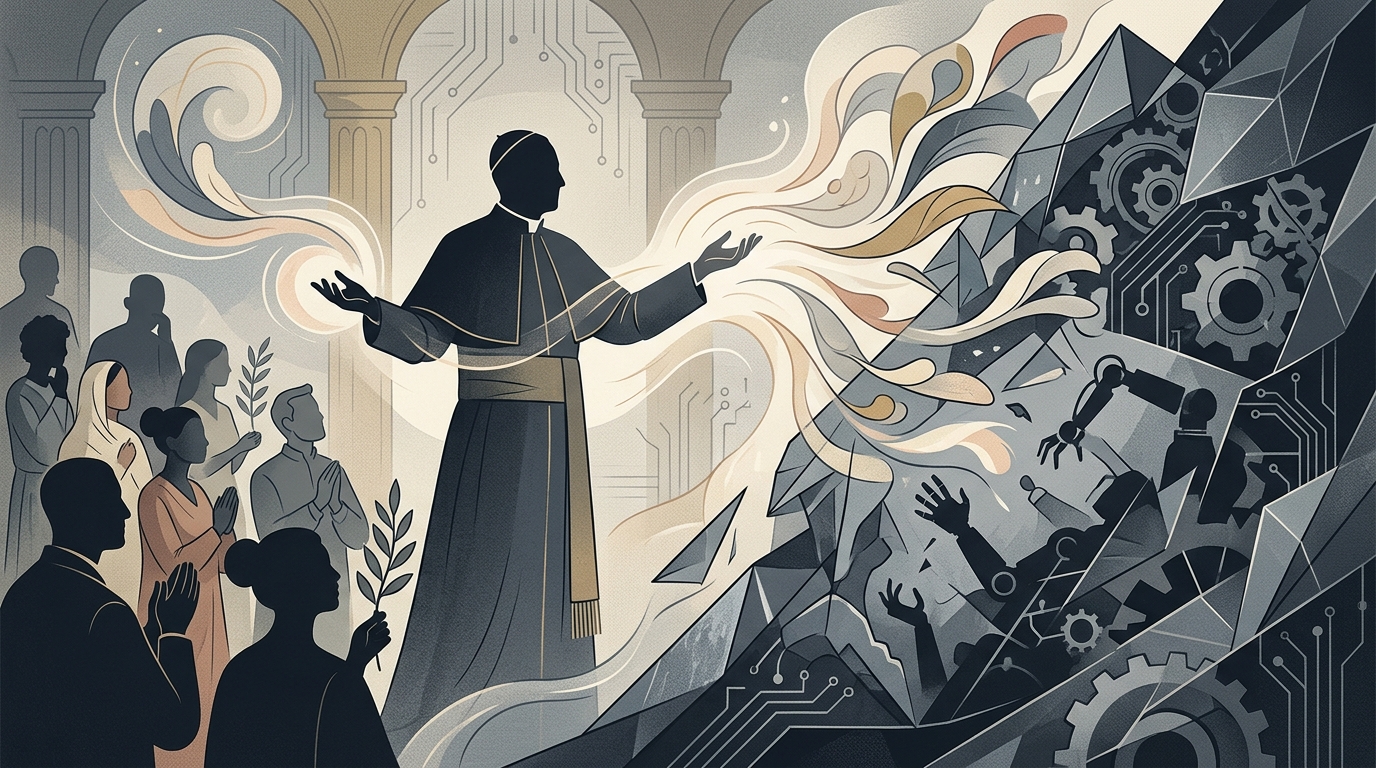
In the heart of the Vatican, beneath the imposing shadow of St. Peter's Basilica, Pope Leo made an intervention today that is expected to resonate across world capitals and Silicon Valley boardrooms. With the encyclical ‘Magnifica humanitas’ (Magnificent Humanity), the Head of the Roman Catholic Church addressed the issue of 'digital disarmament,' calling for a definitive ban on autonomous lethal weapons and the restriction of Artificial Intelligence to roles that exclusively serve human well-being.
This move is not merely a theological stance. It is a political and ethical cry for help in an era where military technology is moving faster than international law. Pope Leo, known for his interest in the convergence of science and faith, argued that delegating the decision over life and death to an algorithm constitutes the ultimate denial of human freedom and dignity.
Algorethics as a New Code of Conduct
In the 150-page document, the Vatican introduces the term 'Algorethics,' a concept that had begun to develop in previous years but now attains the status of official doctrine. The Pope argues that Artificial Intelligence is not a neutral tool but an extension of human will that carries moral responsibility. "We cannot allow machines to choose who lives and who dies based on statistical probabilities," the encyclical states emphatically.
‘Magnifica humanitas’ focuses on three central pillars: algorithmic transparency, human oversight (human-in-the-loop), and an absolute ban on the use of AI in nuclear systems and autonomous strike drones. The Holy See argues that the risk of an 'accidental war' triggered by a software error is now the greatest existential threat to humanity.
A Global Alliance for Digital Humanism
The Pope's intervention is addressed not only to the faithful but to the international community as a whole. The Vatican is calling on the UN to adopt a binding treaty, similar to those for nuclear weapons or landmines, which would outlaw the development of Lethal Autonomous Weapons Systems (LAWS). Already, diplomatic circles in Europe and Latin America seem to be welcoming the proposal, while the US and China remain cautious, citing the need for 'deterrent power.'
Pope Leo also warns of the danger of a 'dictatorship of data.' The encyclical describes how AI can be used to manipulate consciences and erode democracy. "The magnificence of humanity lies in its capacity for mercy, forgiveness, and judgment—qualities that no neural network can replicate," the text notes.
The Tech Industry's Reaction
Reactions from Silicon Valley were immediate. While some tech leaders welcomed the call for ethical frameworks, others argued that total disarmament would leave democratic societies vulnerable to authoritarian regimes that would not adhere to the Vatican's commitments. However, ‘Magnifica humanitas’ seems to create a new ethical benchmark that companies can no longer ignore.
In conclusion, Pope Leo's move signals a shift toward a 'new digital humanism.' In a world fascinated by the speed and efficiency of the machine, the Catholic Church chooses to remind us of the value of human fragility and the need for a world where technology serves humanity, rather than the other way around.
The document further explores the socio-economic impact of AI, suggesting that the pursuit of 'efficiency' should never come at the cost of social cohesion. The Pope emphasizes that while AI can heal diseases and optimize resources, its application in warfare represents a 'perversion of human ingenuity.' The call for disarmament is thus presented as a moral imperative to safeguard the future of the species.
The Road to a Binding Treaty
The Vatican’s diplomatic corps is already mobilizing to present the principles of ‘Magnifica humanitas’ at the next UN General Assembly. By framing AI disarmament as a pro-life issue, the Church is attempting to bridge political divides, appealing to both progressives concerned about algorithmic bias and conservatives focused on human sovereignty. Whether this moral weight will translate into legislative action remains to be seen, but the conversation has officially shifted from 'if' we should regulate AI to 'how' we must disarm its most dangerous iterations.
- Total ban on lethal autonomous weapons systems.
- Demand for transparency in decision-making algorithms.
- Protection of human dignity from automated judgment.
- Call for an international treaty under the UN.