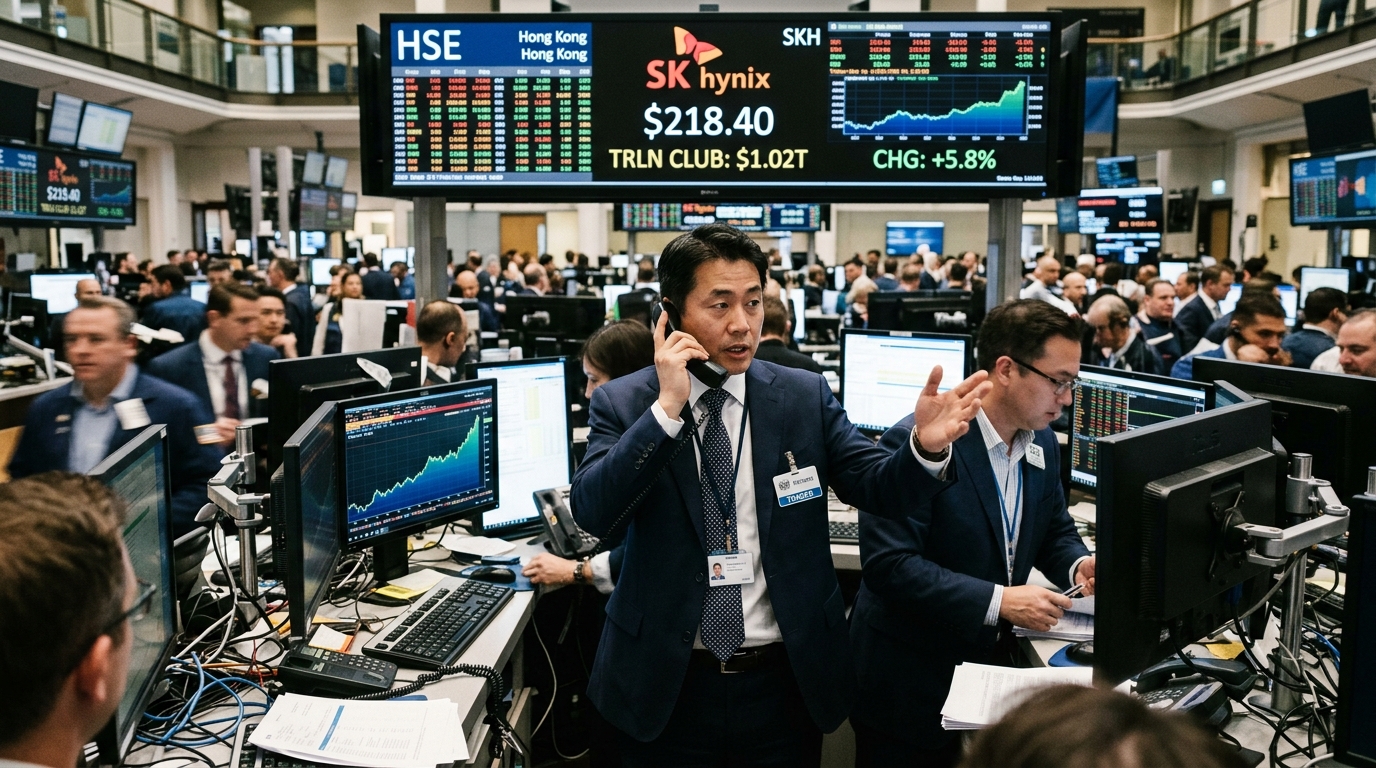
In a historic milestone for the global technology landscape, South Korea’s SK Hynix Inc. has made it clear that the Artificial Intelligence (AI) revolution is no longer just about software or processors, but about the very foundations of data storage. The company officially entered the elite club of corporations with a market capitalization exceeding $1 trillion, a surge fueled by a staggering 900% increase in its share price over the past twelve months. This development marks a fundamental shift in the semiconductor hierarchy, placing SK Hynix at the very core of the global AI supply chain.
The HBM Technological Edge: The Key to Success
SK Hynix’s meteoric rise is far from accidental. The company managed to anticipate market needs long before its competitors by investing heavily in High Bandwidth Memory (HBM). As Nvidia’s AI processors, such as the H100 and the newer B200 series, require massive amounts of data to operate at high speeds, traditional DRAM memory proved insufficient. HBM, which stacks multiple memory layers vertically, provides the necessary speed and energy efficiency required for large language model training.
SK Hynix currently holds the largest market share in HBM3E, the most advanced form of memory used in Nvidia’s systems. Its ability to maintain high manufacturing yields, while its main rival, Samsung Electronics, struggles with the qualification of its own HBM products, has provided a strategic advantage that has translated into billions of dollars in profit.
"We are not just seeing a semiconductor upcycle; we are witnessing a structural reallocation of wealth toward companies that hold the keys to AI infrastructure," says a Seoul-based market analyst.
The Strategic Alliance with Nvidia and Samsung’s Stumble
The relationship between SK Hynix and Nvidia has been described by many as "symbiotic." Nvidia relies almost exclusively on SK Hynix for its cutting-edge memory needs, allowing the Korean firm to command premium pricing. This de facto monopoly has caused ripples in South Korea’s domestic market, as Samsung Electronics, the traditional chip giant, has found itself in an uncharacteristically defensive position. Samsung’s failure to secure timely approval from Nvidia for its HBM3E chips is being viewed as one of the most significant strategic blunders in the company’s history.
While Samsung attempts to recover by reorganizing its semiconductor division, SK Hynix is already moving forward with the development of HBM4. Investors are betting that SK Hynix will remain the "gold mine" of AI for years to come, as demand for data centers shows no signs of slowing down.
Geopolitical Challenges and the Future of the 'Silicon Peninsula'
Despite the triumph, the road to $1 trillion is not without risks. SK Hynix stands at the crossroads of the US-China tech war. With significant production facilities in China, the company must balance Washington’s strict export sanctions with its need to maintain global output. Its recent decision to invest $4 billion in a new advanced chip packaging facility in Indiana, USA, is a clear move toward aligning with American interests and securing its supply chain against geopolitical shocks.
Furthermore, the question of sustainability remains. Can a memory company maintain such a valuation when the semiconductor industry is historically cyclical? Proponents argue that AI is a "super-cycle" that will last decades. Skeptics, however, warn that over-reliance on Nvidia creates a significant single-point-of-failure risk for the company's long-term stability.
Conclusion: A New Era for the Global Economy
SK Hynix joining the $1 trillion club is proof that value in the new economy is shifting from the end product to the specialized component. South Korea, through SK Hynix, has managed to make itself indispensable to the future of computing power. As we move toward 2027, the battle for AI memory dominance will determine not only the fate of shareholders but also the speed at which humanity adopts AI technologies in daily life.
- Market cap exceeded $1 trillion following a 900% stock rally.
- Dominant position in the HBM3E market for Nvidia accelerators.
- Strategic investments in the US to mitigate geopolitical risks.
- Competitive pressure on Samsung, which remains behind in HBM development.